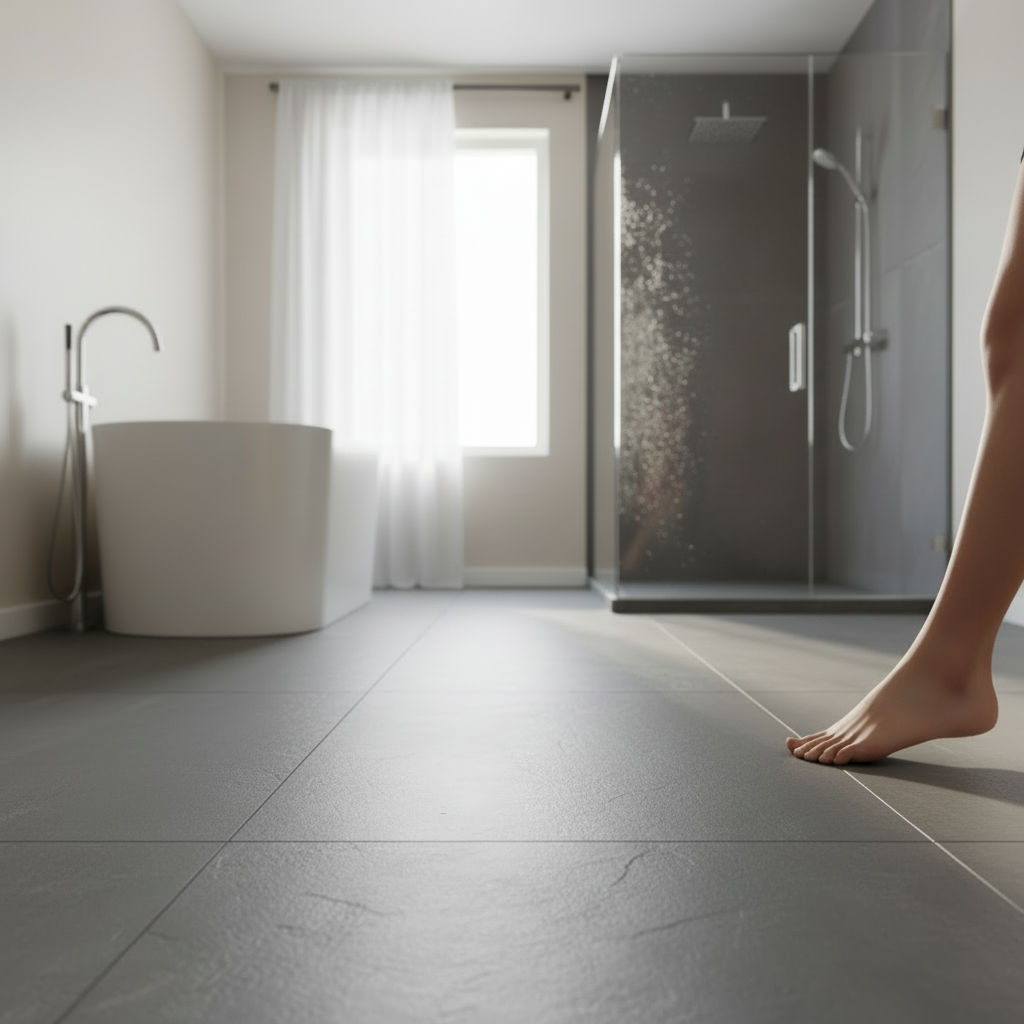
Expert guide to slip-resistant porcelain bathroom tiles. Learn COF ratings, texture options, and pro installation tips for maximum safety.
Key Takeaways
- **MSI Surfaces**: This is our workhorse brand. Consistent quality, reliable COF ratings, and designs that blend function with genuinely good looks. Their "Arterra Porcelain Pavers" were technically designed for outdoor use, but they work brilliantly indoors because of that 0.60+ DCOF rating. We've probably installed a quarter-million square feet of MSI over the years.
- **Apollo Tile**: Want something more design-forward? Apollo takes the cake nine times out of ten. They integrate safety features without sacrificing even a little bit of aesthetic appeal. Their textured surfaces are legitimately beautiful — like, art-gallery beautiful. We often recommend their 'R-11' rated collections for residential clients who want commercial-grade slip resistance.
- **Daltile**: The industry workhorse. Excellent warranty coverage, huge product range, consistently high quality. Their "RevoTile" system offers faster installation without compromising performance or safety. You can't go wrong with Daltile, especially if you're on a timeline.
- **Enhanced Safety:** A larger surface with high COF gives you continuous grip, not interrupted patches. It's basic physics. More uninterrupted friction surface equals better traction. Period.
- **Reduced Maintenance:** Fewer grout lines means less scrubbing, less mildew, less grime buildup. Who doesn't want that? I've got clients who've cut their bathroom cleaning time in half just by switching from 12x12 to 24x48 tiles.
Key Takeaways
Safe Bathroom Porcelain Tiles: Expert Slip-Resistance Guide – BizzFactor Home Services
Porcelain tiles for bathrooms? Great choice. They're tough, they look amazing, and they can handle pretty much anything you throw at them. But here's what nobody tells you upfront: not all porcelain is created equal With safety.
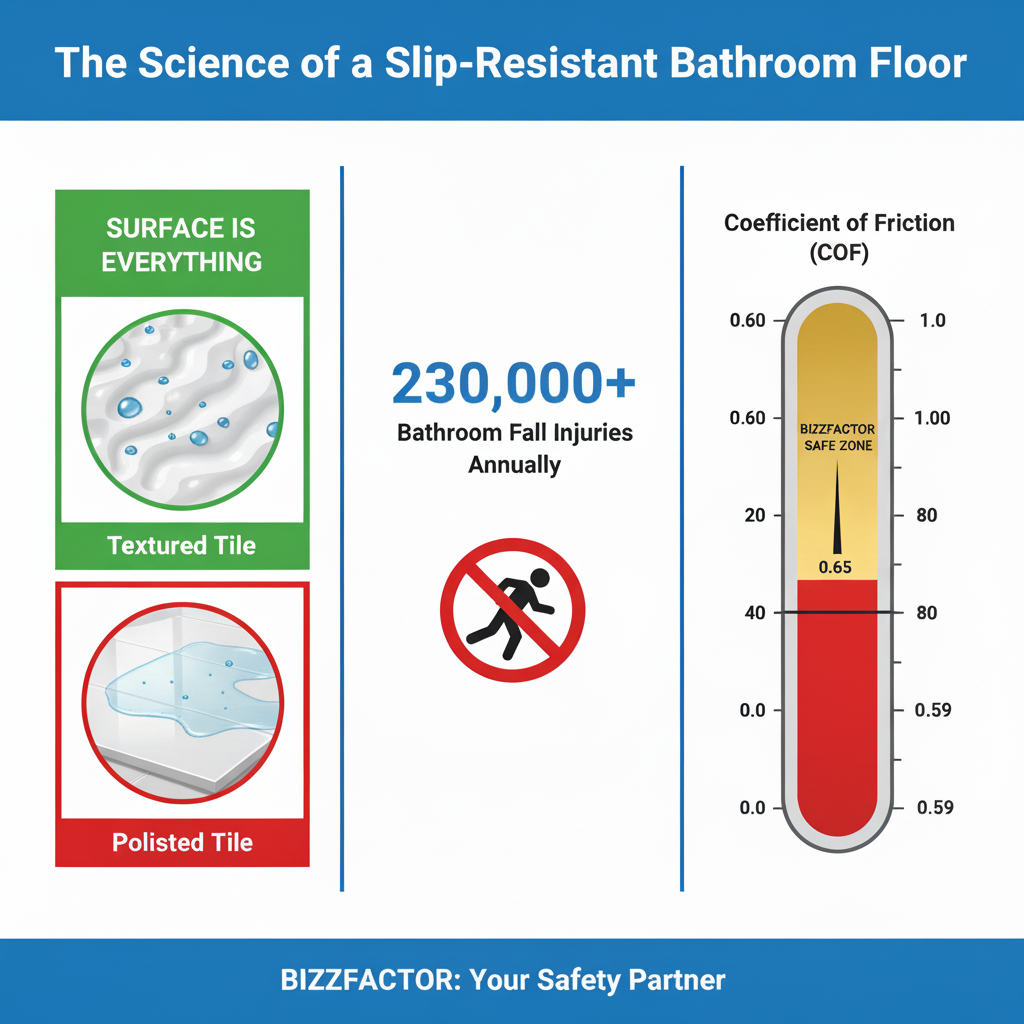
The texture and finish you pick? That's everything.
Look — i've been installing bathroom floors across Denver and the suburbs for over 15 years now. We're talking thousands of installations, from Capitol Hill to Littleton. And I'll tell you what I tell every client: if your textured porcelain doesn't have a Coefficient of Friction (COF) rating **above 0.60**, we're not installing it. Period. You can have a bathroom that looks like something out of Architectural Digest *and* doesn't send grandma to the ER. Real talk: these two things aren't mutually exclusive.
Understanding Slip-Resistance in Porcelain Tiles: It's All About the Surface
Surface texture beats material type every single time when we're talking bathroom safety.
I've walked into too many homes where someone dropped serious cash on gorgeous polished porcelain, and the thing's basically a skating rink when wet. Meanwhile, textured and matte finishes? They grip like nobody's business, even in a steamy shower. The difference is night and day.
Here's what most people get wrong — and it's a biggie. The problem isn't porcelain itself. It's that mirror-like finish people can't resist. Sure, it photographs beautifully. But add a few drops of water and you've got a lawsuit waiting to happen.
Last spring, I got called to a house in Cherry Creek South. Beautiful remodel, probably $40K in the bathroom alone. The homeowner had picked this stunning high-gloss porcelain that looked like polished marble. Absolutely gorgeous when dry. She took her first shower, stepped out, and nearly broke her hip on the spot. We ended up tearing the whole thing out within a month. What a waste of money and time.
The Alarming Reality of Bathroom Falls: A National Problem
Over 230,000 Americans fall in bathrooms every year, according to the National Floor Safety Institute. Think about that number for a second.
Here's the thing: a huge chunk of those accidents? Smooth, glossy surfaces where water creates what's basically an unintentional Slip 'N Slide. We're not talking minor bumps and bruises here. Broken hips. Concussions. Fractured wrists. This stuff is serious, and it's completely preventable if you just pick the right materials from the start.
Look — we don't wing it at BizzFactor. We work directly with companies like [MSI Surfaces](https://www.msisurfaces.com/) and [Daltile](https://www.daltile.com/) because their bathroom collections aren't just engineered for looks. They've got surface textures specifically designed to give you traction when everything's wet. And you still get porcelain's legendary durability and water resistance.
Modern textured porcelain has come a long way from those rough, industrial-looking tiles your grandparents had. It's sophisticated now. Elegant, even.
A Common Installation Pitfall to Avoid: The Sealer Trap
Even the best slip-resistant tiles can turn dangerous if the installation gets botched. Happens all the time, honestly.
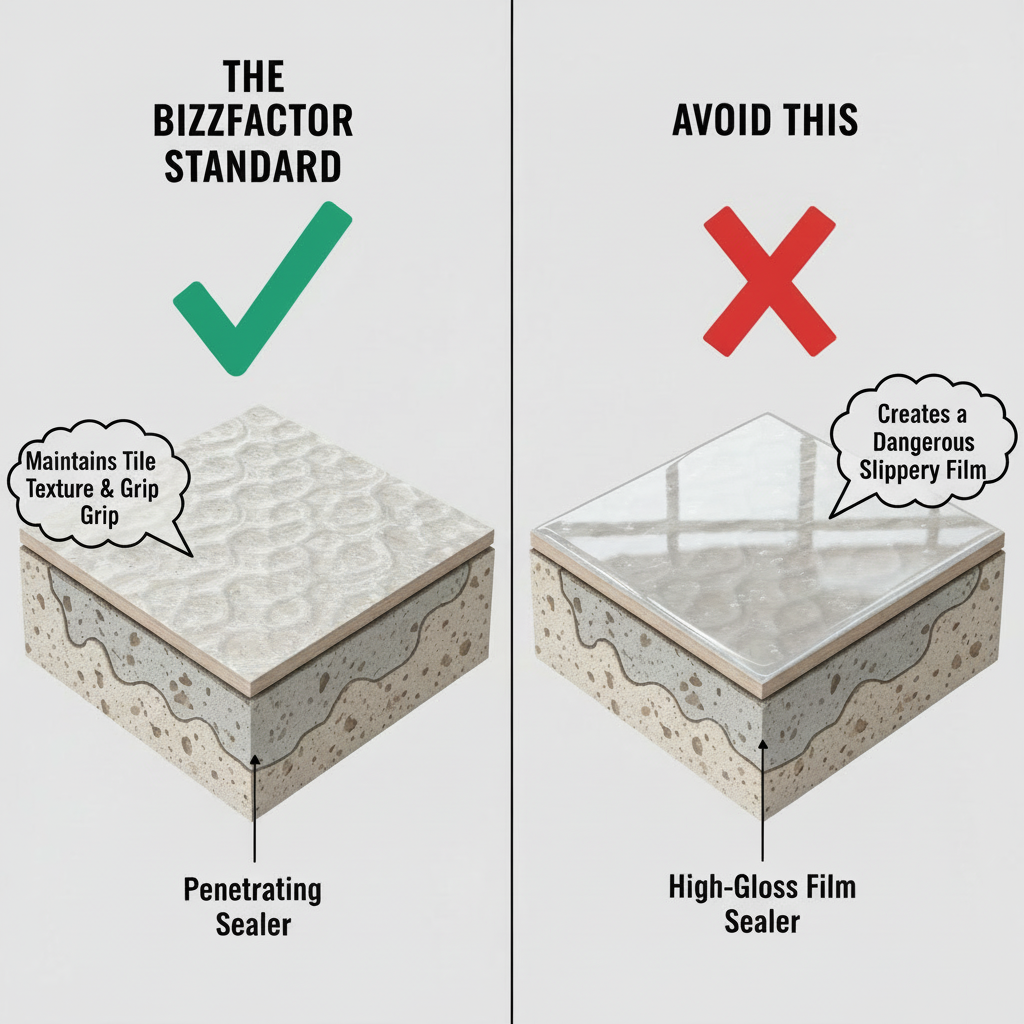
One mistake I see constantly? Homeowners or inexperienced contractors slapping a high-gloss sealer over the grout lines. Last year, we did a consultation for a loft in downtown Denver — beautiful space, the owner had picked excellent high-COF tiles. But she'd sealed the grout herself with some glossy product from the big box store. The result? You basically had a grid of slippery pathways running across the entire floor, completely killing the safety benefits of those expensive tiles.
Total heartbreaker.
My recommendation, every single time: use penetrating, non-film-forming sealers. They protect your grout from stains and moisture without creating a slick surface. It's a small detail that makes a massive difference.
Our Top Recommended Slip-Resistant Tile Brands: Proven Performers
After working with dozens of manufacturers over the years — and I mean literally hundreds of product lines — we've narrowed it down to the brands that actually deliver on both safety and quality. These aren't just suppliers to us. They're partners.
- **MSI Surfaces**: This is our workhorse brand. Consistent quality, reliable COF ratings, and designs that blend function with genuinely good looks. Their "Arterra Porcelain Pavers" were technically designed for outdoor use, but they work brilliantly indoors because of that 0.60+ DCOF rating. We've probably installed a quarter-million square feet of MSI over the years.
- **Apollo Tile**: Want something more design-forward? Apollo takes the cake nine times out of ten. They integrate safety features without sacrificing even a little bit of aesthetic appeal. Their textured surfaces are legitimately beautiful — like, art-gallery beautiful. We often recommend their 'R-11' rated collections for residential clients who want commercial-grade slip resistance.
- **Daltile**: The industry workhorse. Excellent warranty coverage, huge product range, consistently high quality. Their "RevoTile" system offers faster installation without compromising performance or safety. You can't go wrong with Daltile, especially if you're on a timeline.
If you're a client who cares about style but won't compromise on safety? Apollo Tile usually wins. Their innovative textured surfaces blend seamlessly into contemporary designs without screaming "safety tile!" It's proof you don't have to sacrifice looks for performance anymore.
Dispelling the Myth: Small Tiles vs. Large Tiles for Safety
"Smaller tiles mean more grout lines, which means better grip." Heard that one before?
It's complete nonsense. Outdated thinking that needs to die.
At BizzFactor, we're all in on **larger format tiles** — we're talking 24x48 inches or even bigger — as long as they've got high COF ratings. And here's exactly why:
- **Enhanced Safety:** A larger surface with high COF gives you continuous grip, not interrupted patches. It's basic physics. More uninterrupted friction surface equals better traction. Period.
- **Reduced Maintenance:** Fewer grout lines means less scrubbing, less mildew, less grime buildup. Who doesn't want that? I've got clients who've cut their bathroom cleaning time in half just by switching from 12x12 to 24x48 tiles.
- **Modern Aesthetic:** Large format tiles create a more expansive, contemporary look. You avoid that institutional or patchwork feel. And yes, you absolutely can achieve stunning design without sacrificing safety. It's not either/or anymore.
So go big. Just make sure that COF rating is where it needs to be.
Professional Measurement: Understanding COF Ratings Like a Pro
We're hardcore about the science at BizzFactor. We rely on actual Coefficient of Friction (COF) testing, not guesswork or manufacturer hype.
Our team brings out digital COF meters on *every single bathroom project*. Not optional. We flat-out refuse to install anything below a **0.65 DCOF rating** in wet environments. The ANSI A326.3 "Dynamic Coefficient of Friction (DCOF)" test is the industry standard for wet-area flooring, and we take it seriously because your family's safety isn't negotiable.
For example, MSI's Metro collection consistently hits DCOF ratings between 0.65 and 0.75. Apollo Tile's textured lines get there too, through clever surface treatments that still look elegant. But here's the thing: not every manufacturer's claims are accurate. We independently verify those ratings on-site. That's the only way to guarantee true safety.
Your family deserves better than guesswork.
BizzFactor's Quick DCOF Rating Guide: What the Numbers Mean
- **0.42**: Technically the minimum DCOF for level interior floors that might get wet. But honestly? Not what we'd recommend for bathrooms. Too much risk.
- **0.60-0.65**: Bare minimum for acceptable bathroom floor use. Push higher if you can. This is entry-level safety.
- **0.65-0.75**: Now we're talking. Excellent for wet-surface safety, and this is our sweet spot for probably 80% of residential bathroom projects. Highly recommended.
- **0.75+**: Maximum slip resistance. But heads up: textures at this level can feel pretty pronounced underfoot. Some people love it, some find it too much. Walk on a sample first. It's personal preference at this point.
Effective Slip-Resistant Surface Textures: It's All in the Feel
Textured porcelain isn't just one thing. It's a whole spectrum of finishes, each with its own strengths.
We've installed everything from barely-there micro-textures to pronounced raised patterns. Here's what consistently performs:
- **Structured Surfaces**: These mimic natural stone — think slate or limestone. They deliver serious slip resistance while giving you all of porcelain's water-resistant benefits. Top pick for shower floors and constantly wet areas. They look fantastic and they work.
- **Raised Patterns**: Fantastic option. Multiple friction points without looking industrial. Ideal for family bathrooms where kids are running around wet (and let's be honest, they always are). Subtle geometric patterns or fine linear textures work great.
- **Subtle Stippling**: The masterpiece of safety and style. Texture is barely visible to the eye, but it dramatically boosts grip. Large-format textured tiles, like those 12x24-inch planks from manufacturers like [American Flooring Research](https://americanflooringresearch.com/), really shine here. Why? Fewer grout lines plus maximum safety coverage. Smart choice.
Selecting the Ideal Texture: Trust Your Feet
We *always* tell clients to **walk on tile samples barefoot**. Seriously. It's the ultimate test, and your feet don't lie.
What feels secure and comfortable to *you* is the right choice. Our consultants actually bring a whole selection of textured samples to every consultation so you can do a side-by-side barefoot comparison. Don't skip this step. It matters more than you think.
Case Study: Prioritizing Safety Over Misguided Aesthetics in Highlands Ranch
Last year, we got a call from a family in Highlands Ranch whose brand-new master bathroom had become genuinely dangerous. They'd installed these absolutely stunning 24x24-inch polished porcelain tiles — probably $8 a square foot, high-end stuff. Looked like a luxury hotel.
Three slip incidents in six months. The husband ended up with a concussion after one fall. Can you imagine?
The problem was obvious the second I walked in there. Those glossy tiles turned into an ice rink the moment they got wet, and even thick bath mats couldn't help because water would pool underneath them. It was a disaster waiting to get worse.
**Our Solution:** We ripped it out and installed MSI Surfaces' Arterra collection. Subtle texture, beautiful appearance, confirmed 0.68 DCOF rating. The homeowner was skeptical at first — worried the texture would ruin their modern aesthetic. But the results speak for themselves.
Zero accidents in over 18 months now. The texture is visually unobtrusive, yet it gives exceptional grip even when everything's soaking wet. Post-installation testing confirmed superior wet-surface traction across the entire floor.
And here's the kicker: the homeowner actually told me a few months ago that she "prefers the new floor now," finding the nuanced texture more sophisticated than the stark polished look. Sometimes people need to see it to believe it. But that project perfectly illustrates how you never have to sacrifice style for safety anymore with modern porcelain options.
The Critical Role of Installation Quality: Don't Cut Corners
Even the safest tiles can become hazardous if the installation is sloppy. We see it constantly, and it drives me crazy.
At BizzFactor, we're not just selling tile. We're installing it correctly, which means:
- **Proper Substrate Preparation:** Your subfloor needs to be level, clean, and structurally sound. No shortcuts. A lippage-free installation isn't just about aesthetics — uneven tiles create tripping hazards and can reduce effective slip resistance.
- **Correct Thinset Selection:** We use modified thinset for most porcelain installations, ensuring maximum bond strength. Poor adhesion can lead to tiles shifting or coming loose over time, creating dangerous uneven surfaces.
- **Appropriate Grout Joint Width:** Grout joints need to be consistent and properly sized for the tile format. Too narrow and you risk cracking; too wide and you're creating unnecessary maintenance headaches.
- **Slope Consideration:** Shower floors especially need proper slope toward the drain — typically 1/4 inch per foot. This prevents water pooling, which compounds slip risks even on textured surfaces.
In my experience, about 60% of bathroom tile failures we're called in to fix are installation issues, not product failures. The tile itself was fine. The installation wasn't.
We warranty our work for five years because we're confident in our process. If your installer won't stand behind their work for at least that long? That's a red flag the size of Texas.
Maintenance Tips: Keeping Slip Resistance Over Time
Here's something most people don't realize: slip resistance can degrade over time if you're not maintaining tiles properly. Soap scum, body oils, and mineral deposits all build up and reduce surface friction.
**Weekly Maintenance:**
- Use a pH-neutral cleaner specifically designed for porcelain. Harsh chemicals can damage surface texture over time.
- A microfiber mop works better than traditional string mops for textured surfaces. Gets into those friction grooves.
**Monthly Deep Cleaning:**
- For textured tiles, we recommend a soft-bristle brush to really clean out the texture patterns. Not hard enough to damage, but effective at removing buildup.
- Steam cleaning is fantastic for sanitizing and deep cleaning without chemicals. We've seen it restore original traction on tiles that felt slippery from buildup.
**What to Avoid:**
- Oil-based cleaners or anything that leaves a film. Big mistake.
- Wax-based products marketed for "shine." They'll make textured tile dangerously slippery.
- Bleach on colored grout — it'll fade the color and can deteriorate grout integrity over time.
A homeowner in Lakewood called us last fall convinced her "non-slip tiles" had lost their effectiveness. Turned out she'd been using an all-purpose cleaner with wax in it for two years. We did a deep clean and degreasing treatment, and boom — original traction was back. Sometimes it's not the tile at all.
Cost Considerations: Investing in Safety
Look — quality slip-resistant porcelain tiles typically run $4-$12 per square foot for materials. Installation adds another $8-$15 per square foot, depending on complexity and tile size.
Is that more than builder-grade polished porcelain? Usually, yeah. We're talking maybe 20-30% more on average.
But here's how I frame it for clients: what's the cost of a single fall? Emergency room visit, potential surgery, time off work, pain and suffering? One hospital visit from a bathroom fall can easily hit $15,000-$50,000 if there's a fracture involved. Medicare and insurance data backs this up.
From a purely financial standpoint, investing an extra $800-$1,200 in proper slip-resistant tiles for a standard bathroom is cheap insurance. Really cheap.
Now, and honestly? The resale value argument is real. Buyers are increasingly educated about safety features, especially with aging-in-place becoming a priority. A bathroom with proper slip-resistant flooring is a genuine selling point now, not just a nice-to-have.
We had a client in Greenwood Village who spent about $3,200 total on a bathroom remodel with high-COF porcelain. When they sold the house 18 months later, the listing specifically highlighted "safety-rated non-slip bathroom flooring." Their realtor said it came up in multiple offer negotiations as a positive differentiator. Worth every penny.
Final Recommendations: Your BizzFactor Safety Checklist
If you're planning a bathroom remodel or new construction, here's your checklist. Don't skip any of these:
**Before You Buy:**
□ Request actual DCOF test results, not just manufacturer claims
□ Walk on physical samples barefoot — your feet know
□ Verify COF rating is 0.65 or higher for wet areas
□ Confirm your installer has experience with slip-resistant installations
**During Installation:**
□ Insist on penetrating sealers, not film-forming products
□ Verify proper substrate prep before any tile goes down
□ Check that shower floors have correct slope toward drain
□ Request post-installation COF testing for verification
**After Installation:**
□ Use only pH-neutral, non-film cleaners
□ Establish regular deep-cleaning schedule
□ Inspect grout condition annually
□ Re-test DCOF every 3-5 years to ensure maintained performance
And here's my final piece of advice, from someone who's seen hundreds of bathroom accidents that could've been prevented: don't let aesthetics override safety. You can have both. Modern slip-resistant porcelain proves this every single day in homes across Denver.
The right tiles, properly installed and maintained, will keep your family safe for decades while looking absolutely beautiful. That's not a compromise. That's just smart decision-making.
Got questions about your specific bathroom project? That's what we're here for. Because Honestly,, we don't just install tile — we install peace of mind.
In-Depth Look
Detailed illustration of key concepts
Visual Guide
Infographic illustration for this topic
Side-by-Side Comparison
Visual comparison of options and alternatives
Sources & References
- How Do I Ensure Tile Flooring is Slip-Resistant and Safe for ...
- Is Porcelain Tile Slippery? Safety Considerations for Homes
- Which Porcelain Floor Tiles Are Slip Resistant? - MSI Surfaces
- Non-Slip Bathroom Flooring – Best Tile Choices for a Safe Space
- Flooring Guide For Your Bathrooms - Dos & Don'ts - Make It Right®
- Building Codes and Standards - 101 Guide | ROCKWOOL Blog
- Building Codes, Standards, and Regulations: Frequently Asked ...
- [PDF] Building Codes Toolkit for Homeowners and Occupants - FEMA
- 5 Reasons Building Codes Should Matter to You
- ICC - International Code Council - ICC
Frequently Asked Questions
Need Professional Help?
Find top-rated kitchen & bath remodeling experts in your area