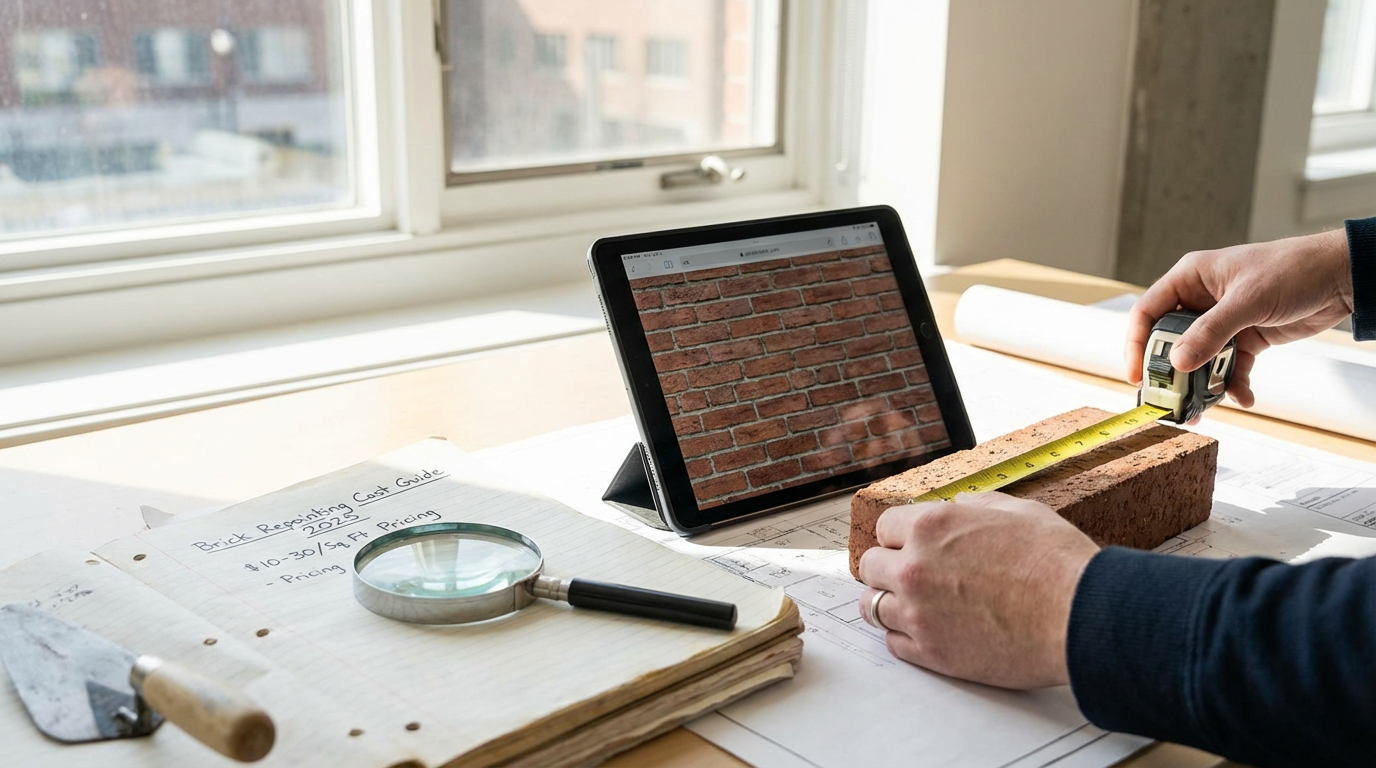
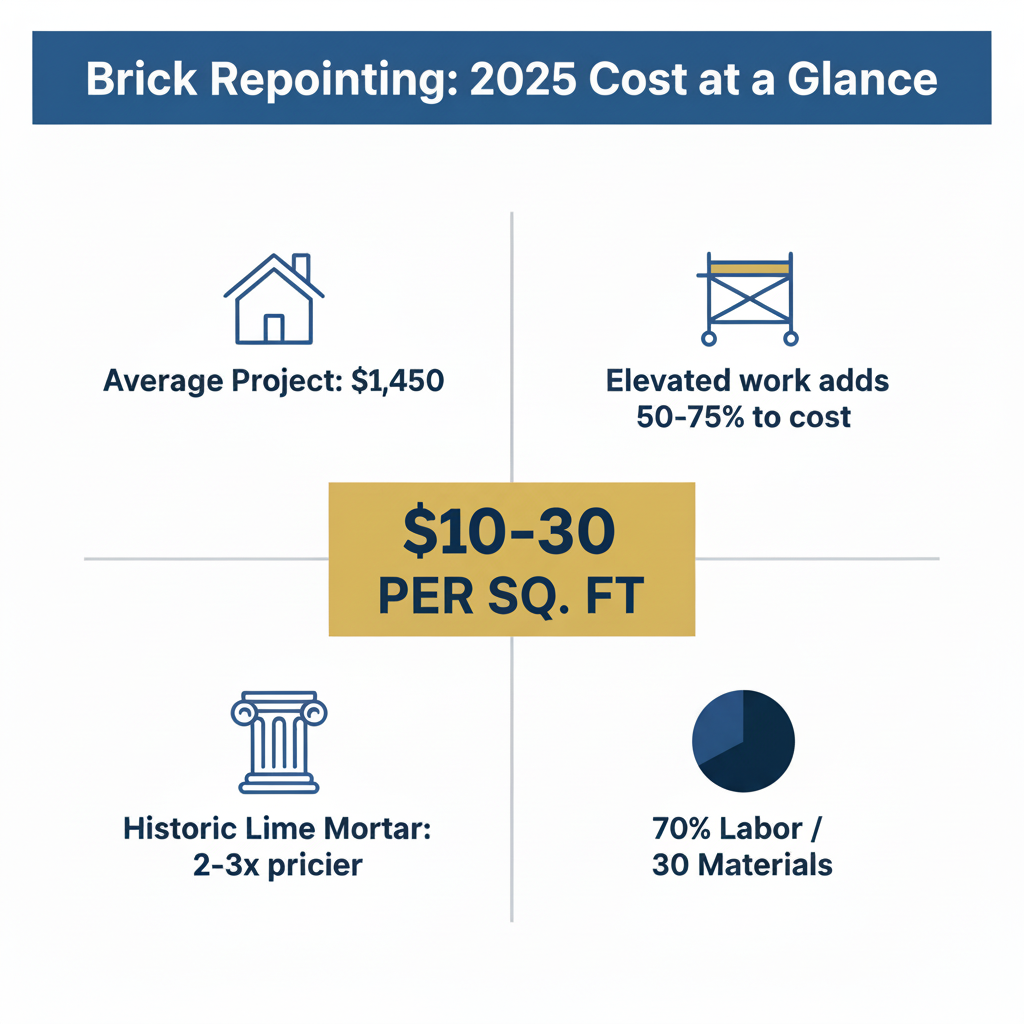
Brick repointing costs $10-30/sq ft in 2025. Get expert pricing guide, cost factors, and professional tips. Most projects: $1,450 average.
Key Takeaways
- **How high we're climbing:** Ground-level work runs $10-$15 per square foot because I can park my truck, grab a ladder, and get started. Second story? We're renting scaffolding — probably $800-$1,500 depending on how long we need it — and that's pure overhead before we mix a single batch of mortar. Third story or higher, and we're talking engineered scaffolding systems, safety inspections, harness requirements, the works. A two-story colonial might cost $3,000 to repoint. Same square footage on a three-story brownstone? Easily $5,500. The bricks don't care, but OSHA does.
- **Property Age & Mortar Type:** Got an older home, especially one built before 1930? You probably need lime mortar. Not the bagged stuff from Home Depot. We're talking specialty lime blends that cost twice as much and require custom mixing. Why? Because modern cement is too hard for old bricks. Slap Portland cement on a 1920s brownstone and you'll crack those irreplaceable bricks within eighteen months. I've watched it happen. A guy in Savannah tried saving maybe $400 by using regular mortar on his historic place. Ended up spending $3,800 fixing spalling bricks that couldn't breathe through the cement he'd trapped them with. Old brick needs mortar that's softer than the brick itself — that way the mortar fails first (and mortar's cheap to replace). Get it backwards and you're buying antique replacement bricks at $8 each.
- **Extent of Damage:** This one's a no-brainer. A few isolated spots showing minor deterioration? That's a relatively quick fix. We're talking minor touch-ups. But if entire sections of your wall look like they've been through a war, with deep, pervasive mortar deterioration, you're looking at a much more involved, labor-intensive, and thus more expensive, project. Sometimes, bricks themselves are already damaged and need replacing. That adds to the bill.
- **Ground-level stuff:** This is where you catch a break — usually $10-$15 per square foot. Easy access, standard ladders, maybe a small work platform. Nothing fancy required, which means you're not paying for elaborate setups.
- **Second-story jobs:** Now you're looking at $18-$25 per square foot because scaffolding doesn't set itself up. You're paying for the equipment rental, the time to install it safely, the OSHA-compliant harnesses, and the extra hours moving tools up and down. Safety costs money, but I'd rather spend it than attend a funeral.
Key Takeaways
Brick Repointing Cost Guide 2025: $10-30/Sq Ft Pricing for Lasting Masonry Repair – Your Home Deserves It!
Ever notice your home's bricks looking a little... tired? Deteriorating mortar isn't just an eyesore; it's a direct threat to your home's structural integrity.
So what's repointing, exactly?
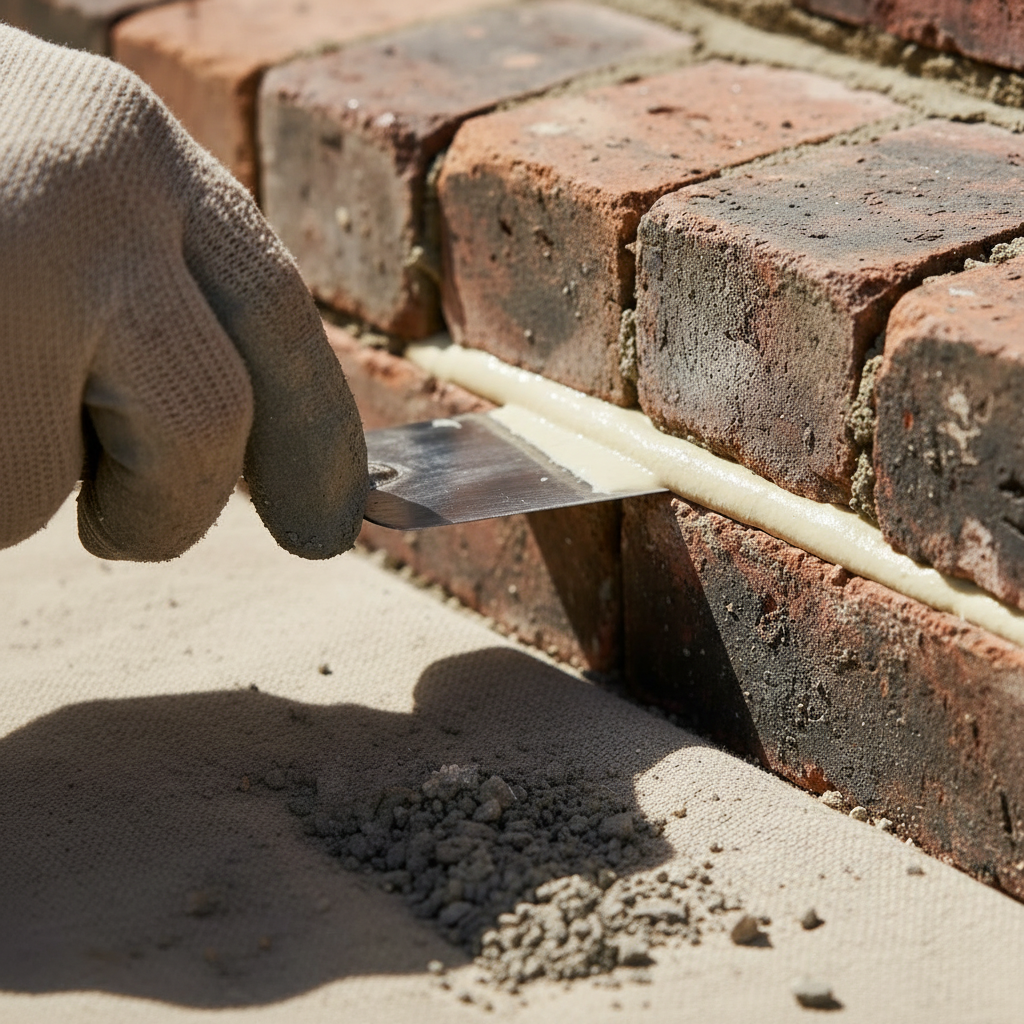
Look — look — you dig out the old, crumbling mortar between bricks — sometimes an inch deep, sometimes more — and pack in fresh material that'll actually hold. Some people call it tuckpointing. Same thing, different regions. It's tedious work that costs around $10-$30 per square foot in 2025. Most homeowners shell out an average of $1,450 for typical projects, but total costs can swing anywhere from $400 for minor touch-ups – a few isolated spots, you know? — to over $2,500 for more extensive, whole-wall work. Look — factors like wall height, accessibility, and just how much that mortar has crumbled (we call that deterioration, folks) all play a huge part in the final bill.
Here's what you're actually paying for: keeping water out of your walls. Not cosmetics. Your mason isn't there to make things pretty — they're there to stop your house from rotting from the inside out. Water damage in a brick wall? That's a $6,000+ nightmare involving structural repairs, not just mortar work. And yeah, it's foundational work in the most literal sense possible.
What's the Real Deal on Professional Brick Repointing Costs in 2025?
Here's what you're actually paying: $10 to $30 per square foot in most cases. Ground level? You're at the low end — maybe $10-$15. No scaffolding means less setup time, which means you're not bankrolling an equipment circus.
But second story? Third story?
Yeah, that's where it gets expensive.
We're talking scaffolding rentals (not cheap), safety harnesses, extra labor hours hauling tools up and down. A contractor in Buckholdt told me about a three-story job last summer where the scaffolding alone ran $2,100. That was before they touched a single brick.
When you see those telltale gaps opening up between your bricks, that's not cosmetic. I don't care if it's just "a few spots" — those few spots let in water. Water finds every weakness in your wall assembly. Over the course of a winter, that water freezes, expands, and turns small problems into structural nightmares. In Philadelphia and Boston (cities we service heavily), the freeze-thaw cycle is brutal. That's the real issue. Last year alone, a homeowner in Fishtown ignored what looked like maybe two square feet of failing mortar. "I'll get to it in spring," she figured. Five freeze-thaw cycles later, she was staring at a $7,000 bill — not just repointing but interior water remediation, replacing damaged studs, the whole nightmare. Original quote? $800. That's what waiting costs.
You'd think the job's straightforward: chip out the old stuff, pack in the new.
But watch a mason work for ten minutes and you'll understand why they charge what they do.
You can't just smear mortar in there and call it done. Every joint has a specific depth requirement — usually a minimum of 3/4 inch, sometimes deeper depending on exposure. The mortar consistency needs to match what you're removing (more on that later). Seriously. The tooling has to compress the new mortar properly without leaving voids where water can hide. One mason I know in Baltimore won't even take jobs unless he can remove at least an inch of old mortar. "Anything less is just putting makeup on a corpse," he told me. And he's right — shallow repointing fails within three to five years because there's not enough new material to bond properly.
Key Cost Drivers: What Makes the Price Tag Go Up (or Down)?
So what actually jacks up your quote? Three things, mainly:
- **How high we're climbing:** Ground-level work runs $10-$15 per square foot because I can park my truck, grab a ladder, and get started. Second story? We're renting scaffolding — probably $800-$1,500 depending on how long we need it — and that's pure overhead before we mix a single batch of mortar. Third story or higher, and we're talking engineered scaffolding systems, safety inspections, harness requirements, the works. A two-story colonial might cost $3,000 to repoint. Same square footage on a three-story brownstone? Easily $5,500. The bricks don't care, but OSHA does.
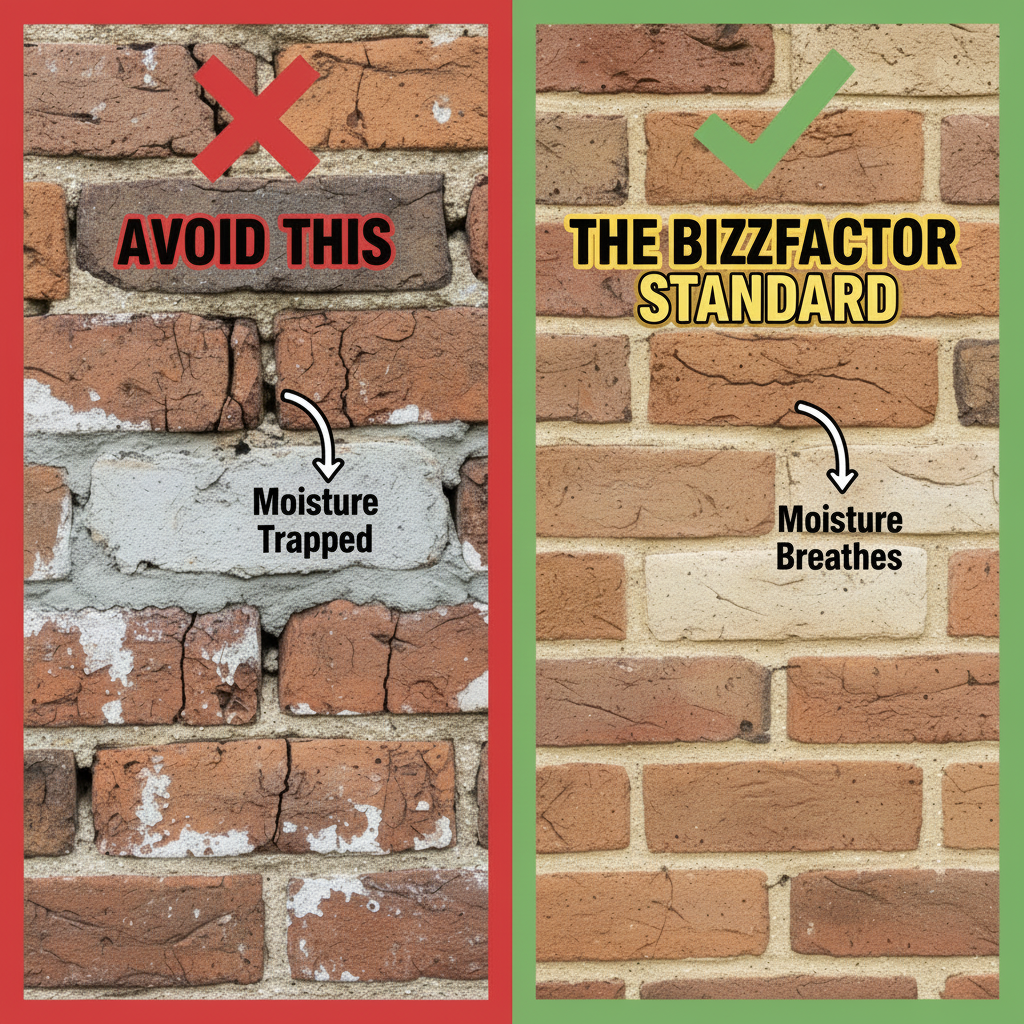
- **Property Age & Mortar Type:** Got an older home, especially one built before 1930? You probably need lime mortar. Not the bagged stuff from Home Depot. We're talking specialty lime blends that cost twice as much and require custom mixing. Why? Because modern cement is too hard for old bricks. Slap Portland cement on a 1920s brownstone and you'll crack those irreplaceable bricks within eighteen months. I've watched it happen. A guy in Savannah tried saving maybe $400 by using regular mortar on his historic place. Ended up spending $3,800 fixing spalling bricks that couldn't breathe through the cement he'd trapped them with. Old brick needs mortar that's softer than the brick itself — that way the mortar fails first (and mortar's cheap to replace). Get it backwards and you're buying antique replacement bricks at $8 each.
- **Extent of Damage:** This one's a no-brainer. A few isolated spots showing minor deterioration? That's a relatively quick fix. We're talking minor touch-ups. But if entire sections of your wall look like they've been through a war, with deep, pervasive mortar deterioration, you're looking at a much more involved, labor-intensive, and thus more expensive, project. Sometimes, bricks themselves are already damaged and need replacing. That adds to the bill.
Most decent masons spend at least fifteen minutes — probably closer to half an hour — just staring at your mortar before they price anything. We're looking at color, sure, but also hardness, texture, sand content, lime-to-cement ratio. Why the forensic approach? Because I've scraped out too many walls where someone used whatever mortar was on sale, only to have the bricks start spalling within two years. Modern Type N mortar (the standard at Home Depot) is way too hard for most pre-1940 construction. You need something softer — a Type O or a custom lime mix — so the mortar fails before your bricks do. That's by design. It's supposed to be the sacrificial element. Get that backwards and you're replacing bricks instead of mortar, which costs about four times as much.
How to Build a Realistic Budget for Brick Repointing Services
Here's the thing: figure $15-$25 per square foot as your starting point for most residential work. I've seen it go as low as $10 for simple ground-level patches on newer construction. Don't skip this. I've also seen $40+ for three-story Victorians where we had to custom-match lime mortar from the 1890s. Your specific number depends on those three factors we just covered — how high we're going, what kind of mortar your house needs, and whether we're fixing a few spots or repointing half the facade.
Which is why you need someone to actually look at it.
Not a phone estimate. Not a "send me photos" quote. An actual human standing in front of your actual wall with actual experience. You wouldn't buy a car unseen, would you? Same principle applies here. An expert eye makes all the difference.
The Nitty-Gritty: Cost Breakdown
Where does your money actually go? I'll tell you — roughly 30% goes toward materials. Mortar, sand, water, those specialized additives that make everything bond right. The other 70%?
That's labor.
And honestly, that reflects the skill involved. Removing mortar without damaging brick faces, mixing batches that match sixty-year-old formulas, tooling joints so they shed water instead of collecting it. These aren't skills you pick up watching YouTube for an afternoon. You're paying someone who won't wreck your house. That costs more than someone who might.
**Breaking Down Material Costs (for a clearer picture):**
Now, your typical Portland cement mortar — the stuff that went into most homes after about 1930 — costs maybe $3-$5 per square foot in raw materials. You can grab a bag at any masonry supply yard. Mix it 1:3 with sand, add water until it's the consistency of peanut butter, and you're good to go. Works great on anything built in the last 75 years. Strong, weather-resistant, sets up fast.
Problem is, it's absolutely wrong for older construction.
Lime-based mortars for historic work? You're spending $8-$12 per square foot just on materials. These mixes use hydrated lime instead of Portland cement (or very little cement), specific grades of silica sand that you can't find at Lowe's, and sometimes proprietary additives that control the cure rate. Why so expensive? Because you're not buying commodity materials anymore. A 50-pound bag of hydrated lime costs about three times what cement does, and you need more of it to get proper workability. Plus, historic mortars require coarser sand — stuff with irregular particles that lock together mechanically. That's specialty material. Limited suppliers. Higher prices. Supply and demand at work.
**How Project Complexity & Accessibility Hit Your Wallet:**
- **Ground-level stuff:** This is where you catch a break — usually $10-$15 per square foot. Easy access, standard ladders, maybe a small work platform. Nothing fancy required, which means you're not paying for elaborate setups.
- **Second-story jobs:** Now you're looking at $18-$25 per square foot because scaffolding doesn't set itself up. You're paying for the equipment rental, the time to install it safely, the OSHA-compliant harnesses, and the extra hours moving tools up and down. Safety costs money, but I'd rather spend it than attend a funeral.
- **Complex features — chimneys, corbelling, intricate patterns:** These can easily hit $30-$40+ per square foot. Think about it: tight corners, custom color matching that takes three tries to nail, areas where one wrong move destroys irreplaceable details. That's artisan work. Last year we handled a chimney in Capitol Hill (Seattle) where what looked like simple repointing turned into a partial rebuild because the flue liner had failed. Started with crumbling mortar, ended with a $4,800 invoice.
Real talk — accessibility isn't just about height. I've seen properties where the landscaping alone added 25% to the bill. That deck you built right against the house? The prized Japanese maple three feet from the wall? The hot tub that seemed like a great idea in 2019? All of that makes our job harder, slower, and yeah — more expensive. We once spent half a day in Round Rock, Texas, carefully working around a homeowner's award-winning rose garden just to reach a failing foundation wall. Beautiful roses. Painful logistics.
BizzFactor Case Study: When DIY Turns into a Disaster — A Victorian Warning
Last month we got called to a beautiful 1920s Victorian in Savannah. The homeowner had spent a weekend doing what they thought was basic repointing — grabbed some cement mix on sale at Home Depot for $47, watched two YouTube videos, and went to work on the south wall.
Three months later they called us because the bricks were falling apart.
Literally crumbling off the facade.
Now, what should've cost around $800 for proper repointing ended up at $3,200 for full restoration. The problem? They'd packed modern Portland cement — hard, dense, waterproof stuff — into joints that were designed for soft, breathable lime mortar. In historic masonry, the mortar is supposed to be the weak link on purpose. It's sacrificial. When water gets in (and water always gets in), you want it escaping through the mortar, not through your irreplaceable hundred-year-old bricks.
But when you flip that script — when the mortar is harder than the brick — the bricks take all the stress. They crack. They spall. They absorb moisture that can't escape. Then winter comes, that trapped water freezes and expands, and suddenly you've got chunks of brick falling into the flowerbeds.
We see this constantly.
This is why BizzFactor won't touch a repointing job without analyzing the existing mortar first. You can't just eyeball this stuff. We need to know the compressive s
In-Depth Look
Detailed illustration of key concepts
Visual Guide
Infographic illustration for this topic
Side-by-Side Comparison
Visual comparison of options and alternatives
Sources & References
- How Much Does Repointing Brick Cost [2025 Data] - HomeAdvisor
- Brick Repair vs. Replacement: Making the Right Choice for Your ...
- How Much Does It Cost To Repoint Brick? - Sardar Restoration Corp
- How Much Does Masonry Work and Brick Repair Cost? (2026)
- Building Codes, Standards, and Regulations: Frequently Asked ...
- Building Codes and Standards - 101 Guide | ROCKWOOL Blog
- [PDF] Building Codes Toolkit for Homeowners and Occupants - FEMA
- ICC - International Code Council - ICC
- Home Insurance Building Code Coverage - Allstate
Frequently Asked Questions
Need Professional Help?
Find top-rated home services experts in your area