
Understand the real factors influencing moving costs. Learn about volume, weight, access issues, and how to save money on your next move.
Key Takeaways
- # Moving Costs Explained: Real Factors That Matter – A BizzFactor Guide A client in Dunwoody paid $2,800 more than quoted last summer
- Nobody mentioned the three flights of stairs or that the upright piano wouldn't fit through the hallway
- After watching hundreds of moves go sideways (and a few go perfectly), here's what actually drives the numbers
- We watched a guy pack his home office last year
Key Takeaways
Moving Costs Explained: Real Factors That Matter – A BizzFactor Guide
A client in Dunwoody paid $2,800 more than quoted last summer. Why? Nobody mentioned the three flights of stairs or that the upright piano wouldn't fit through the hallway. That's how this works — your final moving bill comes down to four things: how much stuff you're hauling, how far it's going, how hard it's to reach, and what extra help you need.
After watching hundreds of moves go sideways (and a few go perfectly), here's what actually drives the numbers.
Unpacking the Biggest Factor in Moving Costs: Volume and Weight
Look — the sheer weight of your stuff matters more than anything else on your invoice.
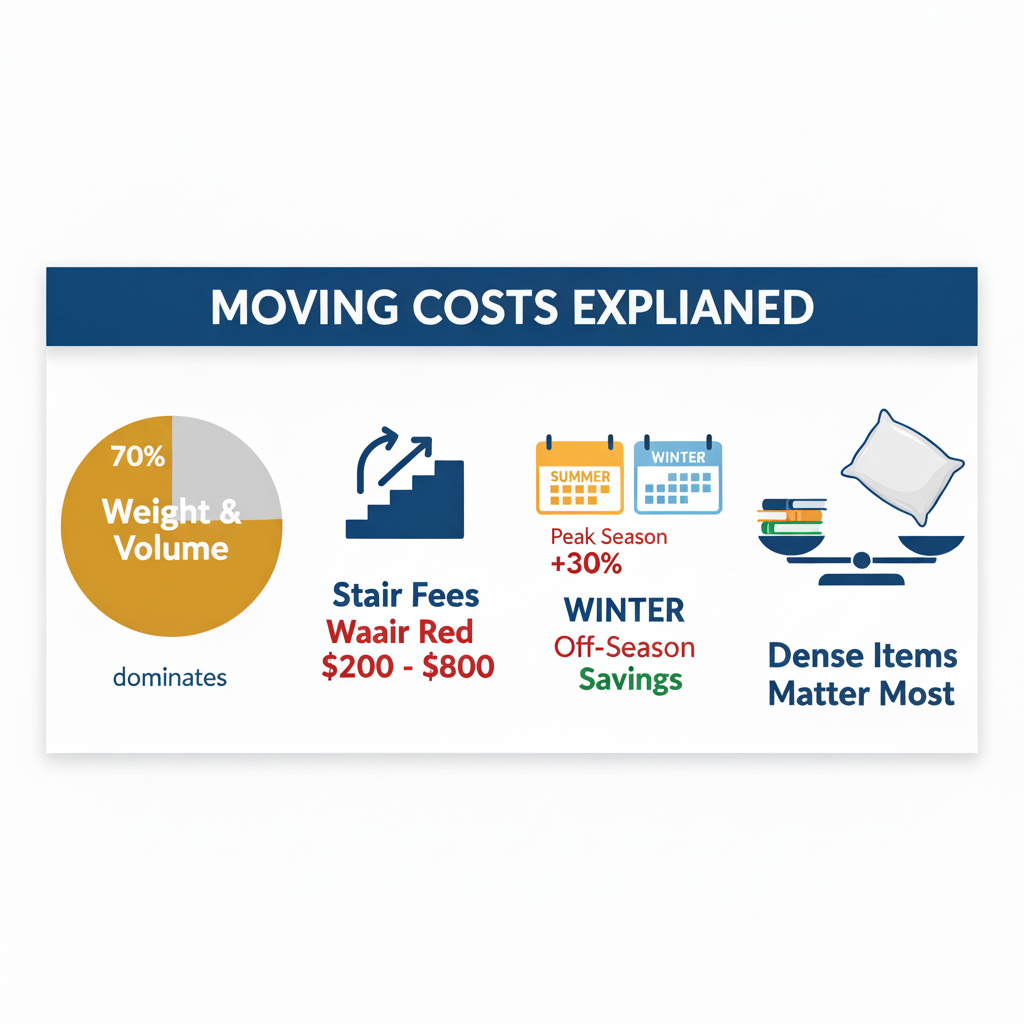
We watched a guy pack his home office last year. Four boxes of hardcover books, maybe 45 pounds each. That single bookshelf? Added $300 to his bill because he didn't warn the crew. Books are killers.
Here's the thing about local movers: they're literally watching the clock tick. Every extra box means another trip to the truck. More stuff wedged through doorways. More time securing loads so nothing shifts when the driver hits a pothole on Peachtree. Hours stack up fast, and you're paying for every one of them. Long-distance outfits work off a totally different playbook — FMCSA rules (federal law, can't skip this) force them to drive your entire shipment to a certified scale. Companies like Dunmar Moving? They'll send someone to actually walk through your place beforehand. Sometimes in person, sometimes over video where you're panning your phone around like you're shooting a house tour. They're not guessing. They're counting. Every lamp, every box, every random piece of furniture you forgot existed.
Ever get a quote that felt *too* good, then the final bill knocked you sideways?
Yeah. That's the dense-stuff trap.
The "Dense Collection" Dilemma
Here's what people miss: they budget for the couch and dining table, then forget about the 200-pound file cabinet. Or the vinyl collection. Or grandma's china set that takes up half a room.
Look — a home office with wall-to-wall books? That'll outweigh your entire living room setup. I've seen it happen. Records, dish collections, those metal filing cabinets — they don't *look* heavy until someone's carrying them.
**Long-distance moves charge by certified weight, not how much space stuff takes up.** Which is why you'll sometimes see invoices jump by thousands from the estimate. Nobody weighed the basement beforehand.
Choosing the Right Moving Partner: Beyond the Basics
Quick clarification (people get this wrong all the time): Chubb isn't a moving company. They insure expensive stuff — fine art, wine collections, antiques. You'd hire them *in addition to* your movers if you've got a Picasso or a $40,000 wine cellar.
For the actual move? Our team usually points people toward Clancy Moving. They're a United Van Lines agent — been doing this for over 20 years — so you get national resources with local accountability. ER Logistics works fine for simple moves, but they won't give you the same guarantees if things get complicated.
The Savvy Mover's Secret: Drawer Packing
Conventional wisdom says empty every drawer before moving day.
That's... not always true.
Here's the thing: if you've got a solid dresser — nothing flimsy — you can absolutely leave soft stuff inside. Clothes, linens, light fabrics. The crew wraps the whole unit (basically turns it into its own box), and you're good. We've been doing this for years. Cuts packing time in half, saves you buying 15 extra boxes, and makes unpacking way easier.
Don't try this with dishes or books. Use your head.
Impact of Access Issues on Moving Costs: Stairs, Long Carries, and Obstacles
Last year we reviewed a move from a fourth-floor walkup in Midtown. No elevator. Stair fees alone? $800.
Logistical nightmares — multiple flights, long carries from truck to door, narrow hallways that make maneuvering impossible — will absolutely wreck your budget. Ground-floor unit with the truck parked right outside? Cheap. Fourth floor with street parking only? Expensive.
What's a "long carry"? Industry standard is about 75 feet. If movers can't park within that distance of your front door, you're paying extra for them to haul everything farther. Sometimes there's no way around it (downtown buildings, gated communities with strict parking), but you need to mention it upfront.
Local vs. Long-Distance Moves: Understanding the Pricing Differences
The math changes completely depending on how far you're going.
Now, local jobs — anything under 50 miles, maybe 100 depending on the company — run on an hourly clock. Crew shows up, timer starts, you're paying until they're done. Pretty simple math. But cross a state line? Totally different ballgame. Interstate movers operate under federal weight rules. FMCSA doesn't play around with this stuff. So here's what actually happens: they load your entire house, drive the truck to a certified scale (usually at a weigh station), get an official weight ticket, then multiply pounds by miles to calculate what you owe. Plus fuel surcharges. Plus driver wages for multi-day hauls. Plus tolls if you're moving through the Northeast corridor where everything costs money. Coast-to-coast moves? Now you're also paying for overnight storage between transit days and route planning.
None of this is negotiable, by the way. Federal regs dictate the whole process.
The "Downtown High-Rise" Scenario: A Cautionary Tale
Real story: client books a move for a two-bedroom apartment. Quote looks reasonable. Great.
What they didn't mention — building loading dock requires a two-hour reservation window (which they didn't book), and the antique wardrobe won't fit in the service elevator.
The crew shows up (similar setup to Five College Movers, good guys). They wait. Then they have to muscle this massive wardrobe down *six flights* of fire stairs because there's no other option.
Final bill? 40% over estimate.
**Tell your movers everything.** Every. Single. Detail. Background-checked professionals need the full picture to give you accurate numbers, not surprises on moving day.
Decoding Add-On Services: What Truly Costs Extra?
"Extra services" sounds like code for hidden fees, but it's really just stuff beyond the basics — load truck, drive truck, unload truck.
Elite companies list everything out so there's no confusion.
**Full-Service Packing:** So the crew shows up the day before your move (sometimes same morning if it's a small job) with boxes, tape, bubble wrap, the whole deal. They pack your house room by room while you sit there wondering why you didn't throw more stuff away. Some companies charge per box — anywhere from $3 to $8 depending on size. Others bill hourly with a two or three-person crew dedicated just to packing. Three-bedroom house? You're probably looking at $500 to $1,200. Depends how much random stuff you've accumulated.
**Furniture Disassembly/Reassembly:** That king-size bed frame you bought from West Elm? Dining table with the removable leaves? Those god-awful IKEA contraptions with the cryptic instruction diagrams? Most crews will take stuff apart and put it back together, but it costs extra. Usually runs $50 to $150 per piece depending on complexity. Grandfather clock with internal mechanisms? You're hitting the high end of that range.
**Specialty Item Handling:** This is where costs get serious. Grand pianos need custom crating, hydraulic lifts, sometimes a dedicated truck if you're going long distance. I've seen baby grands cost $300 for a local move, upwards of $800 for cross-country. Gun safes? Those 600-pound monsters require special equipment and extra manpower. Fine art needs climate-controlled transport and custom packaging. One client had a marble sculpture that required a wooden crate built on-site. That added $450 to his invoice before the movers even touched it.
**Storage Solutions:** Your old house closes on the 15th but your new place isn't ready until the 30th. Now what? Storage-in-Transit (SIT in industry speak) means your stuff sits in a warehouse temporarily. Some companies partner with Extra Space or Public Storage. Others use portable containers — basically PODS or 1-800-PACK-RAT units they deliver, load, store, then bring to your new address. Small spaces might run $100/month. Larger units or climate-controlled options? Easily $400+.
These aren't surprise fees if you're working with reputable operators. They cost extra because they require specialized labor, equipment, training, materials. The good companies (the ones with actual insurance and accountability) break this all down before you sign anything.
Strategic Timing and Insurance: Maximizing Savings and Protection
Your move date can swing your budget by 30% or more.
**Peak season** — Memorial Day through Labor Day — sees the highest prices because demand's through the roof. Companies like Clancy Moving are booked solid. **Off-peak moves** (February's usually the cheapest) can save you serious money *and* get you better availability. Crews aren't rushing between jobs, so service quality improves too.
Insurance choices matter more than people think.
So federal law says movers have to include this thing called Released Value Protection — 60 cents per pound per item. Sounds okay until you do the math on what that actually means. Your movers drop your grandmother's antique oak dresser coming through the door. Thing probably weighs around 100 pounds. Under released value coverage, you're getting a check for $60. Not the $2,000 it'd cost to replace. Not even in the ballpark. Full Value Protection bumps your total bill (usually 1-2% of shipment value), but here's the difference — if something breaks, the company has to either fix it, replace it, or cut you a check for actual market value. For stuff you genuinely can't replace — family heirlooms, original artwork, collections you've spent twenty years building — we push clients toward separate specialty coverage through outfits like Chubb.
I'm not kidding about this.
**Best time to move for savings?** February through April. Lowest rates, best availability, less chaos.
I've watched clients save $3,000+ by shifting their move from July to March. Same distance, same amount of stuff, just different calendar date. Peak season pricing is no joke — and if you wait until June to book a July move, good luck finding availability at all.
Off-peak moves let professional movers give better guarantees, superior service, and (here's the kicker) lower costs across the board.
---
FAQs
**What are the four main factors that determine moving costs?**
Volume/weight of your stuff (books and file cabinets are killers). Distance you're traveling. Accessibility issues — stairs, tight hallways, long carries from truck to door. Extra services like packing or specialty handling for pianos and gun safes. Everything else is just details on top of those four.
**How do local and long-distance moving costs differ?**
Local moves (usually anything under 50-100 miles) get billed hourly. You're paying for crew time and the truck. Long-distance interstate jobs follow completely different rules — federal regulations require certified weigh tickets (the FMCSA mandates this), and companies calculate your cost by multiplying weight times distance. That's why your book collection barely registers on a local move but destroys your budget when you're going from Atlanta to Seattle.
**When is the best time of year to move to save money?**
So — avoid Memorial Day through Labor Day if you can. That's peak season — highest prices, worst availability. February through April offers the lowest rates (sometimes 30% cheaper than summer), better scheduling, and less stressed-out crews. One month can make a $1,500+ difference on the same move.
In-Depth Look
Detailed illustration of key concepts

Visual Guide
Infographic illustration for this topic
Side-by-Side Comparison
Visual comparison of options and alternatives

Sources & References
- Understanding Factors That Impact Moving Costs
- Understanding Pricing and Key Cost Drivers | Dunmar Moving
- A Guide to Moving Company Cost | 1-800-PACK-RAT
- How Much Do Movers Cost? - Forbes
- Factors That Affect Your Local Move Cost - Moovick
- Best Moving Companies in California Of 2026 - Forbes
- The Best Moving Companies in California for 2026 - This Old House
- 10 Best Moving Companies in California (2026 Reviews) - YouTube
- 10 Top Moving Companies in California | SecureSpace Self Storage
- How to Choose a Reliable Moving Company - Consumer Reports
Frequently Asked Questions
Need Professional Help?
Find top-rated moving companies experts in your area