
Spot moving scams before they happen. Our licensed pros reveal red flags, verify movers' insurance, licensing & pricing. Protect your belongings today.
Key Takeaways
- **Legitimate companies** want to see your stuff before quoting. Could be in person, could be video — but they're counting boxes, eyeballing that sectional, measuring doorways, asking about parking. Because how do you price a job you haven't even looked at? You can't. That's the whole point of binding estimates — the number they give you is what you pay, period (unless you add stuff last minute). Protects everyone.
- **Scammers** just toss out random numbers. Two-minute phone call, you say "three-bedroom," they say "$900." Based on what? That's not estimating. That's fishing. Then comes the non-binding estimate trick where suddenly *everything's* extra.
- **Legitimate Movers:** They'll take a reasonable deposit — usually 10-15% tops, often less for local jobs. Final payment? That happens at delivery, and they're fine with credit cards. Actually, they prefer it. Creates a record for both parties. Protects everyone. If there's a dispute, you've got options through your card company.
- **Scam Movers:** Cash is king. Wire transfers. Money orders. Anything that disappears without a trace. I talked to a woman in Tempe last year who wired $2,800 as a "deposit" to a company she found online. They never showed up. No answer when she called. Website went dark three days later. That money? Gone forever.
- **Generic or Non-existent Websites:** No professional website? Or one that looks like it was slapped together in an afternoon with stock photos of random people holding boxes? That's trouble. Legitimate companies invest in their online presence. Look for clear contact information, readily available licensing details (like their MC or DOT numbers prominently displayed, not hidden away), and detailed service descriptions. If it looks like a template from 1998, that's not a good sign. No physical address? No local phone number (just an 800 number)? That's a triple-red flag.
Key Takeaways
Moving Scam Red Flags: How to Spot and Avoid Fake Movers
A woman in Buckhead signed a contract with three blank spaces — figured she'd fill them in later. Moving day comes, truck gets loaded, and suddenly those blanks? They're not blank anymore. $3,200 in "additional fees" materialized out of thin air. Fuel surcharge. Long carry. Something about stairs she swears they never discussed. Her stuff's already on the truck. What's she gonna do?
That's how they get you.
Look — look — moving's stressful enough without getting robbed in broad daylight. But here's the reality — the moving industry's crawling with scammers. We're not talking minor overcharges. I mean full-blown hostage situations where your grandmother's china sits in some warehouse until you wire another three grand you don't have. Happens every day.
Think of this as your scam-buster playbook. I've seen enough horror stories (and helped clients dig out of enough messes) to know what separates legitimate movers from the bottom-feeders. We're going deep on warning signs, step-by-step vetting tactics, and the resources you actually need to protect yourself. Don't skip this step. It'll save you headaches and heartbreak.
Look — a little elbow grease upfront pays off in spades later.
Key Red Flags to Watch Out For When Hiring a Mover
You know something's off when the price sounds too good or the guy on the phone keeps dodging simple questions. Sometimes it's subtle — a weird pause when you ask about licensing. Other times? It's glaringly obvious, like demanding cash only or refusing to put anything in writing.
Trust your gut, but also know what to look for.
1. Extremely Low Estimates Without a Proper In-Home or Virtual Assessment
Here's the oldest trick in the book: the lowball estimate. A company quotes you $800 when everyone else is saying $2,200. Feels like you hit the jackpot, right?
Wrong.
If they haven't actually *seen* what you're moving—no walkthrough, no video call, just a quick "yeah, we can do it for $800"—you're being set up. They hook you with that sweet number, then triple it once your couch is on their truck and you're 200 miles from home.
I know a guy in Sherman Oaks who thought he scored big with a $1,200 quote. Moving day arrives, stuff gets loaded, then suddenly it's $5,400 because of "stairs" and "distance from curb" and fifteen other fees that magically appeared. They wouldn't unload until he paid. Cash only, naturally.
- **Legitimate companies** want to see your stuff before quoting. Could be in person, could be video — but they're counting boxes, eyeballing that sectional, measuring doorways, asking about parking. Because how do you price a job you haven't even looked at? You can't. That's the whole point of binding estimates — the number they give you is what you pay, period (unless you add stuff last minute). Protects everyone.
- **Scammers** just toss out random numbers. Two-minute phone call, you say "three-bedroom," they say "$900." Based on what? That's not estimating. That's fishing. Then comes the non-binding estimate trick where suddenly *everything's* extra.
2. Demanding Large Upfront Cash Deposits
Okay, so yeah — good companies sometimes want a deposit to hold your spot. Maybe 10%, sometimes 15% for bigger jobs. That's standard. Credit card, usually refundable if you cancel with reasonable notice.
But when they're asking for 30%, 40%, half upfront? And they want it in cash or wire transfer?
That's where the alarm bells should be going off.
The reason's simple: they don't want your money to be traceable. Once cash leaves your hand, it's gone. No chargeback, no recourse, no paper trail when they vanish.
- **Legitimate Movers:** They'll take a reasonable deposit — usually 10-15% tops, often less for local jobs. Final payment? That happens at delivery, and they're fine with credit cards. Actually, they prefer it. Creates a record for both parties. Protects everyone. If there's a dispute, you've got options through your card company.
- **Scam Movers:** Cash is king. Wire transfers. Money orders. Anything that disappears without a trace. I talked to a woman in Tempe last year who wired $2,800 as a "deposit" to a company she found online. They never showed up. No answer when she called. Website went dark three days later. That money? Gone forever.
3. Lack of Professionalism: Generic Websites, Unmarked Trucks, and Vague Information
So yeah, real companies act like real companies. Scammers don't even try to fake it sometimes:
- **Generic or Non-existent Websites:** No professional website? Or one that looks like it was slapped together in an afternoon with stock photos of random people holding boxes? That's trouble. Legitimate companies invest in their online presence. Look for clear contact information, readily available licensing details (like their MC or DOT numbers prominently displayed, not hidden away), and detailed service descriptions. If it looks like a template from 1998, that's not a good sign. No physical address? No local phone number (just an 800 number)? That's a triple-red flag.
- **Unmarked or Rented Equipment:** Real moving companies use branded trucks. Company logo on the side. DOT number. Contact info. The crew shows up in matching shirts or uniforms. They've got professional equipment — dollies, pads, shrink wrap, the works. You see a sketched-out U-Haul rental with no company markings and three guys in whatever they wore to bed? Run. A homeowner in San Diego hired "movers" with an unmarked van — they took off halfway through with half her stuff and she never saw them again.
- **Vague Answers and Pressure Tactics:** Ask about insurance and they get squirrelly? Bad sign. Legit movers spell it all out — General Liability, Workers' Comp, Cargo insurance, everything. They'll explain Released Value versus Full Value Protection without making you feel stupid for asking. And they don't hit you with "This price is only good TODAY!" pressure garbage. Real companies? They know their schedule, they know their worth, and they'll give you time to think. They'll also hand you a proper bill of lading without you having to threaten them with a lawyer.
4. Absence of a USDOT Number or Inability to Verify It
Moving across state lines? They need a USDOT number.
Period. Federal law. If they're hauling household goods interstate without FMCSA registration, they're literally operating illegally. Not "kinda sketchy" — actually breaking federal law.
Intrastate moves (within one state) have different rules depending where you live, but most states require *some* kind of licensing.
- **Actionable Tip:** Go to the FMCSA's SAFER system (https://safer.fmcsa.dot.gov/CompanySnapshot.aspx) and plug in their USDOT number. Don't take their word for it — verify yourself. This database shows you everything: safety record, complaint history, operating authority. Check their "Operating Status" (should say "AUTH. CARRIER") and their "Insurance Detail" (needs to show active policies). For local moves, check your state's public utilities commission or DOT for licensing requirements. Rules vary wildly. Florida, for example, has its own licensing authority for intrastate movers through FDACS. Do your homework. Not all states handle this the same way.
5. No Written Contract or Vague Terms and Conditions
Without a contract in writing, you've got absolutely nothing when things go sideways.
Your furniture's loaded on their truck, they're demanding three grand you never agreed to, and you're standing there with...what? A verbal agreement from two weeks ago? That's worth less than the paper it's not written on. I've watched this play out probably a dozen times — people scrambling to borrow money from relatives because their stuff's being held hostage and they never got anything documented.
Your bill of lading needs every single detail spelled out. Not "approximately $2,500" — the actual binding price. Every piece of furniture listed and numbered. Pickup date. Delivery window with real dates, not "sometime the week of." Insurance coverage explained in plain English. Payment terms. What happens if you cancel.
**Fill in every blank before you sign.**
Those empty spaces in the Buckhead woman's contract? That's where $1,500 in "fuel surcharges" magically appeared. After her signature was already on the page.
- **What needs to be in there:** Binding price (or if it's non-binding, the exact formula they're using — weight times rate per pound, whatever). Complete inventory with condition notes. Actual pickup date and delivery dates — if there's a window, spell out the first possible day and last possible day. Insurance type spelled out. Released Value is basically worthless (60 cents per pound per item — your $2,000 couch is covered for maybe $40). Full Value Protection actually replaces or repairs stuff at current value. Payment schedule — when deposits are due, when final payment happens, what methods they accept. What fees apply if you cancel, and under what timeline. Every surcharge itemized before the fact — stairs, long carry, elevator, shuttle truck if needed, whatever. Your signature means you read and agreed to all of it, so actually read every word. This contract's your only weapon when (not if) something goes wrong.
6. Extremely Poor Online Reviews or a Complete Lack of Online Presence
Sure, every business catches a bad review now and then. Customer had a rough day, maybe the crew was late because of traffic, stuff happens.
But when you're seeing patterns — five reviews all mentioning hostage situations, ten complaints about phantom fees, a dozen stories about broken furniture — that's not bad luck. That's who they're.
Here's the thing: the flip side's just as sketchy. Brand new company with zero online footprint, or maybe three glowing 5-star reviews that all sound like they were written by the same person. Companies that keep changing names to escape their reputation do this. They'll be "Reliable Movers LLC" for six months, rack up complaints, then rebrand as "Trustworthy Moving Services" and start fresh.
- **Actionable Tip:** Always check multiple independent review sites. We're talking Google Reviews, Yelp, Better Business Bureau, Facebook pages, and even industry-specific platforms like MovingScam.com or the American Moving & Storage Association (AMSA) websites. Look for both consistency in positive and negative feedback and, crucially, observe *how* the company responds to any complaints. Do they engage professionally and offer solutions? Or do they dismiss and attack? That's telling. A pattern of uncivil or defensive replies to legitimate complaints is a massive sign of poor customer service and potential fraud.
How to Thoroughly Vet a Moving Company: Your Comprehensive Checklist
Beyond just watching for red flags, you need to actively vet these companies before signing anything. This takes time. Do it anyway. Here's what I tell everyone:
Here's the thing: 1. **Get at least three written estimates:** In-person or virtual walkthrough — not phone quotes. This isn't just about finding the cheapest price (which, remember, is usually a scam). That's the real issue. You're comparing services, looking at how they break down costs, and spotting outliers. One quote's $1,800, another's $2,100, third one's $2,300? That's normal variation based on services and scheduling. One quote's $900? Yeah, that's bait. What are they leaving out? Or what are they planning to add later?
In-Depth Look
Detailed illustration of key concepts

Visual Guide
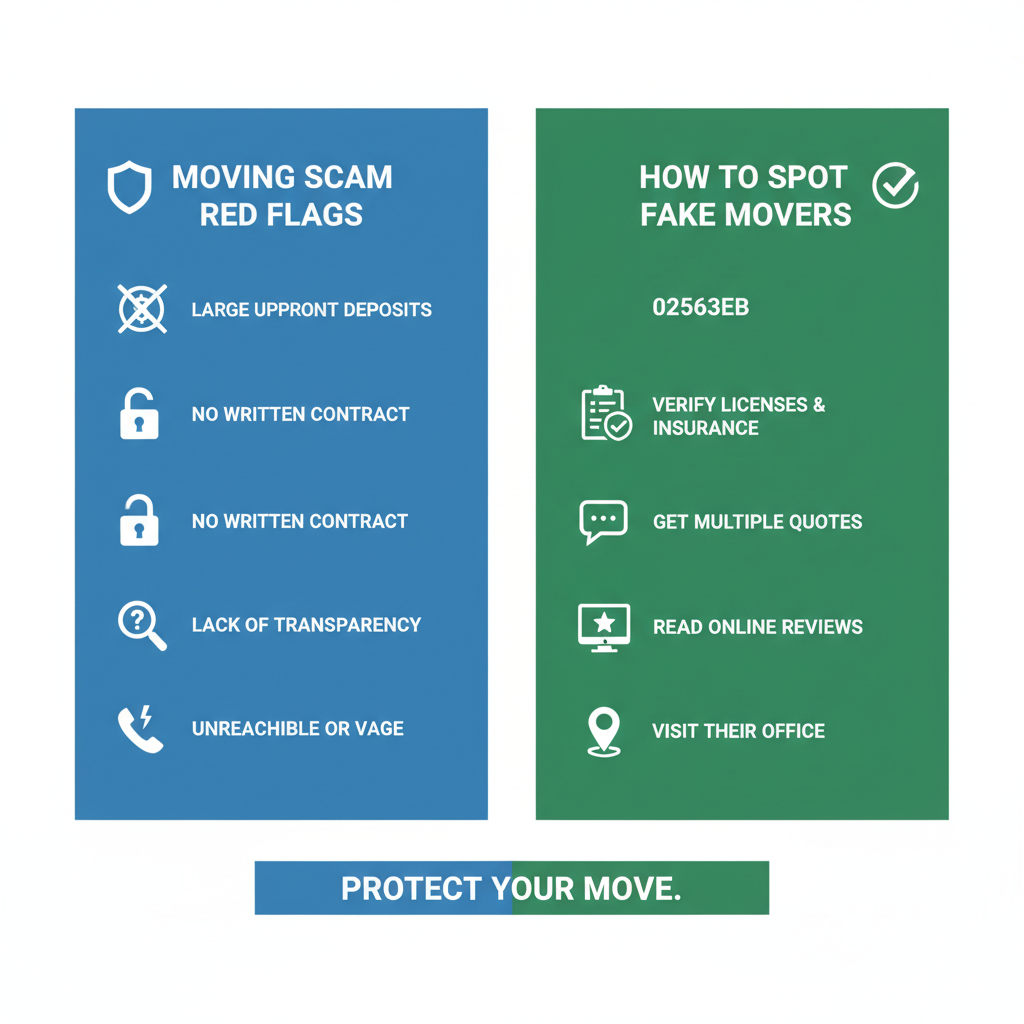
Infographic illustration for this topic
Sources & References
- Five Tips On How to Steer Clear From Unprofessional Moving ...
- How to Avoid a Bad Moving Experience: 5 Red Flags
- What to Expect from Professional Movers – Professionalism at Its Best
- Common red flags and how to avoid scams - Moving - Yahoo! Local
- Types of Moving Companies & Services
- How to Choose a Reliable Moving Company
- Best Moving Companies of 2026 | Real Estate & Home
- Best Cross Country Moving Companies Ranked US 2025
- Best Long-Distance Moving Companies | Expert Reviews & ...
Frequently Asked Questions
Need Professional Help?
Find top-rated moving companies experts in your area