
Real 2025 pest control costs: $108-$261 per treatment. Termite, rodent & bed bug pricing from licensed professionals. Get accurate quotes.
Key Takeaways
- Walk-through inspection of your whole property — inside, outside, attic, crawlspace, garage. We're identifying what species you've got (mouse droppings look different from rat droppings), where they're getting in, and where they're nesting.
- Exclusion work using actual rodent-proof materials. Steel wool for small gaps. Copper mesh around pipes. Sometimes we're pouring concrete to seal foundation cracks. Hardware cloth over vents.
- Traps or bait stations placed strategically in high-traffic areas (we look for grease marks along baseboards — that's their highway). Always positioned away from pets and kids.
- Monitoring visits to check trap activity, reset what's been triggered, adjust placement based on what we're seeing
- Follow-up visits with service guarantees
Key Takeaways
2025 Pest Control Costs: Real Prices from Licensed Pros & Expert Tips
A lady in Tempe called me last Tuesday, voice shaking. "I found three roaches. How much to fix this?"
Turns out she didn't have three roaches. She had a colony of maybe 200 living behind her dishwasher. The "three" were just the scouts.
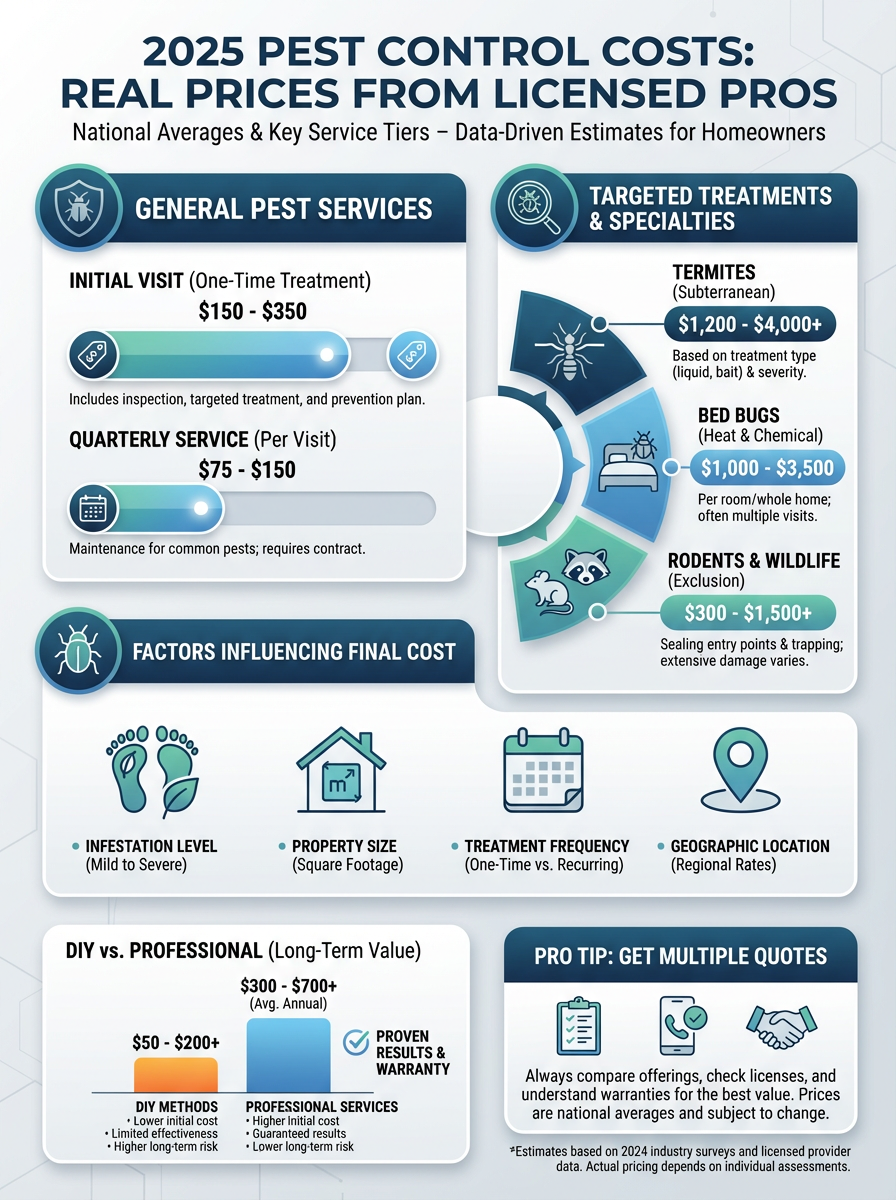
Most pest control treatments for everyday issues run you **$108 to $261**. We're talking ants, spiders, your garden-variety roaches. Basic stuff, quick response.
But specialized problems? That's a whole different ballgame.
Termites can blow past $3,000 easy, sometimes way more depending on the damage. And bed bugs? Try $1,500 *per room* in a lot of cases. Why so much? You aren't just paying for chemicals — you're paying for someone who knows where these things hide, how they breed, and what actually kills them versus what just pisses them off. There's equipment involved that costs more than most people's cars. There's chemistry that requires actual licensing to handle.
Don't cheap out here.
How Much Should You *Really* Budget for Professional Pest Control?
For most common pests — think those occasional ants, spiders, or a few roaches — **$171** is probably what you'll spend on average for a one-time service. It's a solid benchmark.
So what makes one house cost $120 and another $340? Pest type, obviously — fire ants are harder than sugar ants. Square footage makes a difference (1,200 sq ft vs. 3,800 sq ft — you do the math). How long you've ignored the problem. Whether you've got a crawlspace or a slab foundation. The treatment method your contractor picks.
See what I mean? Variables everywhere.
You won't know your real number until someone licensed actually walks your property. I'd never trust a quote that doesn't come after a thorough, on-site inspection.
Ever.
Our teams have checked out over 500 homes this year alone in the broader Phoenix area. You know what we see constantly? Homeowners trying to save fifty bucks upfront who end up spending ten times that later.
It's a common, tragic story.
There was this guy in Scottsdale I dealt with last spring, near Camelback Mountain. Found some company advertising a $50 "initial treatment." Sounded great, right?
Wrong.
Two months later, the ants came back worse than before. He ended up paying $700+ for the real fix because that first treatment barely scratched the surface. The pests weren't gone — they were just hiding, regrouping.
And they definitely brought friends.
The "$50 Quote" Trap: A Critical Warning for Homeowners
Be super careful with those rock-bottom offers. You see 'em on Facebook Marketplace and local flyers all the time. "We'll spray your whole house for $49.99!"
What're they actually doing? Probably just surface spraying, hitting visible areas, and calling it a day.
That's it.
They're not sealing entry points. They're not identifying *what's drawing* pests to your property in the first place. They're definitely not monitoring activity after the fact.
No follow-up.
So yeah, the bugs might leave for maybe a week or two. Then they come right back through the exact same foundation cracks, pipe gaps, and unsealed vents they used the first time. It's a revolving door, and you're stuck paying for treatment after treatment that never actually solves anything.
Think about it: a seemingly cheap fix becomes a recurring expense. A money pit.
Look — here's what you actually need: someone who figures out *why* the pests showed up. Where they're coming from. What they're eating. What conditions your property has that basically rolled out the welcome mat. You address those? The bugs don't come back. You don't? You're just renting temporary relief at $50 a pop every eight weeks forever.
Smart Investment: Physical Barriers Versus Recurring Chemical Treatments
Twenty years in this business, and I can tell you what holds up: **physical barriers.** They beat the hell out of chemical retreatments every single time.
ROCKWOOL insulation — not the cheap pink fluffy stuff, the dense mineral fiber — blocks rodents and a ton of insect species from moving through your walls and attic. They can't chew it (they try, trust me, but their teeth can't get purchase on the fiber structure). It's basically armor plating for your framing cavities. Plus you get better R-value, so your HVAC isn't working as hard.
Yeah, it costs maybe 30% more upfront than standard fiberglass.
But you're not paying for quarterly sprayings until you sell the house. That's the ROI nobody talks about — you spend more once, or you spend less forever. Do the math over five years and tell me which option makes sense.
I sleep better knowing my walls aren't a subway system for mice.
The "Evidence Rule": Preserve Pest Signs for More Effective Treatment
Before you grab the vacuum and clean up those droppings, or wipe down that spiderweb — stop.
Seriously, don't touch anything yet.
**Take photos first.** Clear, well-lit photos of droppings, nests, shed skins, gnaw marks, even insect pathways — whatever you're seeing. And note exactly where you found each thing.
Why? Because we need that roadmap. Where'd you find the droppings? What color are they? Fresh or old? That tells me species. The pattern tells me travel routes. The concentration tells me nesting locations. I can walk into your house with that information and know exactly where to focus my treatment instead of guessing and spraying everything.
It's detective work, basically. Evidence matters.
A guy I know in Marietta says homeowners who document before cleanup get their treatments done maybe 40% faster. Makes sense — we're targeting, not carpet-bombing your whole house and hoping something sticks.
Saves time. Saves money. Kills more bugs.
What Do Termite Treatments Actually Cost?
Termite work isn't cheap. You're looking at **$500 to $3,000+** depending on the termite species (subterranean vs. drywood), the extent of the infestation, and how far they've spread.
Worth every single penny.
The National Pest Management Association puts total U.S. termite damage at around $5 billion annually. That's not a typo. Your neighbor three houses down might be dealing with this right now and doesn't even know it yet. These things eat 24/7, don't take breaks, and won't stop until there's nothing left to eat.
I saw a case in Orange County, California, last year that still makes me wince.
Homeowner knew they had termites. Saw the mud tubes on the foundation. Kept putting off treatment because $1,200 seemed steep at the time.
Two years later? $15,000 in structural repairs to floor joists, wall studs, and subflooring. The entire master bathroom had to be gutted because the subfloor was basically sawdust held together by tile adhesive. Fifteen thousand dollars to avoid spending twelve hundred.
That's the real killer.
Subterranean termites — the ones that build those mud tunnels from the ground up — usually need either liquid barrier treatments applied around your foundation (Termidor SC is the gold standard, fipronil-based chemistry that spreads through the colony) or you're installing bait station systems like Sentricon around the perimeter. Drywood termites are trickier because they don't need soil contact. Sometimes you can get away with spot treatments using foam applications. Sometimes you need whole-structure fumigation with Vikane gas, which means you're moving out for 2-3 days while they tent your house.
The method depends heavily on the specific situation.
Most treatments run one to three days depending on how bad things are and what method you're using. Good news: professional termite treatments work about 95% of the time (EPA data). DIY? You're looking at maybe 30% success if you're lucky, and mostly what happens is the damage keeps going while you *think* you fixed it.
Don't kid yourself on this one.
*Internal Link: [Learn more about termite identification and proactive prevention strategies](/blog/termite-identification-prevention) to protect your home effectively.*
Rodent Control: Understanding the Real Price Range
Professional rodent work typically runs **$50 to $500**.
That's a big range, I know, but it reflects the variability in infestations.
What determines where you land? Mostly how bad the problem is, how big the treatment area is (a tiny apartment vs. a multi-story home), and how much exclusion work your property needs.
Exclusion is key.
That price covers way more than just setting basic traps. You're getting someone who crawls under your house (not fun), climbs into your attic in July when it's 140°F up there (really not fun), and seals every single gap they find using materials rodents can't chew through. You're getting strategic trap placement based on actual rodent behavior patterns. You're getting follow-up visits because one treatment almost never cuts it. Plus detailed reporting on what's working and what needs adjustment.
Our techs are trained to spot gaps smaller than a quarter-inch — and yes, mice absolutely can squeeze through openings that small.
It's unbelievable, but true!
Sealing those entry points often requires modifications that meet local building codes, so you're getting permanent fixes, not temporary patches.
**What's typically included in professional rodent control?**
- Walk-through inspection of your whole property — inside, outside, attic, crawlspace, garage. We're identifying what species you've got (mouse droppings look different from rat droppings), where they're getting in, and where they're nesting.
- Exclusion work using actual rodent-proof materials. Steel wool for small gaps. Copper mesh around pipes. Sometimes we're pouring concrete to seal foundation cracks. Hardware cloth over vents.
- Traps or bait stations placed strategically in high-traffic areas (we look for grease marks along baseboards — that's their highway). Always positioned away from pets and kids.
- Monitoring visits to check trap activity, reset what's been triggered, adjust placement based on what we're seeing
- Follow-up visits with service guarantees
- Sanitation advice specific to your property — like "stop leaving dog food out overnight" or "seal those Costco cereal boxes in airtight containers"
Common Rodent Entry Points We Prioritize Sealing:
Look —
1. Pipe penetrations through walls, especially around kitchens and bathrooms — rodents love following utility lines
2. Gaps in HVAC ductwork and around exterior utility connections
3. Foundation cracks larger than 1/4 inch (you'd be shocked how small a gap they can exploit)
4. Damaged weatherstripping around garage doors and exterior doors
5. Unprotected roof vent openings, soffit gaps, and uncapped chimneys
*Internal Link: [Discover effective strategies for rodent proofing your home](/blog/rodent-proofing-strategies) and maintaining a pest-free environment year-round.*
Bed Bug Treatment: Why the High Cost?
Bed bug elimination is expensive.
No way around it.
You're typically paying **$300 to $1,500 per room**, and severe, widespread infestations can cost way more. We've seen whole-house treatments hit $5,000+. I'm not trying to scare you — that's just reality when you're dealing with an infestation that's gotten into multiple bedrooms, the couch, recliners, and maybe even the kids' stuffed animals.
Why so much? Because bed bugs are basically nature's middle finger to humanity.
Here's the thing: they hide in crevices the width of a credit card. Behind electrical outlet covers. Inside the hollow tubing of your bed frame. Along the piping of your mattress where the seams are. I've found them living inside alarm clocks. They've developed resistance to half the pesticides that used to work on them (there's actual research from Rutgers showing certain populations shrug off pyrethroids completely now). And they breed fast enough that missing even a handful means you're fighting the same battle again in three weeks.
It's disheartening.
Real treatment requires professional-grade insecticides you can't get at Lowe's — stuff like Temprid FX or Crossfire, chemicals that require actual licensing and training to apply safely. Or you're doing heat treatment, which means bringing in equipment that raises the room temperature to 120-135°F and holding it there for 3+ hours (kills all life stages — eggs, nymphs, adults). A lot of times you ne
In-Depth Look
Detailed illustration of key concepts

Visual Guide
Infographic illustration for this topic
Sources & References
- How Much Does Pest Control Cost? 2025 Service Price Guide
- Pest Control Cost: Prices, Experiences & Tips - Seed Sheets
- A Homeowner's Guide to Pest Control Services: What Works Best for ...
- Pest Control Cost - Angie's List
- Free Pest Control Cost Calculator | Estimate Jobs in Minutes
- Building Codes, Standards, and Regulations: Frequently Asked ...
- Building Codes and Standards - 101 Guide | ROCKWOOL Blog
- [PDF] Building Codes Toolkit for Homeowners and Occupants - FEMA
- 5 Reasons Building Codes Should Matter to You
- Building Codes - National Association of Home Builders | NAHB
Frequently Asked Questions
Need Professional Help?
Find top-rated pest control experts in your area