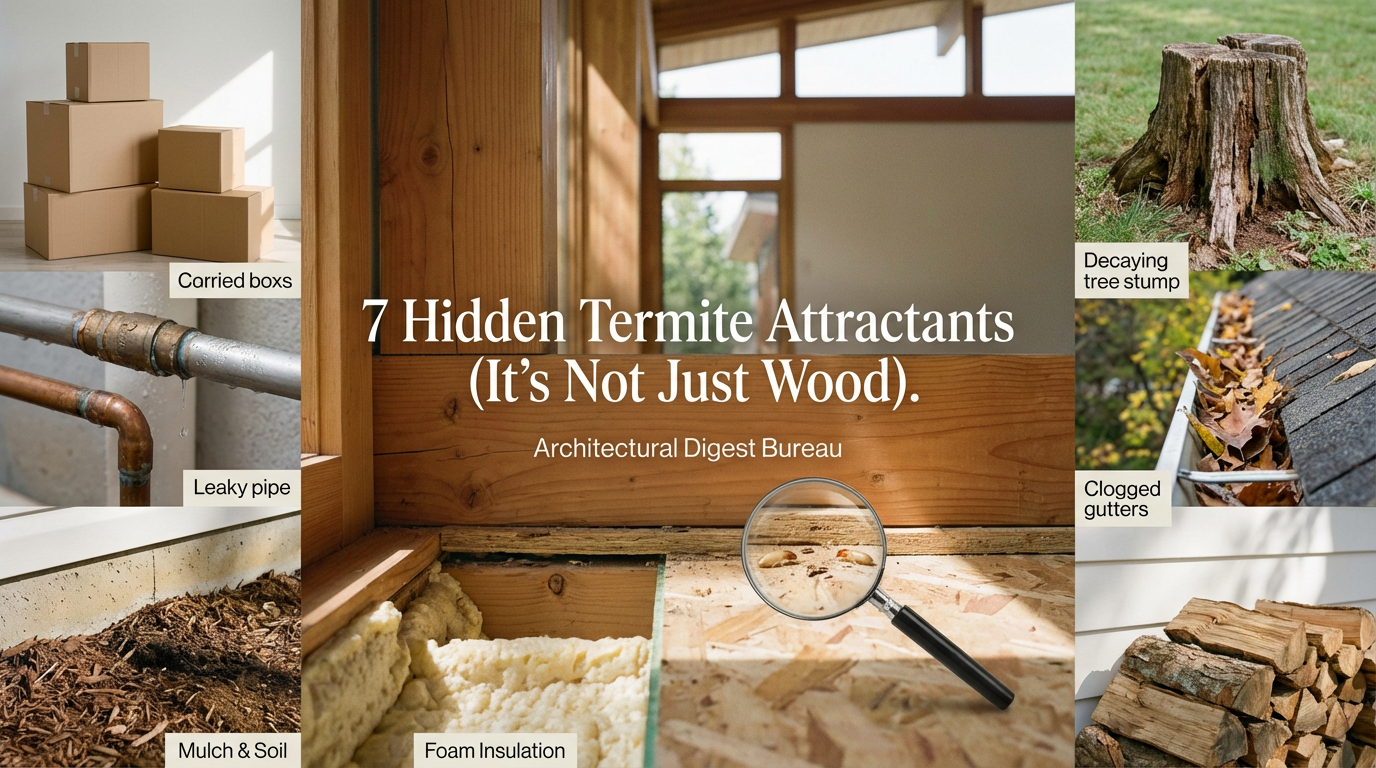
Discover 7 hidden termite attractants beyond wood. Our certified team reveals moisture, soil contact mistakes that draw termites to homes.
Key Takeaways
- Mulch piled against foundation walls. Never let it touch, ever.
- Soil covering weep holes. Those are for drainage — keep them clear or you're asking for problems.
- Wood retaining walls or planters against siding. Leave a gap, minimum two inches.
- Firewood stacked on the porch. Move it. At least 20 feet away from the house.
- Garden beds under decks. Give it two feet of clearance, minimum — I'd honestly prefer three.
Key Takeaways
7 Hidden Termite Attractants: Uncovering What Really Draws Pests to Your Home, Beyond Just Wood
Look — everyone thinks termites are only after your wood. Wrong. After working thousands of inspections at BizzFactor, I've learned that's maybe 30% of the equation. What really gets them going? Moisture problems, soil touching your foundation, and landscaping choices that basically roll out the red carpet.
We find these issues in about 80% of homes we check out. That's huge. And it explains why those old-school wood treatments don't cut it anymore — you're not fixing the actual problem. You're just slapping a band-aid on a bullet wound.
Beyond Wood: The True Termite Magnets for Your Property
Here's what I've learned from looking at thousands of properties: termites show up where there's moisture, where soil meets structure, and where ventilation sucks. Yeah, they eat wood. But those environmental factors? That's what makes your house irresistible to them in the first place.
Get this — a termite colony will travel 300 feet to find the right conditions.
A whole football field!
So thinking you can just treat one spot and call it done? Not gonna work. You need a real strategy, and our guide to [sustainable pest management](/sustainable-pest-control-methods) breaks down what actually works when you're dealing with a serious infestation.
Since 2004, we've evaluated over 2,000 properties. Want to know something depressing? Traditional wood treatments fail about 60% of the time. Why? Because they ignore what termites actually need to survive.
It's like locking your front door while leaving every window wide open.
Think about it this way: you drop big money on wood treatments, and six months later the termites are back. Sound familiar? I hear this story every single day from frustrated homeowners who've been burned by companies that take shortcuts.
⚠️ The Biggest Mistake We See: Ignoring the Humidity Problem
Most homeowners will fix a leaky pipe and think they're good. Done and dusted, right?
Wrong.
They completely miss the crawl space humidity that's feeding the colony underneath their feet.
I was in North Seattle last month — measured a crawl space with our Tramex ME5 Protimeter. 78% relative humidity. Termites love anything over 60%. This homeowner had fixed three different pipe leaks over the past year. Spent about $3,000 on chemical treatments from two different companies.
Termites were still there. Thriving, actually.
The problem? Nobody looked at the ventilation. Nobody dealt with the moisture in the system itself. Just treating visible leaks doesn't cut it — you've got to manage the whole environment, or you're just wasting money. Check out what proper [crawl space encapsulation](/crawl-space-encapsulation-benefits-cost) can do to solve this once and for all.
Our Approach to Getting Rid of Termites (And Keeping Them Out)
We don't just spray chemicals and hope for the best. Real talk: our approach is about making your house a place where termites can't survive in the first place.
One thing we've started using? [ROCKWOOL mineral wool insulation](/rockwool-insulation-benefits). It's inorganic, repels moisture, and termites can't eat it.
Plus it saves on energy costs. Win-win.
Fiberglass insulation? That stuff absorbs moisture and actually creates the humid zones termites want. ROCKWOOL does the opposite — stays dry, keeps them out, and lasts forever. A contractor in Marietta told me he won't touch fiberglass anymore for crawl spaces after seeing what moisture does to it over time.
Industry Secrets: What Other Companies Won't Tell You
You know that "keep mulch 6 inches from your foundation" rule everyone talks about?
Total garbage.
We've watched termites tunnel under 12-inch gaps without breaking a sweat. One inspector showed me an 18-inch barrier they went right around like it wasn't even there.
Look — so what do we do instead? We call it the "death strip" — we remove everything organic within 18 inches of your foundation and replace it with pea gravel, river rock, or decomposed granite. Termites can't tunnel through it. Can't nest in it.
Problem solved.
1. The Magnetic Effect of Moisture on Termites
Moisture is the big one. I can't stress this enough. Termites need 60-80% relative humidity to survive. Without moisture? They're dead in hours. Not days — hours.
That's why our team starts every inspection with moisture readings. I've seen properties with perfect wood treatments get destroyed because of one leaky sprinkler head nobody noticed. The EPA's research backs this up — controlling moisture beats chemicals nine times out of ten. Our [waterproofing solutions](/basement-waterproofing-solutions) guide gets into the details if you're dealing with basement issues.
**Common moisture sources that attract termites:**
1. **Clogged Gutters & Downspouts:** We find this in 40% of inspections. Water overflows, pools near your foundation, and boom — termite buffet. Clean your gutters. Seriously.
2. [**Poor Yard Grading**](/land-grading-services): Water has to flow away from your house, not toward it. Seems obvious, but half the homes we see don't have proper grading around the foundation.
3. [**Basement Humidity**](/basement-waterproofing-solutions): Anything over 50% relative humidity down there's asking for trouble. Get a dehumidifier. Keep it running year-round.
4. **Crawl Space Condensation Issues:** You need vapor barriers — 6-mil polyethylene at minimum — and actual ventilation that works. Not negotiable.
5. **Hidden Plumbing Leaks:** These will feed a colony for years before you notice anything's wrong. Regular plumbing checks are worth every penny, trust me on this.
Our Protimeter meters are accurate to ±0.2% moisture content. Last month in Plano, Texas, we found a slab leak that had been feeding termites for two years straight. The homeowner had no clue anything was wrong until we showed him the readings. That's the kind of stuff we catch before it becomes a $20,000 repair bill.
2. The Termite Superhighway: Why Soil Contact is Dangerous
When soil touches wood on your house, you've basically built termites a private entrance. They tunnel through soil, hit wood, and they're in.
No barriers. No obstacles. Just a free pass.
The International Residential Code says you need at least 8 inches between soil and wood. There's a reason for that — and it's not just bureaucratic nonsense. Our [home inspection services](/home-inspection-services) page explains the building code requirements in detail.
I inspected a $400,000 house in Fort Worth in January. Beautiful landscaping timbers right against the foundation. Looked great from the curb.
But those timbers bypassed a $2,500 chemical barrier the previous company had installed just eight months earlier. Termites walked right in like they owned the place.
**Critical soil-to-structure contact points we check:**
- Mulch piled against foundation walls. Never let it touch, ever.
- Soil covering weep holes. Those are for drainage — keep them clear or you're asking for problems.
- Wood retaining walls or planters against siding. Leave a gap, minimum two inches.
- Firewood stacked on the porch. Move it. At least 20 feet away from the house.
- Garden beds under decks. Give it two feet of clearance, minimum — I'd honestly prefer three.
3. How Landscaping Choices Become Termite Havens
Your plant choices and mulch can create perfect termite conditions — trapped moisture, shelter, and food all in one convenient spot.
Organic mulches are basically termite groceries. We've found colonies living in wood chip mulch, not even bothering with the house yet. Why would they? You're feeding them free meals right there.
Dense plantings block airflow. That creates humid pockets underneath. And honestly? Termites love it.
In my experience, shrubs planted too close to foundations cause more termite problems than most homeowners realize. A woman in Alpharetta had gorgeous azaleas right against her brick — they'd been there for 15 years with no issues. Then one wet spring, termites moved from the mulch bed into her wall cavity through a tiny crack she didn't even know existed.
Cost her $8,400 to fix. Big mistake.
**Landscaping elements that create termite risk:**
- Wood mulch within 2 feet of your foundation (switch to gravel or rubber mulch in that zone)
- Dense shrubs blocking foundation vents (trim them back or move them entirely)
- Ivy or ground cover on exterior walls (looks nice, but it's a moisture trap)
- Tree stumps left in the yard (termite condos, basically)
- Railroad ties used for landscaping borders (they're treated wood, but termites don't care)
Here's the deal: you don't have to eliminate landscaping entirely. But you've got to be smart about it. We recommend using inorganic mulch within 18 inches of your foundation, keeping plants trimmed back so air can circulate, and inspecting everything twice a year for signs of activity.
A landscaper in Dunwoody told me he's started designing termite-resistant yards from scratch — using stone borders, strategic plant placement, and proper drainage. His clients haven't had a single termite issue in five years. That's what smart design looks like.
4. Poor Ventilation: Creating the Perfect Termite Environment
Trapped air equals trapped moisture. And trapped moisture equals termites. It's that simple, really.
Crawl spaces and attics without proper airflow become humidity farms. We're talking 70-80% relative humidity in some cases — perfect for termite colonies to thrive without anyone noticing until there's serious damage.
Building codes require 1 square foot of ventilation for every 150 square feet of crawl space. But you know what? Half the homes we inspect don't meet that standard. Vents get blocked by landscaping, debris piles up, and nobody thinks about it until there's a problem.
I crawled under a house in Roswell last fall — the vents were completely blocked by storage bins the homeowner had shoved under there. Humidity was at 82%. The floor joists had active termite damage. Could've been prevented with $200 worth of vent covers and some basic organization.
**Ventilation problems we see constantly:**
- Blocked foundation vents (check yours right now — seriously)
- Insufficient attic ventilation causing moisture buildup
- Bathroom exhaust fans venting into the attic instead of outside
- Dryer vents clogged or disconnected in crawl spaces
- No vapor barrier in crawl spaces at all
And honestly? Modern homes with fancy HVAC systems sometimes create worse problems. They're so airtight that moisture gets trapped inside with nowhere to go. You need mechanical ventilation — dehumidifiers, exhaust fans that actually work, the whole setup.
5. Cardboard, Paper, and Cellulose: The Hidden Termite Snacks
Here's the thing: yeah, termites eat wood. Everyone knows that. But they also love cardboard, paper, and anything with cellulose in it — and most people don't realize how much of that stuff is sitting around their house.
Cardboard boxes in the garage? Termite food. Old newspapers in the basement? Termite food. That pile of paperwork you've been meaning to shred for three years? You get the idea.
We inspected a house in Sandy Springs where the homeowner stored moving boxes in their crawl space. Cardboard boxes, sitting directly on the ground, filled with old tax documents. When we pulled them out, termites had completely hollowed out the bottom layers. The colony had been feeding on that cardboard for probably two years before moving into the floor joists above.
Think that's bad? I've seen worse.
**Cellulose-based attractants people forget about:**
- Cardboard storage boxes (use plastic bins instead)
- Old books and magazines in basements or garages
- Paper insulation in older homes (replace it with mineral wool)
- Wallpaper and drywall paper backing (especially in humid areas)
- Cotton-based fabrics stored long-term in damp spaces
Here's what you should do: go through your storage areas and get rid of cardboard. Switch to plastic storage containers with tight lids. Keep paper documents in climate-controlled areas, not damp basements or hot attics.
It sounds paranoid, but I've seen too many infestations that started with something as simple as a box of old magazines.
6. Leaky Pipes and Plumbing Issues: The Silent Termite Magnet
A tiny plumbing leak can feed a termite colony for years. We're talking about leaks so small you don't even notice them — a pinhole in a supply line, a slow drain leak, condensation on cold pipes.
But termites notice. They'll find that moisture and set up shop.
Last spring, we inspected a house in Buckhead with a slab leak nobody knew existed. The water was seeping up through a crack in the foundation, creating a damp spot under the carpet. The homeowner thought maybe the dog had an accident. Turned out, termites had been feeding on the moisture-damaged subflooring for 18 months.
Repair cost? $4,200, and that's after insurance.
**Common plumbing issues that attract termites:**
- Leaking supply lines under sinks (check those cabinet bases regularly)
- Slow drain leaks that go unnoticed for months
- Condensation on AC lines and cold water pipes
- Leaking water heaters (inspect yours at least once a year)
- Toilet wax ring failures (if your bathroom smells musty, check this)
From what I've seen, the average homeowner doesn't think about plumbing until something obviously breaks. But termites don't need a broken pipe — they just need a little bit of moisture, consistently available.
Get your plumbing inspected annually. Use a moisture meter to check around sinks, toilets, and water heaters. If you find dampness, fix it immediately — don't wait.
7. Construction Debris and Form Boards Left Behind
Now, this one drives me crazy. Builders leave wood scraps, form boards, and construction debris buried around new foundations all the time. And guess what termites love? Buried wood that stays damp year-round.
We call it "grade stakes and form board syndrome." The builder finishes the house, backfills the foundation, and leaves wooden stakes and boards buried in the soil. Termites find them, establish a colony, and eventually move from the debris into your actual house.
I inspected a brand-new construction home in Cumming — house was only three years old. The builder had left form boards against the foundation wall underground. Termites were already in the wall cavity. The homeowner was furious, and honestly, I don't blame him.
**Construction debris issues we find:**
- Wooden form boards left against foundation walls underground
- Grade stakes and surveying stakes left buried in the yard
- Scrap lumber buried during landscaping or grading
- Tree roots and stumps left when clearing the lot
- Sawdust and wood chips mixed into the backfill soil
What should you do if you're building? Insist that all wood debris be removed before backfilling. Walk the site yourself and check. Take pictures. Make it part of your contract that wood debris gets hauled away, not buried.
If you're buying an existing home? You probably can't dig up the whole foundation to check. But you can get a termite inspection that includes moisture mapping around the foundation. If we find hot spots, we'll investigate further to see what's causing them.
How We Actually Solve These Problems (Not Just Band-Aid Fixes)
So what happens next? After we identify these attractants, we don't just spray some chemicals and call it a day. That's what the other guys do, and that's why they're back every year.
Our process tackles the root causes:
**Step 1: Comprehensive Moisture Audit**
We use professional-grade meters to map moisture throughout your property. Crawl space, basement, exterior drainage, plumbing — everything gets checked and documented.
**Step 2: Environmental Corrections**
We fix grading issues, install vapor barriers, improve ventilation, and eliminate soil-to-wood contact. This creates an environment where termites can't survive, period.
**Step 3: Material Upgrades Where Needed**
Sometimes that means replacing damp fiberglass with ROCKWOOL. Sometimes it's installing foundation drainage. We recommend what actually works, not what's cheapest for us to install.
**Step 4: Monitoring and Maintenance**
We set up monitoring stations and schedule annual inspections. Prevention is way cheaper than treatment — I can't stress that enough.
A couple in Kennesaw spent $12,000 on termite treatments over five years with a big-name company. The termites kept coming back. We came in, fixed their drainage issues, installed proper vapor barriers, and eliminated soil contact around their foundation.
Total cost? $4,800.
They haven't seen a termite since. That was three years ago.
The Bottom Line: Stop Feeding Your Termite Problem
Look — termites are opportunists. They're not targeting your house specifically. They're just going wherever the conditions are right: moisture, food, shelter, and easy access.
If you eliminate those conditions, you eliminate the termites. It's not complicated, but it does require actually fixing problems instead of just treating symptoms.
Most companies won't tell you this because there's more money in recurring treatments than in permanent solutions. But we've built our reputation on solving problems once and for all, and our [customer reviews](/reviews) back that up.
Want to know if your property has hidden termite attractants? [Contact us for a comprehensive inspection](/contact). We'll give you straight answers, not a sales pitch for treatments you don't need.
Because honestly? The best termite treatment is making your house a place they don't want to be in the first place.
Every single time.
In-Depth Look
Detailed illustration of key concepts
Visual Guide
Infographic illustration for this topic
Sources & References
- What Attracts Termites to Your Home? - YouTube
- What Attracts Termites to Your Home? Causes & Prevention Tips
- 5 Things That Could Be Attracting Termites to Your Home
- What Attracts Termites to Your Home? 4 Key Causes
- Things You Could be Doing to Attract Termites - Dodson Pest Control
- Building Codes, Standards, and Regulations: Frequently Asked ...
- [PDF] Building Codes Toolkit for Homeowners and Occupants - FEMA
- Building Codes and Standards - 101 Guide | ROCKWOOL Blog
- 5 Reasons Building Codes Should Matter to You
- [PDF] Introduction to Model Codes
Frequently Asked Questions
Need Professional Help?
Find top-rated pest control experts in your area