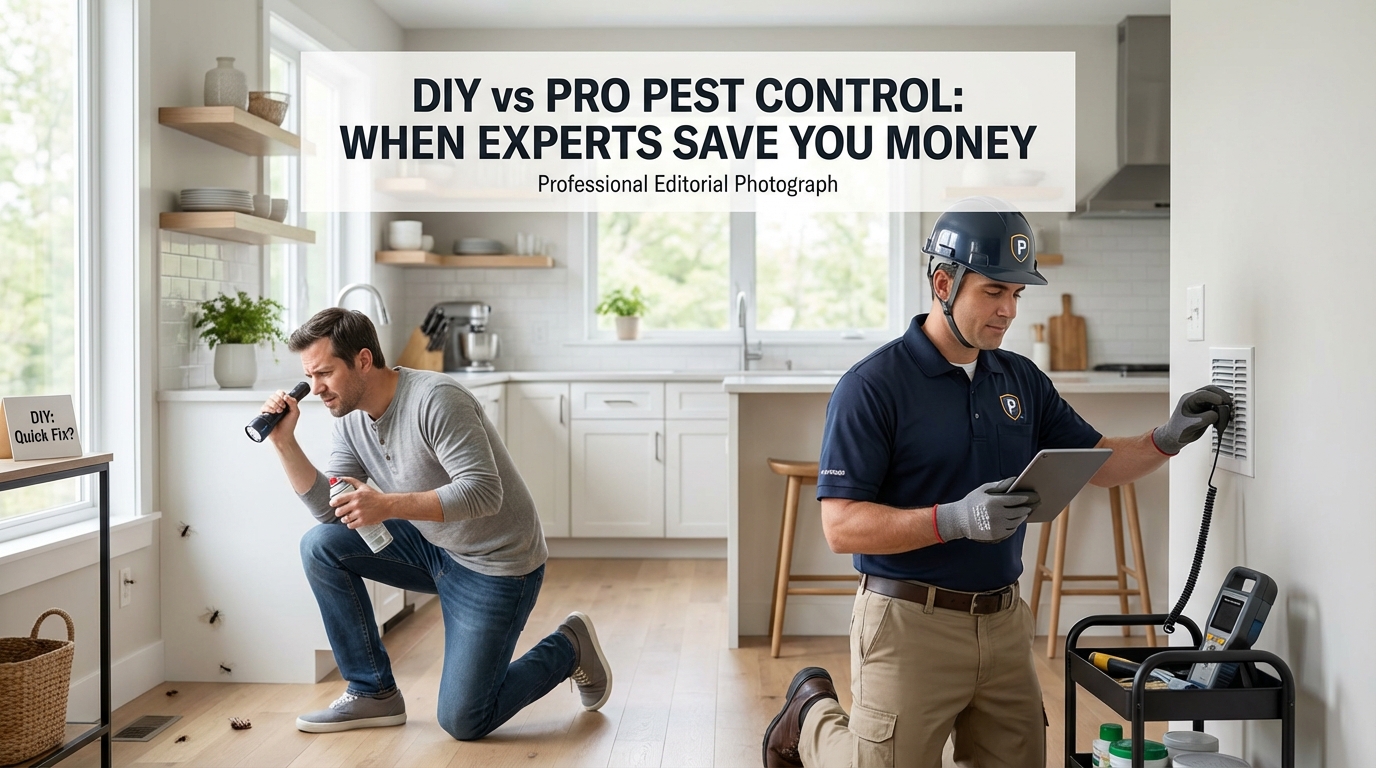
Learn when DIY pest control saves money vs when pros prevent costly damage. Expert guide covers real costs, safety risks, and warning signs.
Key Takeaways
- **Occasional Ants (The Scouters, Not the Army):** Light ant trails near doorways or windows, especially during certain seasonal shifts, can often be managed with readily available baits and barrier sprays. We're talking about seeing a few scouts, not a marching column ready to invade your pantry. For deeper insights into common ant species and their habits, including how to differentiate a solitary explorer from a full-blown colony, refer to our definitive guide on [Understanding Ant Behavior and Control](/blog/understanding-ant-behavior-and-control). Don't just spray; observe where they're coming from.
- **Fruit Flies (The Kitchen Nuisance):** You've got a handful of fruit flies buzzing near the sink? Nine times out of ten, they're breeding in that overripe banana you forgot about or that gross residue in your garbage disposal. Get rid of the food source. Clean out the drains. Set up those cheap apple cider vinegar traps — they work. Just move fast, because these things breed like crazy. What's ten flies today becomes two hundred by Friday.
- **Isolated Spiders (The Non-Threatening Resident):** One or two spiders hanging out in the corner of your basement? That's normal. Grab a broom, knock down the web, relocate the spider outside (or vacuum it up, I won't judge). Just make sure you're not dealing with black widows or brown recluse spiders. Those aren't DIY types. Your safety isn't something to gamble on.
- **Single Mouse Sightings (The Rare Intruder):** An isolated mouse, a true rarity, *might* be caught with snap traps or strategically placed bait stations before a larger infestation establishes. But here's the catch: persistent sightings, droppings popping up in multiple locations, or signs of gnawing? That's a huge red flag. It almost certainly means there's a larger, established population in residence, making it way past DIY capabilities.
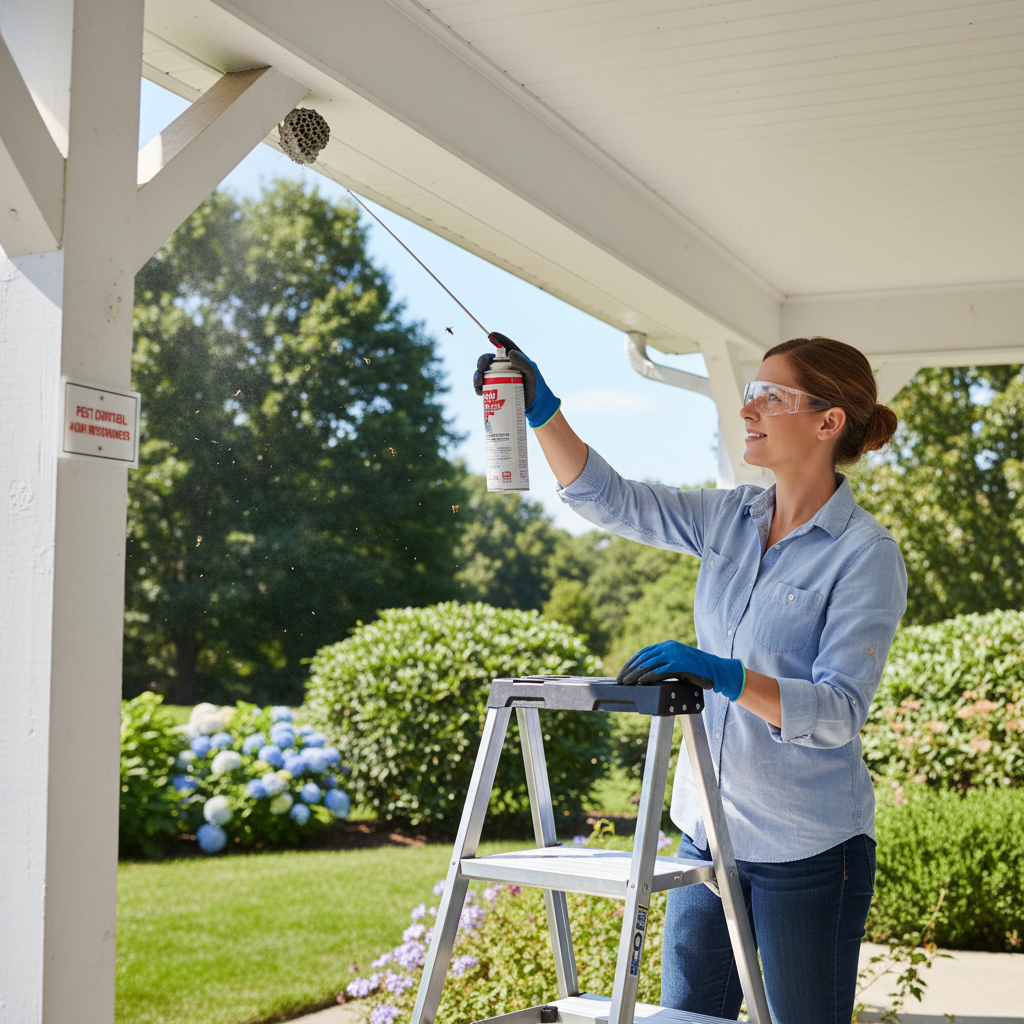
- **Small, Accessible Wasp Nests (Proceed _Extremely_ Carefully!):** A small, newly formed wasp nest—think the size of a golf ball or lemon—that can be safely reached and treated with a specialized aerosol spray *from a distance*, ideally at dusk when wasps are least active and most are inside the nest. I once saw a homeowner in Maple Grove try to knock down a softball-sized hornet nest with a garden hoe. Bad idea. He got stung a dozen times, ended up in urgent care, and we still had to come out anyway to deal with the now-enraged colony. Never attempt to remove a large, established, or highly active nest yourself. That's just asking for trouble.
Key Takeaways
DIY vs. Professional Pest Control: Maximizing Savings and Effectiveness
You see a few ants, grab some spray from the store, problem solved — right?
Not always.
Look — at BizzFactor, we handle over 500 service calls monthly, and I can't tell you how many times we've walked into a house where a $50 DIY attempt turned into a $1,200 nightmare. Some minor pest issues? Yeah, you can handle those yourself. But others — the ones that make contractors like me sweat — require expert intervention to prevent serious damage and health risks. This guide breaks down precisely when to tackle pests yourself and when calling the pros becomes not just smart, but financially imperative for protecting your biggest investment.
When DIY Pest Control is a Viable Option: Small Scale, Big Caution
Look — minor pest problems — the kind you catch early, in one spot — sometimes respond fine to store-bought solutions. Emphasis on *sometimes*. DIY can save you money and get you results fast if you're dealing with something small and contained. But you've gotta know where the line is.
When might DIY actually work (and I mean *might*):
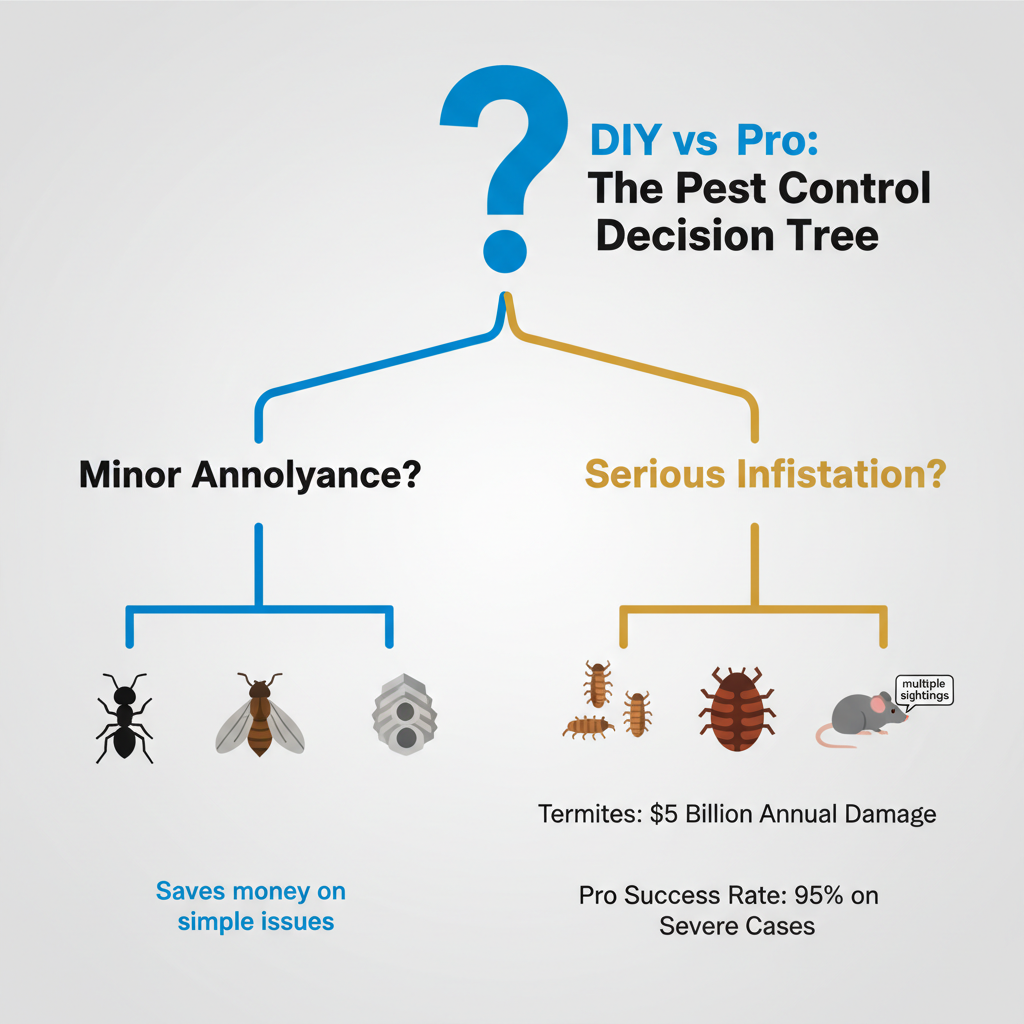
- **Occasional Ants (The Scouters, Not the Army):** Light ant trails near doorways or windows, especially during certain seasonal shifts, can often be managed with readily available baits and barrier sprays. We're talking about seeing a few scouts, not a marching column ready to invade your pantry. For deeper insights into common ant species and their habits, including how to differentiate a solitary explorer from a full-blown colony, refer to our definitive guide on [Understanding Ant Behavior and Control](/blog/understanding-ant-behavior-and-control). Don't just spray; observe where they're coming from.
- **Fruit Flies (The Kitchen Nuisance):** You've got a handful of fruit flies buzzing near the sink? Nine times out of ten, they're breeding in that overripe banana you forgot about or that gross residue in your garbage disposal. Get rid of the food source. Clean out the drains. Set up those cheap apple cider vinegar traps — they work. Just move fast, because these things breed like crazy. What's ten flies today becomes two hundred by Friday.
- **Isolated Spiders (The Non-Threatening Resident):** One or two spiders hanging out in the corner of your basement? That's normal. Grab a broom, knock down the web, relocate the spider outside (or vacuum it up, I won't judge). Just make sure you're not dealing with black widows or brown recluse spiders. Those aren't DIY types. Your safety isn't something to gamble on.
- **Single Mouse Sightings (The Rare Intruder):** An isolated mouse, a true rarity, *might* be caught with snap traps or strategically placed bait stations before a larger infestation establishes. But here's the catch: persistent sightings, droppings popping up in multiple locations, or signs of gnawing? That's a huge red flag. It almost certainly means there's a larger, established population in residence, making it way past DIY capabilities.
- **Small, Accessible Wasp Nests (Proceed _Extremely_ Carefully!):** A small, newly formed wasp nest—think the size of a golf ball or lemon—that can be safely reached and treated with a specialized aerosol spray *from a distance*, ideally at dusk when wasps are least active and most are inside the nest. I once saw a homeowner in Maple Grove try to knock down a softball-sized hornet nest with a garden hoe. Bad idea. He got stung a dozen times, ended up in urgent care, and we still had to come out anyway to deal with the now-enraged colony. Never attempt to remove a large, established, or highly active nest yourself. That's just asking for trouble.
Yeah, you'll save money if you catch it early — maybe $100, maybe $300. Depends. A homeowner in Edina spotted a handful of carpenter ants near his deck last spring, applied some Terro bait stations he grabbed at Menards for like twelve bucks, sealed up the gap they were using, done. Whole thing cost him maybe twenty minutes and that $12. Perfect scenario. But that's the exception. Most people wait too long, misidentify the problem, or use the wrong product entirely.
Essential Safety Measures for DIY Pest Control: Non-Negotiable Rules
Read the label.
Here's the thing: seriously — all of it. Every single word, front and back, because that's where they bury the important warnings about whether you're about to poison your dog or melt your lungs. Don't mix products (people think combining two pesticides makes some kind of super-killer — it doesn't, you're just creating a toxic cocktail you don't understand). Wear gloves. Wear safety glasses if it's a spray. Mask up if the label says respirator recommended.
Store everything in the original container — not an old Gatorade bottle, not a mason jar with a Sharpie label. Somewhere locked, cool, dry, away from kids and pets. We've gotten panicked calls from parents whose toddler drank ant bait because Dad transferred it to an unmarked cup and left it under the sink.
This stuff will hurt you if you're careless.
⚠️ The Most Common and Destructive DIY Pest Control Mistake
So you've got ants. You buy a gallon of perimeter spray. You soak the baseboards, the doorways, maybe even spray a little extra "just to be sure." Problem solved, right?
Wrong. Dead wrong.
You just made it worse. Way worse.
Heavy, broad-spectrum sprays don't kill the colony — they scatter it. Ants retreat deeper into wall voids, attics, crawl spaces. You've essentially built them a protected highway system inside your home's structure where they can breed undetected. Our BizzFactor professionals often spend hours locating these hidden, entrenched infestations, turning what could've been a straightforward $200 localized treatment into a complex, multi-day, $800+ remediation. A contractor in Bloomington did exactly this last summer — sprayed Ortho Home Defense around his entire foundation. Two months later, he's got ants in three different rooms, none of them near the original entry point. We had to drill into walls to find the satellite colonies. It gets exponentially more difficult and expensive to fix at that point.
Don't create an underground railway for them.
Expert Tip: The Science of Scout Ants, Don't Destroy Your Intelligence
Here's what we do on every inspection: we watch the ants. Don't kill them right away. Follow the trail. Those little scouts leave chemical breadcrumbs that'll lead you straight to the entry point — sometimes even the nest location. That's intelligence you can't buy. Spray too early and you erase that trail. Now the ants panic, scatter, establish new routes you'll never find. You've basically destroyed your own evidence and made our job (and your problem) ten times harder.
Long-Term Pest Prevention: Beyond Chemicals, Into Exclusion
Here's the thing: keeping pests out long-term? Chemicals aren't the answer — exclusion is. Seal 'em out before they get in. Foundation repair companies like A-1 Concrete handle the big structural gaps (which absolutely matters for bugs coming up from below), but we also recommend ROCKWOOL insulation during any remodel or new construction. Rodents literally can't chew through it — the stone wool fibers are too dense — and insects won't nest in it because there's nothing to eat. It basically turns your wall cavities into dead zones for pests. Up-front cost, but it pays off. For more on keeping your foundation tight (which directly affects pest entry), check out our article on [Foundation Repair: What Homeowners Need to Know](/blog/foundation-repair-what-homeowners-need-to-know).
Red Flags: When to Immediately Call Professional Pest Control Services
Some problems you don't DIY first "just to see what happens."
You call a pro today. Right now. Before this turns into a five-figure disaster.
Now, the money you save skipping a $150 service call? That becomes $5,000 in structural repairs eight months down the road when the damage finally shows itself. I've seen it dozens of times. The homeowner always says the same thing: "I thought I could handle it." They couldn't.
Structural Damage: A Critical and Often Silent Threat
Termites — usually the subterranean kind we get around here, *Reticulitermes flavipes* if you want to get technical — they'll hollow out your floor joists while you're upstairs wondering why the hardwood feels a little spongy. By the time you spot mud tubes climbing your foundation or find piles of discarded wings near a window after spring swarming season, they've been there for months. Could be years.
The damage? Around $5 billion annually across the U.S., according to EPA estimates. And guess what your homeowner's insurance covers? Nothing. Zilch.
You need professional-grade termiticides — fipronil, imidacloprid, stuff like that — applied with commercial pump sprayers and soil injection rods. You need someone who knows where to drill, how deep to trench, what concentration actually works. You can't buy this stuff at Home Depot, and even if you could, you don't have the equipment or the training to use it correctly. Explore our [Termite Control Services](/services/termite-control) for solutions that actually come with a warranty. This genuinely isn't something to mess around with.
Now carpenter ants — *Camponotus pennsylvanicus*, the big black ones, sometimes with reddish coloring — they don't eat wood like termites do, but they carve out smooth tunnels and galleries to build nests. End result's the same: hollowed-out beams, weakened supports, structural failure waiting to happen. You'll see large ants (maybe half an inch long) and piles of sawdust-like frass that looks like somebody's been sharpening pencils inside your wall. They love moisture-damaged wood.
I've seen deck collapses in St. Paul. Compromised floor joists in Minneapolis. One guy in Highland Park ignored the signs for three years — said he thought it was just "regular ants" — and ended up with $4,200 in beam replacement costs because the colony had excavated so much material the wood literally couldn't support weight anymore.
Both of these — termites, carpenter ants — stay hidden until the damage is severe. You need professional inspection before something catastrophic happens.
Health Threats Requiring Expert Handling: Beyond a Nuisance
Paper wasps, yellow jackets, hornets near your front door or kids' play area? That's not a Saturday afternoon project. Yellow jacket nests can hold tens of thousands of insects. They defend aggressively. One sting's annoying; twelve stings can send you to the ER if you're allergic (and plenty of people don't know they're allergic until it's too late). Our certified technicians show up in full bee suits, respirators, specialized removal gear you don't own and shouldn't buy. Learn more about our [Wasp and Hornet Removal Services](/services/wasp-hornet-removal).
This isn't a job for shorts and a t-shirt.
**Rodent infestations** — house mice, Norway rats, whatever's gnawing through your drywall at 2 AM — they're disease vectors. Hantavirus, salmonella, leptospirosis. They contaminate food
In-Depth Look
Detailed illustration of key concepts

Visual Guide
Infographic illustration for this topic
Side-by-Side Comparison
Visual comparison of options and alternatives

Sources & References
- DIY vs. Professional Exterminator: When to Get Help | Ehlers
- DIY Pest Control vs. Hiring a Professional: Which is Best For You?
- Do It Yourself Pest Control vs. Professional Pest Control Services
- Tips for Selecting a Pest Control Service | US EPA
- Building Codes, Standards, Regulations: FAQs
- Building Codes and Standards - 101 Guide | ROCKWOOL Blog
- [PDF] Building Codes Toolkit for Homeowners and Occupants - FEMA
- 5 Reasons Building Codes Should Matter to You
- Model Building Codes - Smart Home America
Frequently Asked Questions
Need Professional Help?
Find top-rated pest control experts in your area