
Expert guide to safe pest control for babies, toddlers & pregnant moms. Proven chemical-free methods from certified professionals. Protect your family today.
Key Takeaways
- Minor ant trails that respond to cleaning and sealing entry points
- Occasional spider sightings (just relocate them outside)
- Fruit flies from overripe produce (clean up, problem solved)
- Active cockroach infestation (especially German cockroaches — those things breed like crazy)
- Rodents inside your walls or attic
Key Takeaways
Safe Pest Control for Babies & Pregnant Moms: What Actually Works
A contractor in Buckhead told me about a frantic call he got at 11 PM. New parents, three-week-old baby, cockroaches crawling across the nursery floor. They'd sprayed something themselves earlier that day — something that reeked of chemicals — and now the mom was crying, convinced she'd poisoned her own kid.
That's the nightmare, right?
Look — when you're pregnant or you've got an infant at home, suddenly every decision about pest control feels like you're walking through a minefield. One wrong spray and you're picturing birth defects or respiratory problems. At BizzFactor, we get these calls constantly. So here's what actually works — the real strategy for keeping pests out without turning your nursery into a chemistry lab.
Why This Actually Matters (And Why Most Pest Control Is Dangerous for Babies)
Look, traditional pest control is built around chemicals. Strong ones. The kind that'll drop a roach in thirty seconds flat but also come with warning labels that read like horror novels.
Here's the problem: babies and fetuses are sitting ducks. Their immune systems haven't booted up yet. Their organs are still in beta testing. And because their body mass is so small, even tiny chemical exposures hit them way harder than they'd hit you or me. Plus — and this is the kicker — babies spend their entire day doing exactly what you don't want them doing during chemical treatment: crawling around on floors, putting their hands in their mouths, breathing air that's two feet off the ground where pesticide particles settle.
The research on this stuff is genuinely disturbing. Low-level pesticide exposure has been linked to developmental delays, cognitive issues, asthma (or making existing asthma way worse), and endocrine disruption. For pregnant women? We're talking potential impacts on fetal brain development, birth weight, the whole nine yards.
That's why we don't do traditional pest control for these homes. Period.
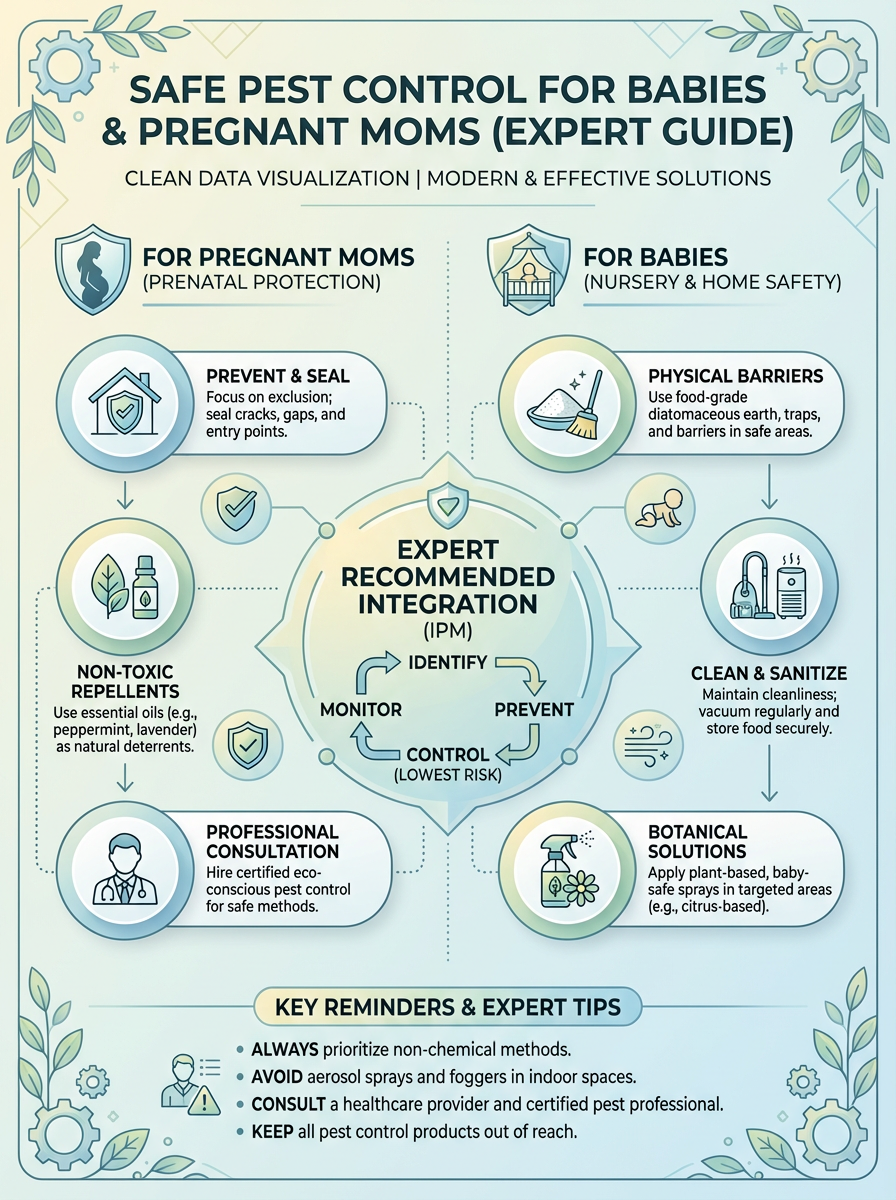
We use what's called Integrated Pest Management (IPM) — which basically means we treat pests like a home invasion problem, not a chemical warfare situation. Prevention first. Monitoring second. Targeted, minimal treatments only when absolutely necessary. Safety isn't negotiable.
Why Babies Are Especially Vulnerable (The Science Part, But Quick)
Here's the thing: a baby's liver can't process toxins the way yours can. Chemicals that you'd flush out in a day might linger in their system for a week. Their skin? Thinner, more permeable — basically absorbs stuff like a sponge. And the developing fetal brain is insanely sensitive to neurotoxins. Even trace amounts of certain chemicals can mess with neural pathways in ways that don't show up until years later.
I've seen studies where exposure levels considered "safe" for adults caused measurable cognitive delays in kids. That's terrifying.
So yeah — we take zero chances. Our approach is designed to sidestep these vulnerabilities entirely.
How BizzFactor Actually Does This (The Real Process)
This isn't marketing fluff. This is the literal playbook we use.
Step 1: Figure Out What's Actually Happening (Before We Touch Anything)
You can't fix what you don't understand.
Every single family-safe pest control plan starts with us sending a certified tech to your home for what we call a "forensic inspection." They're not just looking for bugs — they're investigating *why* you have bugs. What species? Where are they coming from? What's attracting them? What structural issues are letting them in?
Now, we use moisture meters to find hidden water damage (cockroaches love moisture). UV lights to spot rodent urine trails. Bore scopes to peek inside wall voids without tearing anything apart. Thermal cameras to detect temperature anomalies that might indicate nests or entry points.
A tech we work with in Portland found a massive carpenter ant infestation that traced back to a roof leak the homeowners didn't even know they had. It was a pinhole-sized opening that you couldn't see unless you stuck your head in the attic with a flashlight. Without that level of detail, any treatment would've been a Band-Aid.
The point? The more we know, the less we have to spray. That's always the goal.
Step 2: Seal Everything (The Best Pesticide Is a Wall)
Real talk — the most effective pest control method is keeping them out in the first place.
We go absolutely bananas on exclusion work. Think of it like baby-proofing, but for bugs and rodents. Our techs seal every crack, gap, and opening they can find. Foundation cracks (even hairline fractures). Gaps around pipes and wires. Spaces under doors. Holes in window screens. Brick weep holes. Siding gaps.
We use commercial-grade silicone caulk that'll last twenty years. Copper mesh for bigger holes (rodents can't chew through it, and it won't rust). Expanding foam specifically designed for pest exclusion — the kind without VOCs that might off-gas into your nursery.
Here's something most people don't know: a mouse can squeeze through a gap the size of a dime. A quarter-inch opening. Ants need even less — we're talking millimeters. So when we say "seal everything," we mean *everything*.
So — door sweeps? We install heavy-duty aluminum or vinyl ones with rubber seals that actually touch the threshold. Weatherstripping? EPDM rubber or silicone — the stuff that doesn't crack in winter or melt in summer. Window screens? We patch or replace any with tears, using 18x16 weave mesh that stops even tiny insects.
I heard about a house in Phoenix where rodents kept getting in despite multiple treatments. Turned out the garage door seal had basically disintegrated from the desert heat. Forty-dollar fix, problem solved permanently.
Don't underestimate a good seal.
Step 3: Dry Everything Out (Pests Love Moisture More Than Food)
Cockroaches, silverfish, termites, ants — they all need water. Some species can survive weeks without food but only days without moisture.
So we help you eliminate their water sources. Fix plumbing leaks (even a single drip sustains insect populations). Improve ventilation in bathrooms, crawl spaces, basements. Install dehumidifiers if needed. Make sure gutters drain away from your foundation (water pooling within ten feet of your house is basically a pest welcome mat).
We had a client in Atlanta who couldn't figure out why she kept seeing silverfish in her baby's room. Turns out there was condensation forming inside an exterior wall because the insulation had settled. That's the real issue. Once we fixed the moisture issue and sealed the wall penetrations, the silverfish disappeared in two weeks. No chemicals.
A dry home is an inhospitable home for pests. Simple as that.
Step 4: Starve Them Out (Sanitation Is Boring But It Works)
Pests need food. If you deny them food, they leave or die.
We give you specific recommendations: airtight containers for all pantry items (glass or heavy plastic with gasket seals). Immediate cleanup of spills and crumbs. Daily trash removal with sealed bins. Weekly deep cleaning under appliances and furniture where crumbs accumulate.
This sounds obvious, but here's the thing — a single breadcrumb can feed dozens of ants for hours. A tiny grease splatter can sustain a cockroach colony. These pests are survival experts. They need shockingly little.
So yeah, you've gotta be diligent. Think of it like this: your home hygiene standards just went from "normal clean" to "obsessively clean" until the pest pressure drops.
Step 5: Targeted Treatments (Only When Absolutely Necessary, Only Outside)
Okay, so sometimes prevention isn't enough. You've got an active infestation that needs direct intervention.
Here's how we handle it differently:
**Exterior-Only Barrier Treatments**
We apply low-toxicity botanical products (pyrethrin-based — derived from chrysanthemums) or specific pyrethroids with low mammalian toxicity (like bifenthrin) exclusively to the outside perimeter of your home. Two to three feet out from the foundation, one to two feet up the walls. This creates an invisible barrier that stops pests before they get inside.
The key word? *Outside.* We're not spraying inside your nursery. We're not fogging your kitchen. We're treating the exterior so pests never make it through your doors.
**Crack-and-Crevice Applications (Precision Strikes)**
If we absolutely must treat indoors — and I mean *absolutely* must — we use targeted crack-and-crevice applications. We're talking about injecting gel baits or dust formulations (like diatomaceous earth or boric acid) directly into wall voids, behind baseboards, under appliances.
Not broadcast sprays. Not foggers. Pinpoint applications in areas babies can't access.
A family in Marietta had a German cockroach issue in their kitchen. We used gel bait stations placed inside the hinge areas of cabinets and behind the refrigerator — spots a crawling baby couldn't reach in a million years. Infestation gone in three weeks, zero exposure risk.
**Bait Stations (Tamper-Resistant, Pet-and-Kid-Safe)**
For rodents or certain ant species, we use enclosed, tamper-resistant bait stations placed in strategic locations (usually garage, attic, exterior). These are designed so kids and pets physically can't access the bait inside. They're locked, anchored, and positioned away from living spaces.
We prefer snap traps when possible (mechanical kill, zero chemicals), but sometimes bait is necessary. When it's, we use the safest formulations available and monitor them obsessively.
Step 6: Follow-Up Like Your Life Depends On It
We don't treat once and disappear.
Family-safe pest control requires ongoing monitoring. We schedule follow-up visits every 2-4 weeks during active treatment, then quarterly for maintenance. We adjust tactics based on what's working. We re-inspect exclusion work. We track pest activity trends.
Because here's the deal: pest control isn't a one-time event. It's a process. Especially with babies in the house, where "good enough" isn't acceptable.
What About Specific Pests? (The Ones You're Actually Worried About)
Let's get practical.
**Ants**
Exterior perimeter treatments with low-toxicity pyrethroids. Interior gel baits in crack-and-crevice placements. Exclusion work to seal entry points. Usually resolved in 2-3 weeks.
**Cockroaches**
Gel baits in targeted placements (behind appliances, inside cabinets, under sinks). Insect growth regulators (IGRs) that disrupt breeding without harming mammals. Aggressive sanitation and moisture control. Timeline: 4-8 weeks for German cockroaches, faster for American or Oriental species.
**Rodents**
Exclusion is king. Seal every opening larger than a quarter-inch. Snap traps in attics and garages. Exterior bait stations if necessary (but honestly, exclusion usually handles it). I've seen rodent problems solved in a week with good exclusion work — no poison needed.
**Termites**
This is trickier. We use liquid termiticides applied to soil around the foundation perimeter (exterior only). Bait stations for ongoing monitoring. Or — and this is often the best option for families — we recommend physical barriers like stainless steel mesh during construction or renovation.
Termidor (fipronil-based) is one of the safest and most effective termiticides when applied correctly by professionals. It's applied outside, in the soil, nowhere near your baby's crawl space.
**Bed Bugs**
Heat treatment is the gold standard for family-safe bed bug control. We bring in specialized equipment that raises room temperatures to 120-140°F for several hours, which kills bed bugs at all life stages without a single chemical.
If heat isn't an option, we use steam treatments and encasements for mattresses/box springs, plus targeted dust applications (diatomaceous earth) in cracks where bugs hide.
**Spiders**
Exterior perimeter treatments. Removal of webs. Sealing entry points. Honestly, most spiders are harmless and actually help control other pests, so unless you're dealing with black widows or brown recluses, we usually recommend tolerance.
What Products Are Actually Safe? (The Ones We Use)
You're probably wondering what we actually spray. Fair question.
**Pyrethrins** (natural, derived from chrysanthemum flowers)
Low mammalian toxicity. Breaks down quickly in sunlight. Effective against most crawling and flying insects. We use this for exterior barrier treatments.
**Pyrethroids** (synthetic versions of pyrethrins — bifenthrin, permethrin)
Low toxicity when used properly. Longer-lasting than natural pyrethrins. Applied exclusively to exterior surfaces, not interior living spaces.
**Boric Acid/Diatomaceous Earth**
Mechanical killers — they damage insect exoskeletons, causing dehydration. Low toxicity to mammals. We use these as dusts in wall voids and other inaccessible areas.
**Insect Growth Regulators (IGRs)** (like hydroprene or methoprene)
These disrupt insect development cycles. They don't kill adult insects quickly, but they prevent reproduction. Extremely low mammalian toxicity — some formulations are actually used in flea medications for pets.
**Gel Baits** (for ants and cockroaches)
Targeted placements mean minimal exposure. Modern formulations use ingredients like fipronil or indoxacarb, which are toxic to insects but have low mammalian toxicity when used in tiny, enclosed applications.
DIY vs. Professional: When to Call in the Pros
I get it — hiring a pest control company feels like overkill sometimes. Maybe you're thinking, "Can't I just buy some spray at Home Depot?"
Here's when DIY makes sense:
- Minor ant trails that respond to cleaning and sealing entry points
- Occasional spider sightings (just relocate them outside)
- Fruit flies from overripe produce (clean up, problem solved)
Here's when you absolutely need a professional:
- Active cockroach infestation (especially German cockroaches — those things breed like crazy)
- Rodents inside your walls or attic
- Termites (seriously, don't DIY termites)
- Bed bugs (heat treatment requires professional equipment)
- Any pest problem that persists after two weeks of DIY efforts
Look — the big difference? Professionals know how to identify the *source* of the problem, not just the symptoms. We have access to commercial-grade products that aren't available at retail. And we're trained to apply them safely in homes with vulnerable populations.
A guy in Decatur tried to handle a cockroach problem himself. Bought every spray he could find, fogged his whole house, then wondered why his pregnant wife started getting headaches and nausea. Turns out he'd overdosed his home with permethrin and didn't ventilate properly. Professional treatment would've cost $300. His medical bills and temporary relocation? Over $2,000.
Don't be that guy.
Questions You're Probably Asking
**"How long do I need to stay out of the house after treatment?"**
With our exterior-only approach? You don't. You can stay home the entire time. If we absolutely must do interior crack-and-crevice work, we typically recommend 2-4 hours of ventilation time, but that's being extra cautious.
**"Can I breastfeed after you've treated the house?"**
Yes. Our exterior treatments don't create any indoor exposure that would transfer to breast milk. If we do interior work, we ensure you're not in the treated area until it's completely dry and ventilated.
**"What if my baby crawls on treated surfaces?"**
With exterior-only treatments, this isn't a concern — we're not treating surfaces your baby touches. For any interior work, we use products that dry completely and bind to surfaces, preventing transfer to skin.
**"Are natural/organic pest control products safer?"**
Sometimes, but not always. "Natural" doesn't automatically mean "safe" — arsenic is natural. And some botanical pesticides (like rotenone) are actually *more* toxic than synthetic alternatives. We choose products based on actual toxicity data, not marketing labels.
**"How much does family-safe pest control cost?"**
Initial treatment typically runs $200-$500 depending on home size and pest type. Quarterly maintenance is usually $75-$150 per visit. Yes, it's more expensive than a $49 spray-and-pray service. But you're paying for precision, expertise, and peace of mind.
**"Will this actually work, or am I just paying for 'feel-good' pest control?"**
It works. IPM has decades of research backing it up. The difference is timeline — chemical-heavy approaches might show faster initial results, but they don't address root causes. Our approach takes slightly longer (sometimes) but provides permanent solutions without health risks.
The Bottom Line
Pest control when you're pregnant or have an infant at home doesn't have to be a choice between living with bugs or exposing your baby to chemicals.
There's a third option: intelligent, targeted, family-safe pest management that actually works.
It requires more expertise. More time. More attention to detail. But the payoff is a pest-free home without the nightmare scenarios that keep new parents up at night.
At BizzFactor, this is all we do. We've treated hundreds of homes with pregnant women and newborns. We know the protocols. We have the training. We obsess over safety margins.
And we sleep just fine at night knowing we're not putting babies at risk.
Here's the thing: if you're dealing with pests and you've got a little one on the way (or already here), give us a call. We'll walk you through exactly what we'd do for your specific situation — no pressure, no sales pitch, just honest answers.
Because Honestly,, your baby's health isn't negotiable. And neither is ours.
In-Depth Look
Detailed illustration of key concepts

Visual Guide
Infographic illustration for this topic
Sources & References
- Pest Control And Pregnancy | Dade Pest Solutions
- [PDF] integrated pest management - guide for family child care homes
- Pregnancy Safe Pest Control Services
- Can you spray your house for bugs when you're pregnant?
- How to Keep Your Family Safe During a Pest Control Treatment
- Building Codes, Standards, and Regulations: Frequently Asked ...
- Building Codes and Standards - 101 Guide | ROCKWOOL Blog
- [PDF] Building Codes Toolkit for Homeowners and Occupants - FEMA
- ICC - International Code Council - ICC
- [PDF] DESIGN GUIDELINES - Missouri Office of Administration
Frequently Asked Questions
Need Professional Help?
Find top-rated pest control experts in your area