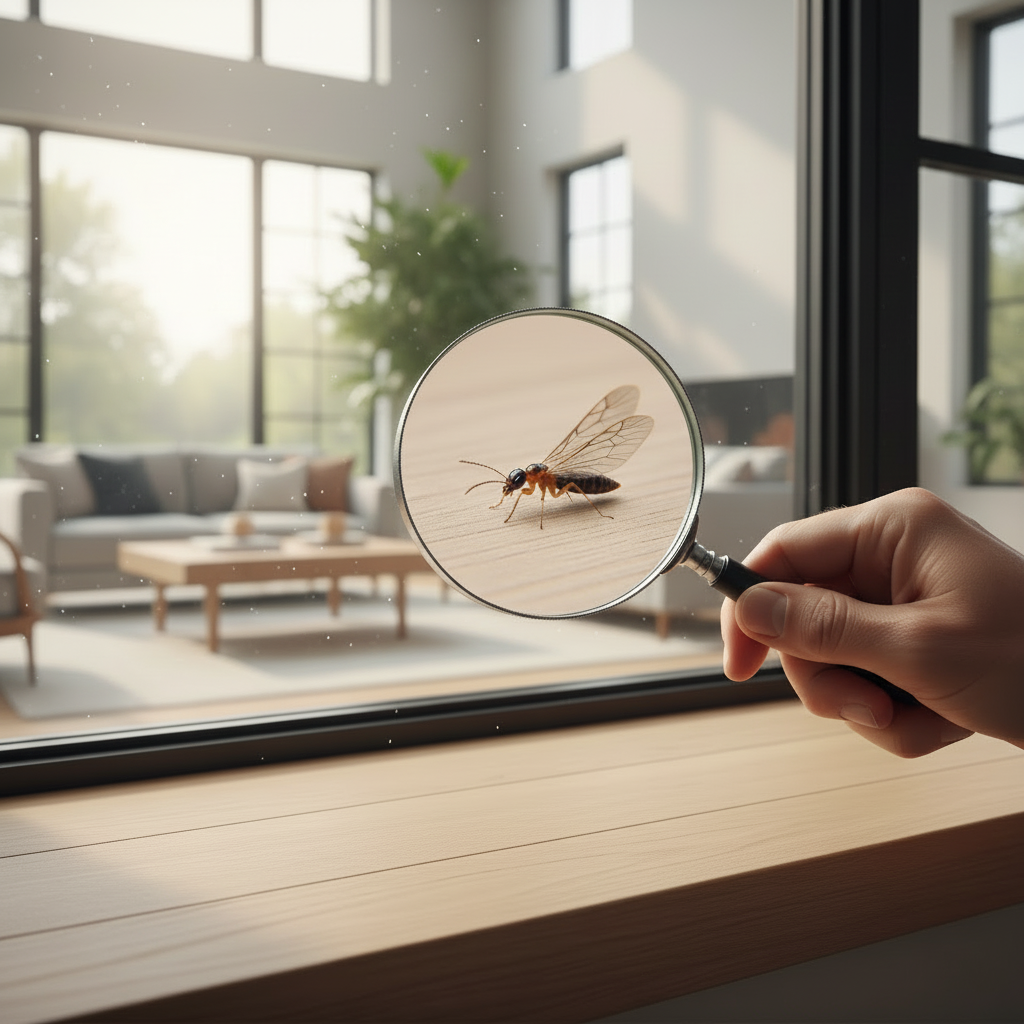
Identify termites vs. flying ants quickly! Learn key differences in wings, body, and antennae to prevent $15K-$25K in home damage. Act fast!
Key Takeaways
- Floor joist replacement: $8,500
- Foundation sill plate repairs: $6,200
- Structural reinforcement and sister joists: $2,800
- Our professional treatment: $1,200
- **Fix plumbing leaks the day you find them.** Not "this weekend," not "when the plumber has an opening." That day. Even a slow drip or pipe condensation can attract termites like crazy.
Key Takeaways
Termite vs. Flying Ant ID: Stop $18K+ Home Damage Fast
A homeowner in Cedar Park watched winged insects swarm around his patio light last March. "Just ants," he figured. Six months later, I walked through his crawl space and found floor joists so hollowed out I could push my thumb through them.
$18,700 in repairs. All because he guessed wrong.
Look — most people can't tell termites from flying ants—and that confusion costs North American homeowners over $5 billion annually. The average repair bill? Somewhere between $15,000 and $25,000. But here's the thing: you can learn to spot the difference in about 90 seconds.
Quick Identification: Termite vs. Flying Ant Differences
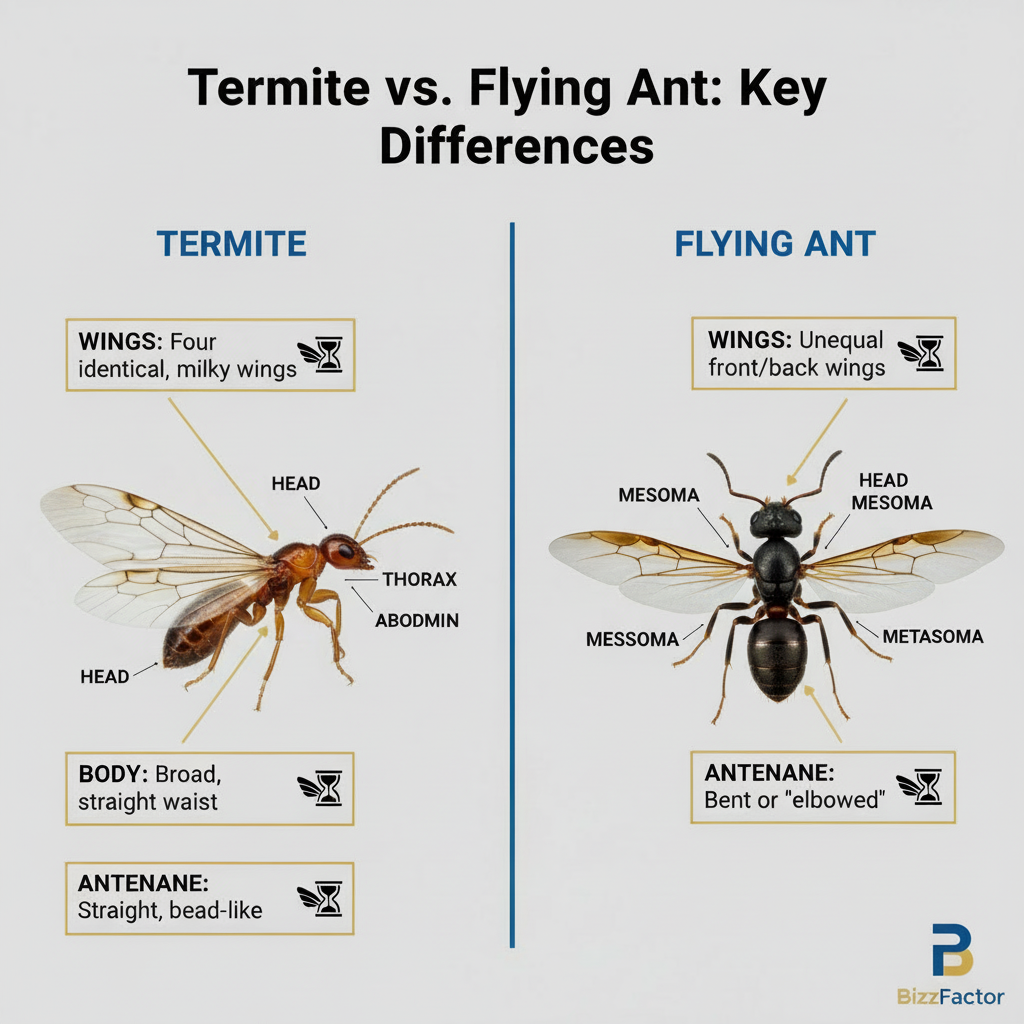
Look, I'm gonna make this stupid simple. You've got four things to check: wings, waist, antennae, and how they fly. That's it.
**Termites:** Four wings, all the exact same length. Thick waist (no "pinch" in the middle). Straight antennae that look like tiny beads on a string. They fly like drunk toddlers.
**Flying ants:** Front wings way bigger than back wings. Obvious pinched waist (think bodybuilder hourglass). Elbowed antennae with a sharp 90-degree bend. Strong, purposeful fliers.
Our crew has done north of 2,000 inspections in the past five years. I've personally pulled hundreds of specimens out of mason jars that panicked homeowners brought to our office. After two decades of this work, I can usually call it from across a room—but you don't need that kind of experience. You just need to know what you're looking for.
Wing Structure: The Primary Identification Mark
Here's your first checkpoint.
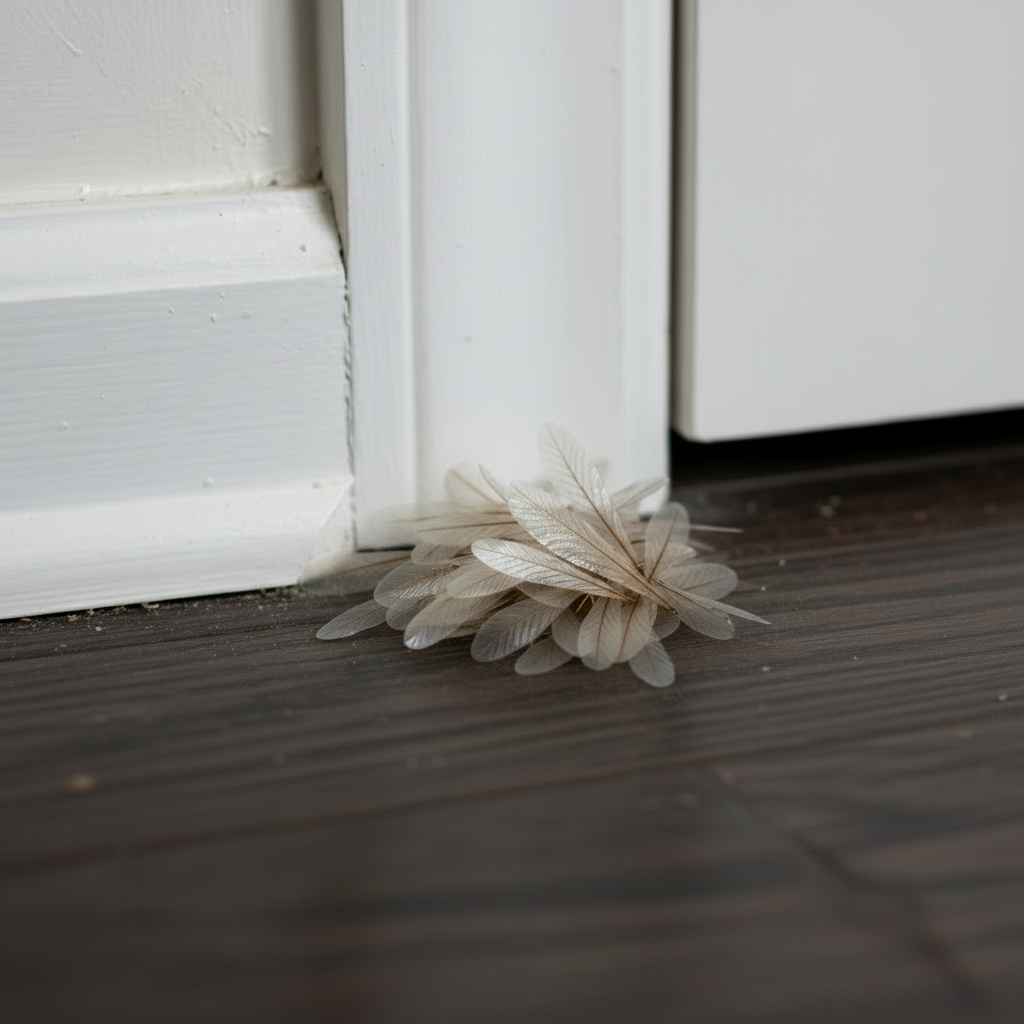
Here's the thing: termite wings look like four identical pieces of wax paper, all the same length. They're translucent, kinda milky-white, and super fragile. After termites swarm (usually to find a mate and start a new colony), they shed these wings fast—within hours. You'll find little piles of discarded wings near windows, door frames, or light fixtures. That's often your first clue there's a problem.
Flying ant wings? Totally different setup. The front pair is noticeably longer than the back pair—like, obviously longer, not some subtle difference you need a magnifying glass to spot. And they're tougher, more durable. Ants usually keep their wings for life unless they're dying.
I tell homeowners to imagine this: termite wings are like four identical playing cards laid side by side. Ant wings are like two credit cards with two business cards underneath. Once you see that mental picture, you won't unsee it.
Body Shape: Straight vs. Pinched
We call this the "tube test" (not an official entomology term—I just made it up because it works).
Could you slide the insect's body through a drinking straw without it getting stuck? If the answer is yes, you're probably looking at a termite. Their bodies are straight tubes, uniform thickness from head to tail. No waist, no curves, no narrowing anywhere.
Flying ants have that classic "hourglass" shape. Wide thorax up top, crazy narrow waist in the middle (technically called a petiole, but who cares), then a fatter abdomen at the back. It's really obvious once you know to look for it. They've got curves. Termites don't.
Antennae: Straight Lines vs. Elbows
Last physical identifier: antennae.
Termites have straight, beaded antennae. They're short, stubby, and look like someone strung tiny pearls on a thread. No bends, no elbows.
Ant antennae bend sharply in the middle—like a human elbow. Usually at a 90-degree angle, sometimes a bit less. You can spot this with the naked eye if the lighting's decent.
Behavioral Differences: Termites vs. Flying Ant Swarmers
Okay, so maybe you didn't get a great look at the wings or antennae. Watch how they move.
Termites are *terrible* fliers. Like embarrassingly bad. They wobble through the air, crash into walls, bounce off windows, and generally look like they have no idea what they're doing. Because they don't. Most of them ditch their wings within a couple hours and disappear into cracks to start nesting.
That's the real issue—those piles of shed wings. If you sweep up a bunch of translucent wings near your back door or garage, you need to assume termites until proven otherwise. For more on what happens during these swarms, check out our guide on [Understanding Termite Swarms](/blog/understanding-termite-swarms).
Flying ants? They're actually good at flying. Strong, controlled, purposeful movement. They keep their wings attached and don't leave piles of debris everywhere (unless they're old and dying, which is rare indoors).
Now, a guy in Plano called us last spring because he found "a bunch of ant wings" near his back door. He'd swept them up twice, figured it was no big deal. When we got there, those weren't ant wings—they were termite wings. Hundreds of them. We found an active colony destroying his floor joists. Cost him over $9,000 to fix, and that was *after* we caught it relatively early.
Don't guess on this stuff.
Swarming Season: When Do Pests Emerge?
Timing matters more than most people realize.
Termites swarm when it's warm, humid, and usually right after it rains. Peak season is late spring through early summer—April, May, June in most of Texas. Some species swarm in the fall, but if you see winged insects in May after a thunderstorm, bet on termites. That's the real issue. You can learn more about when different pests emerge in our [Seasonal Pest Control Guide](/blog/seasonal-pest-control-guide).
Flying ants prefer cooler temps. Late summer, early fall—August through October. They'll come out after rain too, but they don't need that oppressive humidity that termites love.
So if you see a swarm in early June on a muggy evening? Probably termites. If it's late September and cooling down? Probably ants.
(Probably. Which is why you should still get it checked.)
Case Study: The $18,000 Austin Termite Disaster
I mentioned this earlier, but let me give you the full story because it's a perfect example of how bad this can get.
Last March, a couple in South Austin noticed winged insects around their patio lights. The husband swatted a few, saw the pinched waist (or thought he did—lighting was bad), and decided they were "just carpenter ants." His wife wanted to call somebody. He said wait and see.
They waited six months.
When we finally got the call in September, I knew it was bad the second I opened their crawl space access. The smell alone told me we had a serious Formosan termite infestation—those things are absolute destroyers, way more aggressive than our native subterranean species.
The damage breakdown:
- Floor joist replacement: $8,500
- Foundation sill plate repairs: $6,200
- Structural reinforcement and sister joists: $2,800
- Our professional treatment: $1,200
**Total: $18,700.**
Here's what kills me—if they'd called us in March when they first saw the swarm, we could've treated the whole property for around $400-$600, tops. Preventative treatment, no structural damage, done in a day.
That's a $18,000+ lesson in why you don't guess on termite vs. flying ant identification.
Termite Damage Potential: What You Need to Know
Let's talk numbers for a second so you understand the stakes.
A mature termite colony—we're talking 300,000 to 1 million individual termites—can eat through 2-3 pounds of wood *per month*. That might not sound like much, but think about how much a 2x6 floor joist weighs. They can compromise serious structural elements in 3-6 months if left unchecked.
Flying ants? Minimal damage. Carpenter ants will hollow out galleries in wood to nest, but they don't actually *eat* the wood (termites do). The damage is mostly cosmetic. Annoying, sure, but not structural. Not a $15K problem. For prevention strategies, see our article on [Ant Control Solutions](/blog/ant-control-solutions).
There's no comparison in terms of destruction potential.
⚠️ Critical Mistake: Ignoring Outdoor Swarmers
Real talk—this is the mistake that costs people the most money.
Homeowners see a swarm of winged insects *outside* their house and think, "Well, at least they're not inside." Wrong. So, so wrong.
If termites are swarming in your yard, you already have an established colony on your property. And that colony is absolutely looking for a way into your house. They're not "just passing through." They're not "probably going to the neighbor's place." They're *right there*, and they're hungry.
Outdoor swarms are not near-misses. They're warnings.
Every single time we get called for an outdoor swarm and the homeowner says "I didn't think it was a big deal because they weren't inside," we find evidence of termite activity near the foundation within a week. Every. Single. Time.
Don't wait for them to get inside. That's like waiting for the fire to reach your bedroom before calling 911.
Our Expert Recommendation: ROCKWOOL and Borate-Treated Wood
FEMA and most building codes will tell you to use borate-treated wood in high-risk areas (which is good advice—the chemical treatment does deter termites). But after 20 years in this industry, I'm gonna give you a better answer.
Use borate-treated wood *and* ROCKWOOL insulation. Multi-layered defense.
So — here's why: termites literally can't eat ROCKWOOL. It's made from stone fibers. They can't chew it, can't digest it, can't tunnel through it. It's a permanent barrier that doesn't degrade, doesn't need retreatment, and creates an impenetrable zone in your walls. Plus it's moisture-resistant (termites hate that), fire-proof, and mold-resistant.
It's not cheap, but neither is replacing floor joists. We've started recommending ROCKWOOL in all crawl spaces and rim joist areas for new construction and major renovations. If you're concerned about foundation integrity as well, check out our [Foundation Repair Services](/services/foundation-repair).
What Other Guides Often Omit
Here's something nobody tells you: when you see a winged insect, your first instinct is to smack it. **don't do this.**
I can't identify a crushed termite. Nobody can. Even under a microscope, a smashed specimen is basically useless—wings destroyed, body parts separated, all the key identification features obliterated.
Catch them alive if possible, or at least intact. Use a jar, a plastic bag, a Tupperware container, whatever. Seal it up. That intact specimen could save you thousands in misdiagnosis and wasted treatment.
Sounds simple, but probably 40% of the samples people bring to our office are unusable because they've been squished, sprayed, or swept up with a broom.
Action Protocol: What You Find Winged Insects
Okay, you spotted winged insects. Here's exactly what to do, in order:
**1. Collect specimens immediately.** Jars, Ziploc bags, whatever's handy. Get several if you can—different specimens sometimes show features more clearly.
**2. Document everything.** Write down (or type in your phone): exact location (which window, which room, inside or outside), what time you saw them, weather conditions (humid? just rained? temperature?). This stuff helps with species ID.
**3. Take macro photos.** Get your phone as close as it'll focus. Multiple angles—top view, side view, close-up of antennae if possible. These photos back up the physical specimens.
**4. Call a licensed professional within 24-48 hours.** Not next week. Not "when you get around to it." This is time-sensitive.
**5. Don't spray anything.** Pesticides destroy identification features and scatter the colony, making it way harder to figure out how bad the problem is.
We offer same-day response for emergency calls because we know how fast termite situations can escalate. We've got professional magnification equipment and species-specific ID keys—this isn't guesswork. Usually we can give you a definitive answer within 20 minutes of arriving on site.
Cost of Professional Assessment
Professional ID and inspection runs around $150-$300, depending on your location and property size.
I know what you're thinking: "That seems like a lot just to identify a bug." But consider the alternative. Either you spend hundreds on an unnecessary treatment (because you misidentified ants as termites), or you ignore a real termite problem that turns into a $15,000 structural repair.
Our inspectors have prevented, conservatively, over $2 million in unnecessary treatments or missed infestations in the past three years alone. That $200 inspection has a pretty strong ROI when you look at it that way. For more on why professional assessment matters, see our article on [The Value of Professional Pest Control](/blog/value-professional-pest-control).
DIY identification using Google Images? I've seen that go wrong more times than I can count. Online photos don't account for regional species variation, wing damage, or the dozen other factors that affect visual ID.
Don't gamble with this.
Effective Prevention Strategies
So, what if you want to avoid this whole mess in the first place? Smart move.
Number one thing—and I can't stress this enough—is **moisture control**. Termites need moisture to survive. If you eliminate water sources around your foundation, you eliminate most of your termite risk.
Here's what that looks like in practice:
- **Fix plumbing leaks the day you find them.** Not "this weekend," not "when the plumber has an opening." That day. Even a slow drip or pipe condensation can attract termites like crazy.
- **Ventilate crawl spaces and attics properly.** Air needs to move. Stagnant, humid air is termite heaven. We usually recommend powered vents or at minimum adding more passive vents to increase airflow.
- **Keep wood away from soil.** Building code says minimum 6 inches of clearance between any wood structural element and the ground. That's not a suggestion—it's the law for good reason. It breaks the termite highway from dirt to dinner.
- **Get annual inspections.** $150-$200 a year to catch problems early versus $15,000 to fix them later. I've done the math. The inspections win.
The International Residential Code mandates most of these moisture controls in high-risk areas. Our technicians (all background-checked, all licensed) follow IRC protocols as baseline, then usually add a couple extra steps based on your specific property conditions.
Legal Requirements for Termite Treatment
Quick sidebar on regulations, because this matters more than most people realize.
Look — california's Title 24 Code requires specific treatment protocols and detailed documentation for any termite work. Other states have similar rules. Licensed operators have to document every treatment, file it with the county, and keep permanent records.
The International Building Code says if you discover an active infestation, you're legally required to treat it immediately—you can't just "wait and see" or "deal with it next year." It's a structural integrity issue, and there's liability involved if you sell a house with known, untreated termite damage.
Our team handles all the compliance paperwork automatically. You don't have to think about it. We treat, we document, we file, done. It's part of the service.
The Bottom Line: Prioritize Professional ID
Don't guess. Seriously. I've been doing this for 20 years and I still pull out a magnifying glass and reference photos for some species. There's no shame in calling a pro.
Here's your takeaway: **Termites have four identical wings, straight beaded antennae, and a thick straight body. Flying ants have unequal wing lengths, elbowed antennae, and an obvious pinched waist.**
When in doubt, catch a specimen and call us. Same-day identification, 100% accuracy guarantee, and you'll sleep better knowing exactly what you're dealing with.
Your bank account will thank you.
In-Depth Look
Detailed illustration of key concepts
Visual Guide
Infographic illustration for this topic
Side-by-Side Comparison
Visual comparison of options and alternatives

Sources & References
- What's the importance of regular pest control services for ... - Quora
- [PDF] An offer you can't pass up. So snow won't slow you down.
- [PDF] World Wildlife Crime Report - Unodc
- Building Codes, Standards, Regulations: FAQs
- [PDF] CHAPTER 10 BUILDING-RELATED CODES - City of San Antonio
- Building Codes and Standards - 101 Guide | ROCKWOOL Blog
- [PDF] Building Codes Toolkit for Homeowners and Occupants - FEMA
- Codes & Ordinances - City of San Antonio
Frequently Asked Questions
Need Professional Help?
Find top-rated pest control experts in your area