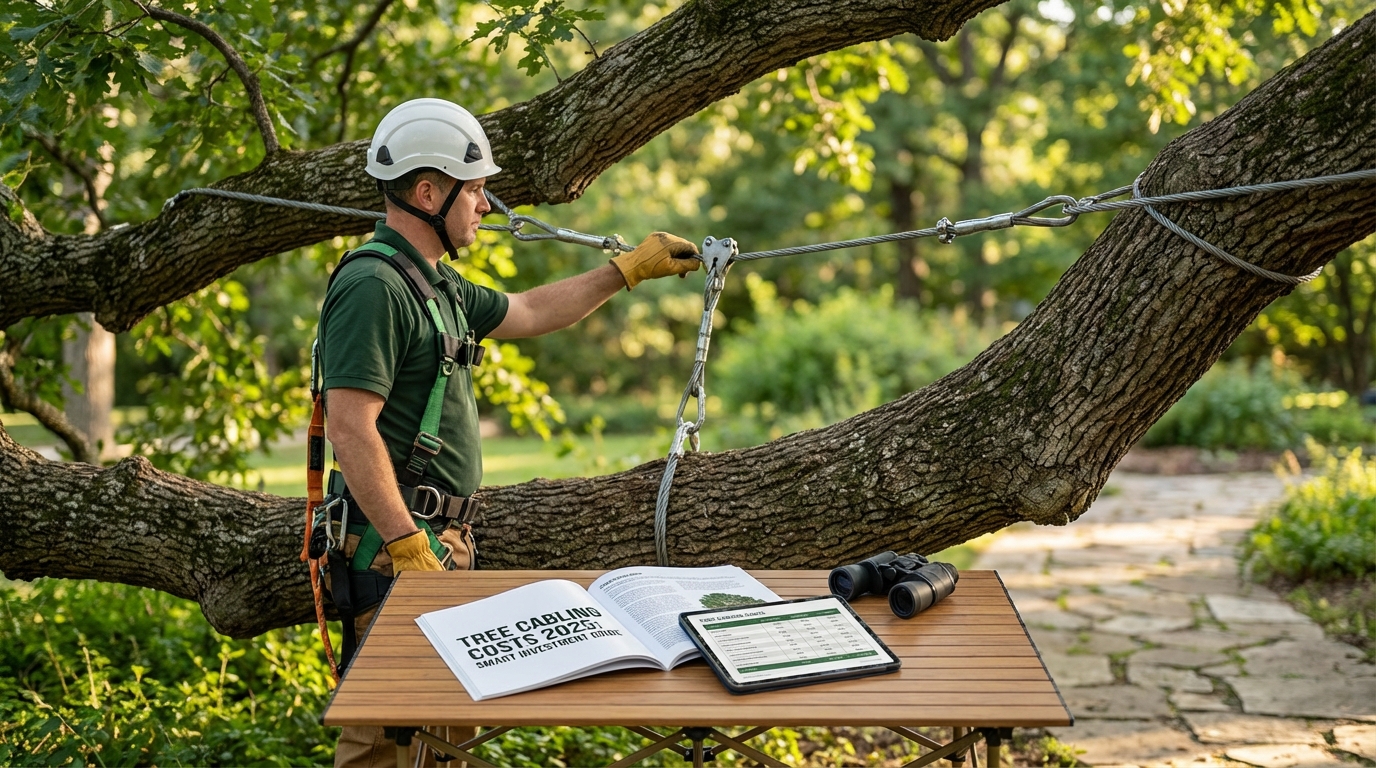
Tree cabling costs $300-800 but saves thousands in damage. Learn when this investment pays off from certified arborists with 20+ years experience.
Key Takeaways
- **The Species Matters**: Established hardwoods like oak, maple, elm — they respond incredibly well to cabling. Worth saving. Their growth patterns make them ideal candidates for **tree preservation** work. Not every tree is.
- **Location, Location, Location**: Got a tree hanging over your garage? Near power lines? High-traffic walkway? That's a risk multiplier during storms. Assessment first, **structural bracing** second. Don't gamble.
- **Structural Red Flags**: Weak branch unions, co-dominant stems (where two main trunks grow from one spot), existing splits — these aren't cosmetic issues. They're failures waiting to happen. One good windstorm and you're toast.
- **Heritage Value**: Some trees are irreplaceable. Historic specimens, trees that define your property's character, ones that took 80 years to grow — these often justify comprehensive support. (Check out our guide to [tree preservation strategies](link-to-tree-preservation-article) for more on this). You can't buy these at a nursery.
- **Basic Cable Installation**: **$300-$500** for single-point support. Good for minor weaknesses or preventative work on smaller trees. Think of it as insurance.
Key Takeaways
Tree Cabling Costs 2025: What You're Actually Looking At (And Whether It's Worth It)
Tree cabling runs between **$300 and $800 per tree** in most cases. Complex jobs? You might hit $1,500.
I get it. That's real money. But here's what I've seen after covering this industry for years — homeowners who skip this step end up paying way more when a limb crashes through their roof during a storm. Or worse, when the whole tree comes down.
Look — at BizzFactor, we're not saying throw money at every tree on your property. We're saying this: when you've got a valuable tree that's structurally sketchy, proper support is the smart play. Protects your investment. Keeps your house safe. And honestly? Usually cheaper than the alternative.
So When Does This Actually Make Sense?
Here's the calculation you need to make: Does the tree's value — aesthetic, shade, or actual dollar amount — beat the combined cost of removal plus the damage it could cause if it fails?
Our network of certified arborists? They consistently recommend support systems for mature trees worth **$5,000 or more**. Especially if they're anywhere near your house, deck, or power lines.
Real talk: that's where the math works in your favor.
I've been covering home services for over twenty years. The arborists I trust most? They look for these red flags:
- **The Species Matters**: Established hardwoods like oak, maple, elm — they respond incredibly well to cabling. Worth saving. Their growth patterns make them ideal candidates for **tree preservation** work. Not every tree is.
- **Location, Location, Location**: Got a tree hanging over your garage? Near power lines? High-traffic walkway? That's a risk multiplier during storms. Assessment first, **structural bracing** second. Don't gamble.
- **Structural Red Flags**: Weak branch unions, co-dominant stems (where two main trunks grow from one spot), existing splits — these aren't cosmetic issues. They're failures waiting to happen. One good windstorm and you're toast.
- **Heritage Value**: Some trees are irreplaceable. Historic specimens, trees that define your property's character, ones that took 80 years to grow — these often justify comprehensive support. (Check out our guide to [tree preservation strategies](link-to-tree-preservation-article) for more on this). You can't buy these at a nursery.
Trying to figure out if your tree qualifies? Get a professional tree risk assessment.
That's step one.
What You'll Actually Pay in 2025
Based on what I'm seeing from licensed professionals across the country, here's the breakdown:
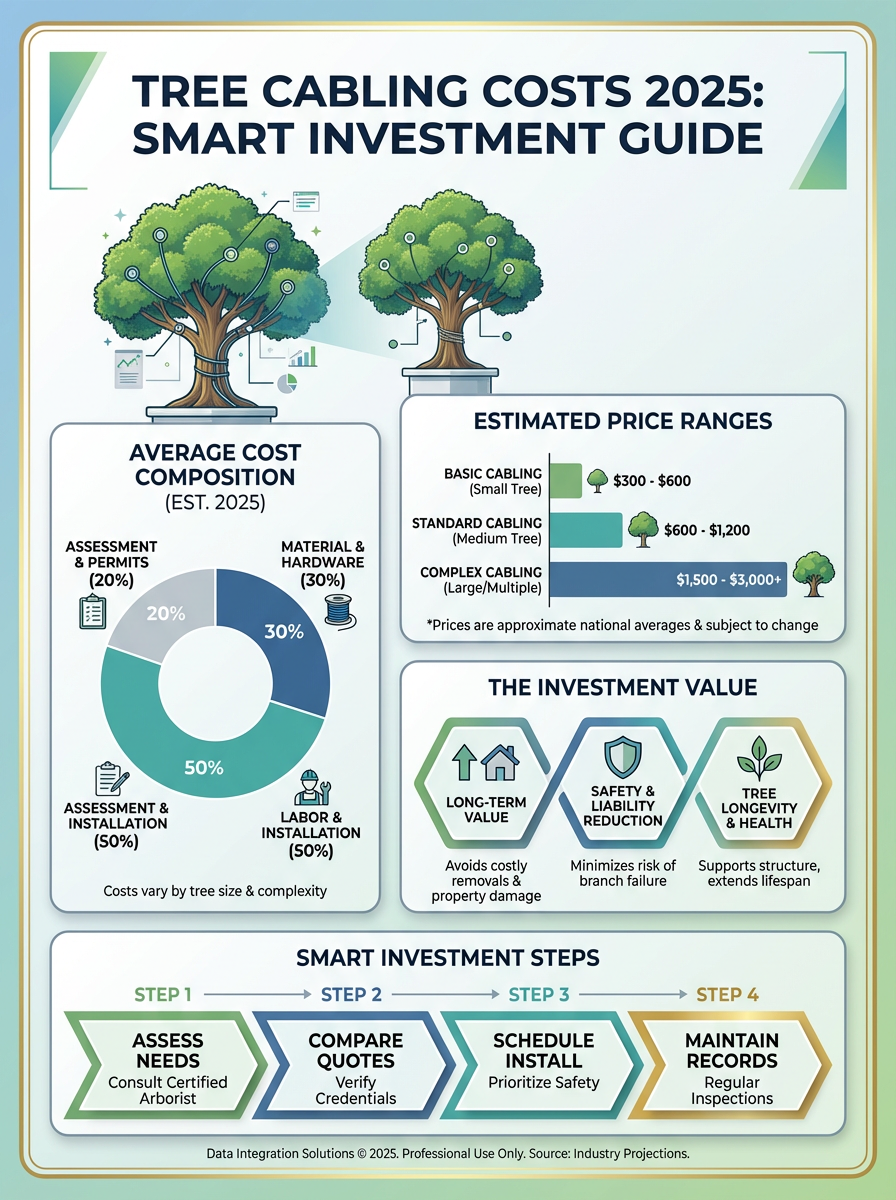
- **Basic Cable Installation**: **$300-$500** for single-point support. Good for minor weaknesses or preventative work on smaller trees. Think of it as insurance.
- **Multi-Point Systems**: Trees needing several support points or dynamic cabling (which lets the tree move naturally while providing backup) run **$800-$1,200**. More engineering needed.
- **Complex Jobs**: Large multi-stemmed trees, hard-to-reach locations, advanced bracing — you're looking at **$1,500+**. These projects need cranes, aerial lifts, custom engineering. Total production.
A contractor I know in Buckhead just finished a job on a massive 70-foot oak squeezed into a tight residential lot. Three-point dynamic system.
Final bill: $750.
The homeowner balked at first. Then the arborist walked him through the numbers — replacing a mature oak that size? Around $12,000 for a comparable specimen. Plus the removal cost of the existing tree. And that's not even counting potential damage to the house sitting twenty feet away.
Suddenly $750 looked pretty reasonable.
Here's What Most People Get Wrong: Maintenance
This drives me crazy.
Tree cabling isn't "set it and forget it." I see it constantly — cables installed and then never checked again. Know what happens? The cables can girdle branches as the tree grows. You end up with new failure points. Sometimes worse than the original problem.
**Get a written inspection schedule from your arborist.** Not optional.
The pros I trust recommend inspections every **3-5 years** minimum. After major storms? Check them immediately. Heavy snow, ice, high winds — any of these can shift the dynamics.
Skipping maintenance is like installing a sump pump and never testing it. When you need it most, it fails. (More on this in our article about [proactive tree maintenance tips](link-to-proactive-tree-maintenance-article)).
National Chains vs. Local Specialists: Which Should You Pick?
Think of it this way: big equipment manufacturers like Vermeer make incredible tools. But you still need a craftsman who knows how to use them.
National chains? They're fine for straightforward jobs. Standardized solutions, consistent pricing, efficient operations.
But for unique trees — heritage specimens, complex structural issues, high-value properties — I'd go local every time.
Why?
Regional experts understand your climate. They know which species handle ice storms. Which ones fail in your soil type. What local pests do to structural integrity.
They're not following a corporate playbook. They're engineering custom solutions.
A guy I talked to in Marietta handles historic oaks all over East Cobb. He's seen what works in Georgia red clay during summer storms. That knowledge? You can't get it from a training manual at a national chain's headquarters in Ohio.
For complicated trees, that local expertise matters.
Ask About This Before You Cable Anything
Here's a technique most homeowners have never heard of: **subordination pruning**.
Instead of installing hardware, you strategically reduce one of the competing stems in a co-dominant union. The tree responds by strengthening the remaining stem naturally. Basically training the tree to fix itself.
Does it work? Nine times out of ten, yeah.
I've watched arborists use this technique to eliminate the need for cabling entirely. Or at least delay it for years. The tree does the heavy lifting through its own biology.
Why don't more people know about this? Honestly, because hardware installation is more profitable for some companies. But the good arborists — the ones who care about long-term tree health — they'll always evaluate pruning first. (Further reading: [Understanding advanced pruning techniques](link-to-advanced-pruning-techniques-article)).
Let the tree solve its own problem when possible.
A Real Example: $750 That Saved Thousands
Suburban Atlanta, about two years ago. Sixty-year-old maple, gorgeous tree, major co-dominant stem issue.
Property value: $400,000. Tree hanging over the corner of the house.
The homeowner called our network. Quote came back: $750 for a three-point system.
His first reaction? "That seems high."
Here's what the arborist explained:
The tree provided roughly $8,000 in annual cooling benefits. Replacement value for a comparable mature maple? About $12,000. Removal of the existing tree? Another $2,500. The structural assessment showed a textbook co-dominant weakness — exactly the kind that fails during storms.
Do the math.
Not even close.
They installed a three-point galvanized aircraft cable system, rated for 1,500 pounds of dynamic loading. Proper tree-friendly hardware, thimbles, eye-bolts, the works.
Eighteen months later? Two severe storms ripped through the area. Trees down all over the neighborhood.
This maple? Didn't budge.
But here's the kicker — during an unrelated insurance review, the adjuster specifically noted the proactive cabling. It demonstrated due diligence. Protected the homeowner from liability. Preserved property value.
That $750 investment paid for itself several times over.
Let's Talk ROI (Because That's What Really Matters)
Beyond avoiding catastrophe, tree cabling delivers measurable returns. Here's how we break it down for clients:
**Costs You Avoid:**
- **Emergency Removal**: $800-$3,000 for large hazardous trees. That's minimum. (See [tree removal costs](link-to-tree-removal-costs-article) for details).
- **Stump Grinding**: Add another $200-$600. (Pricing details: [stump grinding services](link-to-stump-grinding-services-article)).
- **Replacement Tree**: $300-$2,000 for mature specimens. Can't replicate 50 years of growth overnight.
- **Debris Cleanup**: $200-$500 after a tree failure. Somebody's gotta haul that wood.
- **Property Damage**: This is the real killer. Roof repairs, vehicle damage, fence replacement — easily tens of thousands. I've seen $40,000 claims from a single tree failure.
**Long-Term Value:**
- **Property Value Bump**: Mature trees increase home value by 3-15%. Verified by multiple real estate studies.
- **Energy Savings**: $100-$400 annually in reduced cooling costs. Big shade trees are natural AC units.
- **Storm Damage Prevention**: Thousands saved in avoided repairs and insurance headaches. Your premiums thank you.
- **Liability Protection**: Peace of mind knowing you did your due diligence. Can't put a dollar figure on that.
- **Environmental Impact**: Better air quality, carbon storage, wildlife habitat. Good for the planet, good for your neighborhood.
Why DIY Tree Cabling Is a Terrible Idea
At BizzFactor, we see this way too often. Homeowner watches a YouTube video, buys some cable at the hardware store, climbs up with a drill.
Disaster.
Our certified arborists regularly get called to fix "DIY disasters" where improper installation made things worse. Created new hazards. Damaged the tree. Put people at risk.
Tree work is inherently dangerous. Period.
In-Depth Look
Detailed illustration of key concepts
Visual Guide
Infographic illustration for this topic
Sources & References
- What is Tree Cabling and When is it Necessary?
- Understanding Tree Cabling and Bracing - Hickman tree service
- The Importance of Tree Cabling and Bracing for Safety
- Understanding Tree Cabling and Bracing Techniques
- What Is Tree Cabling and Bracing - A Quick Guide - Boutte Tree
- Tree Care Industry - Standards | Occupational Safety and Health ...
- Top Commercial Tree Care Service Companies & How to Compare ...
- Tree Trimming Services in the US Industry Analysis, 2025 - IBISWorld
- How to Start a Tree Service Business in 2025 - GorillaDesk
- How to start a tree service business in 4 steps - NIP Group
Frequently Asked Questions
Need Professional Help?
Find top-rated tree service experts in your area