Quick Answer
Okay, so here's the quick-and-dirty. Your dryer's not heating? Nine times out of ten it's one of two things: a completely clogged vent line, which is dangerous, or a blown thermal fuse, which is a cheap part often triggered by that clogged vent. Before you panic, unplug the dryer, pull it out, and check that vent hose. If it's clean, you're probably looking at a bad part inside. A DIY fix for a fuse or element will run you maybe $10-120 in parts. If you call a professional, you're looking at $150-350 depending on what's busted. But for God's sake, check the vent first.
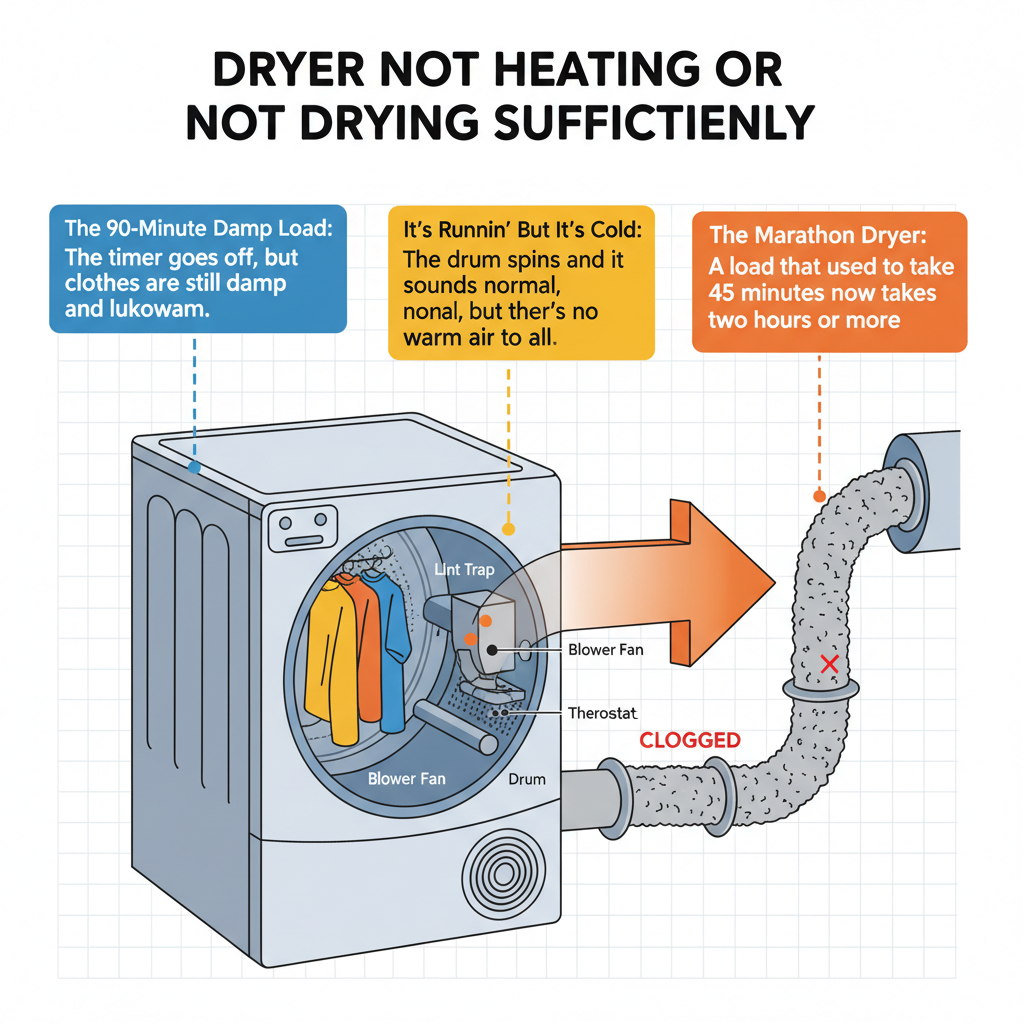
Common Symptoms
Possible Causes
Step-by-Step Diagnosis
Step 1
Unplug the dryer! Safety first. Then check your circuit breaker by flipping it fully off and on.
Step 2
Clean the lint trap thoroughly. Scrape off any dryer sheet residue.
Step 3
Disconnect the vent hose from the back of the dryer. Look for clogs in the hose and the dryer's exhaust port.
Step 4
Perform a test run. Plug the dryer in and run it for 1 minute with the vent hose disconnected. If it gets hot, your problem is a clog in the vent line going outside.
Step 5
If it still doesn't heat, unplug it again. Open the dryer cabinet to access the components.
Step 6
Use a multimeter set to continuity to test the thermal fuse and high-limit thermostat. If the multimeter doesn't beep when testing a part, it's bad.
Step 7
For electric dryers, test the heating element for continuity. If it's broken, it won't beep. Also test from each terminal to the metal casing; if it beeps, it's grounded and bad.
Step 8
For gas dryers, test the igniter and gas valve coils for the correct resistance (ohms) reading specified for your model.
DIY vs Professional Costs
| Repair Type | DIY Cost | Professional Cost | Time Required |
|---|---|---|---|
Cleaning the Dryer Vent | $0 - $30 | $125 - $225 | 1-2 hours |
Replacing a Thermal Fuse | $10 - $25 | $150 - $250 | 1 hour |
Replacing a Heating Element (Electric) | $40 - $120 | $200 - $350 | 1-2 hours |
Replacing an Igniter (Gas) | $25 - $60 | $180 - $300 | 1-1.5 hours |
When to Call a Professional Dryer Vent
- If you smell gas. Stop immediately, turn off the gas, and call a qualified technician.
- If you've used a multimeter to test the fuse, thermostats, and heating element/igniter and they all seem to be good. The issue is likely more complex, like the control board or a wiring issue.
- If you are not confident or comfortable working around electricity or gas lines. Your safety is worth more than the service fee.
- If your dryer is a stacked unit, as they are significantly more difficult to disassemble and work on.
Prevention Tips
- Clean the lint trap before or after every single load. No exceptions.
- Professionally or thoroughly clean the entire dryer vent line, from the dryer to the exterior of your home, at least once a year.
- Avoid crushing the flexible vent hose behind the dryer; leave several inches of space for airflow.
- Do not overload the dryer. Clothes need room to tumble freely in the hot air.
- Periodically check the outdoor vent cap to make sure the flap isn't stuck shut or clogged with lint or debris.

Frequently Asked Questions
Related Guides
Dryer vent blockages and restricted airflow leading to inefficient drying, increased energy consumption, and heightened fire risk. Troubleshooting & Fixes (2024 Guide)
Dryer vent blocked? Learn why your clothes are still wet and how to fix it. A vet tech's guide to troubleshooting and cleaning a clogged dryer vent to prevent fires.
Dryer Not Starting (No Power or Not Tumbling) Troubleshooting & Fixes (2024 Guide)
Dryer not starting? A veteran tech shares fixes for no power or tumbling. Learn to check the plug, door switch, and thermal fuse before you call for a pricey repair.
Dryer vent discharge not working effectively, leading to inefficient drying, increased energy consumption, and potential fire hazards. Troubleshooting & Fixes
Dryer Vent Cleaning Tips for Pet Owners, focusing on increased lint and pet hair accumulation in dryer vents, leading to reduced efficiency and fire hazards. Troubleshooting & Fixes
Dryer Vent Nightmares (Troubleshooting & Fixes)
A veteran tech's guide to fixing dryer vent problems. Learn to diagnose clogged vents, fix slow drying times, and prevent fires. DIY and pro tips inside.
Dryer vent fitting issues, including improper connections, blockages (lint, debris), and physical damage (cracks, kinks, disconnections) leading to reduced drying efficiency, increased energy consumption, and potential fire hazards. Troubleshooting & Fixes
Experiencing long dry times or a hot laundry room? Troubleshoot and fix common dryer vent fitting issues, blockages, and damage. Learn DIY costs vs. pro fees.
Need Professional Help?
Find top-rated dryer vent experts in your area