Quick Answer
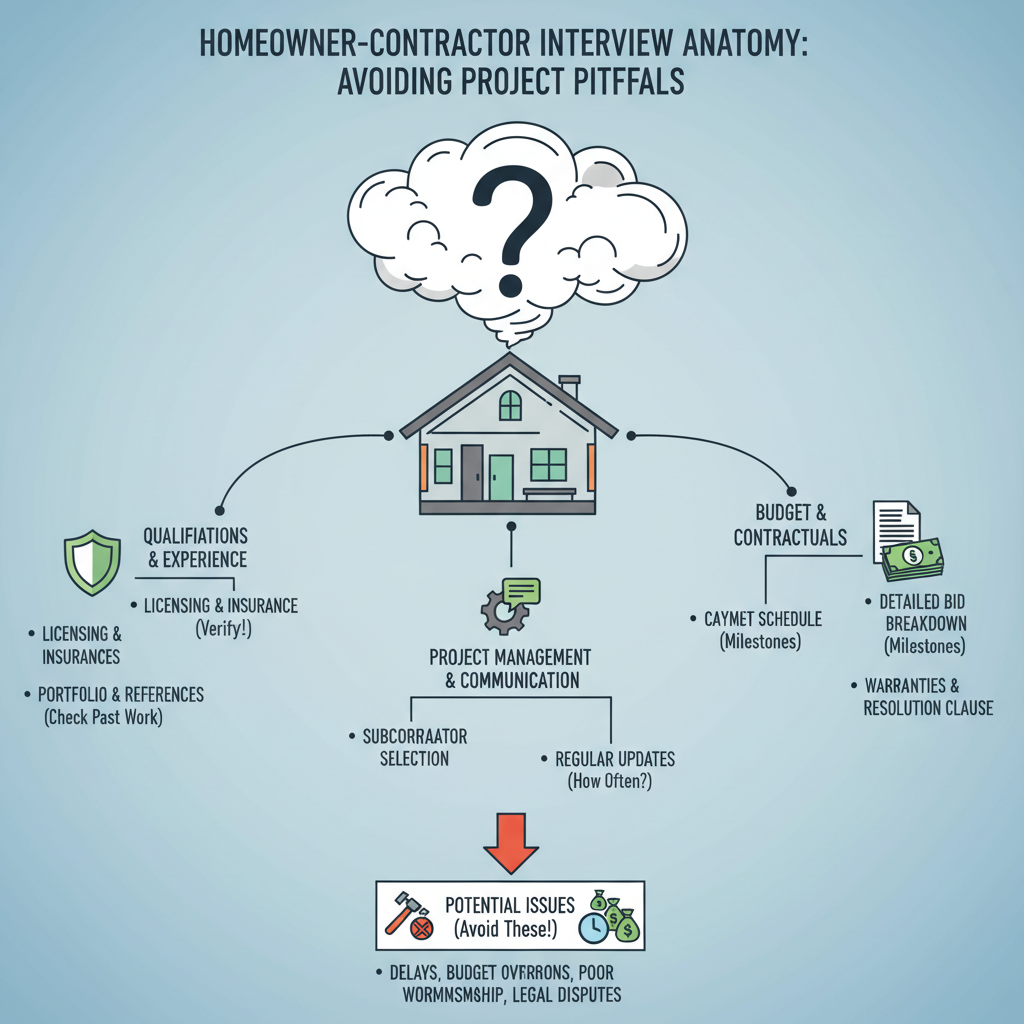
When hiring a general contractor, always ask about their licensing and insurance, request references and a portfolio of similar projects, inquire about their communication style, projected timeline, and specific processes for handling change orders. Ensure they provide a detailed written estimate with a clear payment schedule, and verify their use of subcontractors and material specifications. Finally, demand a comprehensive written contract outlining all project details before any work begins.
Common Symptoms
Possible Causes
Step-by-Step Diagnosis
Step 1
**Define Your Project:** Clearly outline your project scope, requirements, desired outcomes, and realistic budget before contacting any contractors. The clearer you are, the better the bids you'll receive.
Step 2
**Conduct Initial Research & Gather Recommendations:** Seek referrals from trusted friends, family, or neighbors. Check online reviews on reputable platforms (Google, Yelp, Houzz, Angie's List, Better Business Bureau) and verify professional affiliations or certifications.
Step 3
**Develop a Standardized Question List:** Create a comprehensive list of key questions covering licensing, insurance, experience, communication, budget, timelines, and contract specifics. This ensures you ask every candidate the same questions for accurate comparison.
Step 4
**Pre-Screen Contractors:** Before scheduling formal interviews, conduct a brief phone call with potential contractors. Ask about their availability, initial project interest, and ability to meet basic requirements (e.g., licensed for your project type). Aim to interview 3-5 pre-screened contractors.
Step 5
**Schedule Formal Interviews (In-Person):** Meet with each contractor at your home or the project site. This allows them to see the scope firsthand and for you to observe their professionalism and communication style.
Step 6
**Take Detailed Notes:** During each interview, record their responses, proposed solutions, communication style, and willingness to provide required documentation. This is crucial for unbiased comparison later.
Step 7
**Verify Credentials Independently:** Do not rely solely on what contractors tell you. Independently verify all presented contractor licenses and insurance certificates with the appropriate state or local regulatory boards and insurance providers. Confirm they are current and valid for your project type.
Step 8
**Contact References:** Systematically call all provided references. Ask specific questions about the contractor's communication, adherence to budget and timeline, handling of unexpected issues, quality of work, cleanup, and whether they would hire the contractor again.
Step 9
**Review Portfolios and Site Visits (If Possible):** Thoroughly review contractor portfolios, paying close attention to the quality of work on projects similar to yours. If comfortable, ask if it's possible to see a recently completed project in person (with the homeowner's permission).
Step 10
**Compare Detailed Bids:** Request and carefully compare detailed written estimates from each contractor. Ensure they include similar scope, materials, and itemized costs. Be wary of significant discrepancies without clear explanations.
Step 11
**Review Sample Contracts:** Request and review a sample contract or template to understand their standard terms and conditions before entering negotiations. If anything is unclear, ask for clarification.
Step 12
**Evaluate Trust and Comfort:** Beyond facts and figures, evaluate your comfort level and trust with each contractor. A successful project often hinges on strong interpersonal connection, clear communication, and mutual respect.
Step 13
**Perform a Final Background Check:** A quick online search of the contractor's name and company can sometimes reveal additional public information or news articles.

When to Call a Professional General Contractor
- If a contractor refuses or is unable to provide verifiable proof of current licensing and adequate insurance.
- If a contractor requests an unusually large upfront payment (e.g., more than 10-20% or exceeding state-mandated limits).
- If a contractor's bid is significantly lower than all others without a clear, logical explanation, potentially indicating cut corners or hidden costs.
- If a contractor insists on a verbal agreement only and resists providing a detailed, written contract.
- If a contractor has numerous negative online reviews, unresolved complaints with regulatory bodies, or a history of legal actions.
- If you experience persistent pressure, feel uncomfortable, or have a strong 'gut feeling' that something is not right during the vetting or initial project phase.
- If the proposed contract seems vague, incomplete, or contains clauses that are unclear or disadvantageous to you (consult a legal professional for review).
Prevention Tips
- Always obtain a minimum of three detailed, written bids from different qualified contractors for comparison.
- Never pay the entire project cost upfront; establish a clear payment schedule tied to the completion of specific project milestones.
- Ensure the written contract explicitly details every aspect: scope of work, material specifications, payment schedule, project timeline, warranty, and dispute resolution process.
- Be wary of contractors who pressure you into immediate decisions, demand cash-only payments, or offer excessively low bids without clear justification.
- Maintain open and frequent communication with your chosen contractor throughout the entire project lifecycle.
- Document all project communications, decisions, material selections, and changes in writing to avoid future disputes.
- Understand the contractor's process for unexpected issues, change orders, delays, and potential disputes *before* signing the contract.
- Prioritize contractor reputation, experience, communication skills, and comprehensive planning over simply choosing the lowest bid.
Frequently Asked Questions
Related Guides
Finding a Good Contractor That Won't Rip You Off (Troubleshooting & Fixes)
Learn how to find, vet, and hire a reliable general contractor for your home renovation project. Avoid scams and ensure quality work with our step-by-step guide.
Resolving Disputes with a General Contractor: A Homeowner's Troubleshooting Guide
Resolve disputes with your general contractor effectively. Learn how to address poor work quality, project delays, cost overruns, and communication breakdowns with our practical guide for homeowners. Protect your investment.
Deck Permit Requirements: Avoid Fines & Build Confidently (Troubleshooting & Fixes)
Wondering if you need a permit to build a deck? A veteran contractor explains the messy world of deck permits, how to figure out what you need, and how to avoid fines.
Basement Waterproofing During a Remodel (Troubleshooting & Fixes)
A veteran contractor's guide to fixing a wet basement during a remodel. Learn how to stop water intrusion, fix damage, and waterproof for good.
Top Questions to Ask a General Contractor: Your Essential Hiring Guide
Comprehensive guide to choosing a general contractor. Learn essential questions to ask about licensing, insurance, experience, communication, project management, and contracts to ensure a successful home renovation and avoid common pitfalls and scams. Hire with confidence.
Hiring a General Contractor: A Vet's No-Nonsense Checklist (Troubleshooting & Fixes)
A veteran tech's guide to hiring a general contractor. Skip the nightmares by using this checklist to vet licenses, insurance, references, and contracts.
Need Professional Help?
Find top-rated general contractor experts in your area