Quick Answer
If your AC or furnace is running nonstop, first check your thermostat fan setting. If it’s on 'On,' switch it to 'Auto.' If that doesn't fix it, pull your air filter. If it's dirty, replace it. If the issue persists, you might have problems like low refrigerant (for AC), a stuck control component (like a contactor or relay), or a malfunctioning thermostat. A filter costs $10-60, but a pro visit for other issues starts around $150-200, potentially ranging much higher depending on the repair.
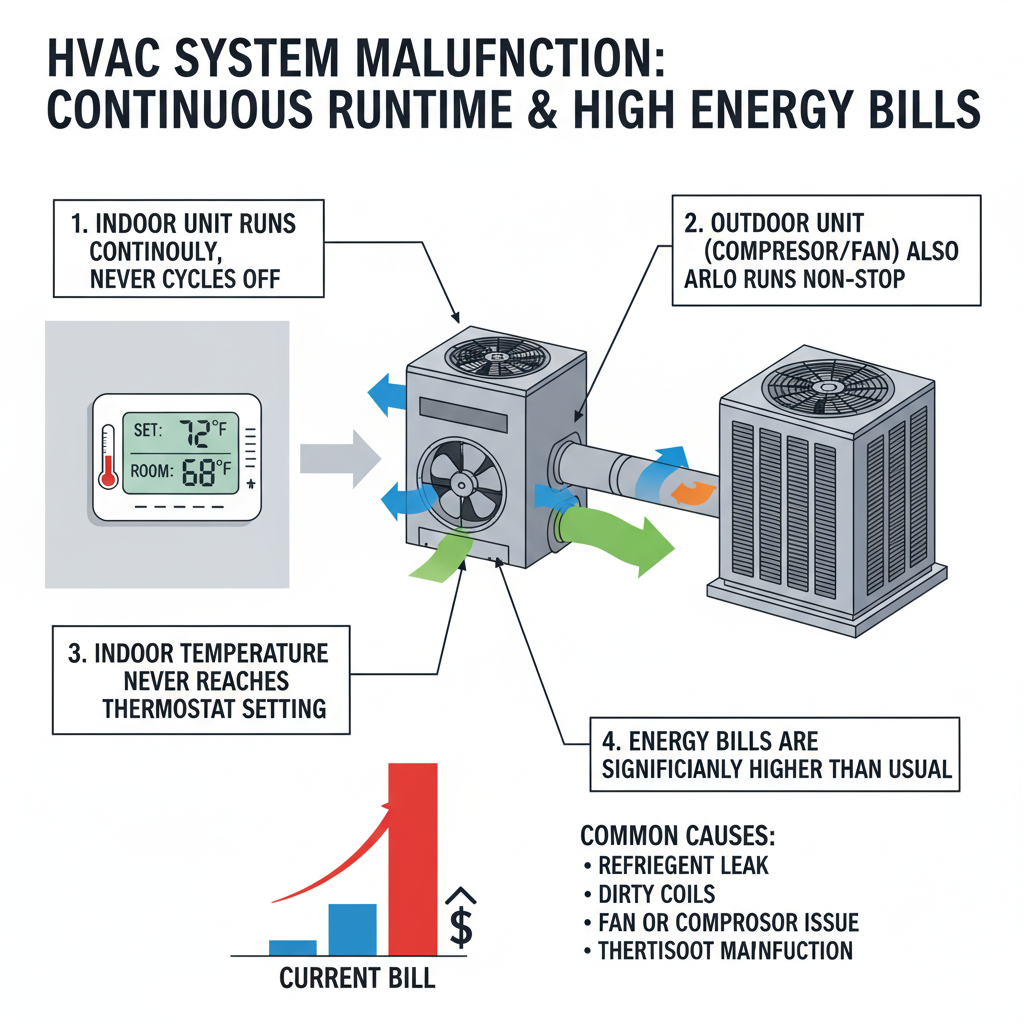
Common Symptoms
Possible Causes
Step-by-Step Diagnosis
Step 1
Verify thermostat settings. Ensure the fan is set to 'Auto' and the temperature setting is reasonable. Replace batteries if it's a battery-powered model.
Step 2
Inspect the air filter. Pull it out and check if it's clogged with dirt and debris. Replace if it's opaque or visibly dirty.
Step 3
Examine the outdoor condenser unit (for AC). Look for dirt, leaves, or other debris clogging the fins. Ensure bushes and other obstructions are at least two feet away.
Step 4
Check for ice. On an AC system, look for frost or ice on the copper lines connected to the outdoor unit and on the indoor evaporator coil.
Step 5
Confirm all vents are open. Walk through the house and make sure all supply registers and return air grilles are open and unobstructed by furniture or rugs.
Step 6
Listen to the outdoor unit. If it continues to run even after you turn the AC off at the thermostat, you likely have a stuck contactor.
Step 7
Reset the circuit breakers. Find the breakers for your 'Air Handler'/'Furnace' and 'Condenser'/'AC' in your electrical panel and flip them off and then on again.
DIY vs Professional Costs
| Repair Type | DIY Cost | Professional Cost | Time Required |
|---|---|---|---|
Replacing the Air Filter | $10-60 | $90-200 (as part of a service call) | 5 minutes |
Replacing a Faulty Thermostat | $30-300 | $150-500 | 1 hour |
Replacing a Stuck AC Contactor | $20-50 | $150-400 | 1-2 hours |
Refrigerant Leak Fix & Recharge | N/A | $500-2000+ | 2-5 hours |
Professional Coil Cleaning | $0-15 (light rinse) | $200-500 | 1-2 hours |
Blower Motor Replacement | N/A | $500-1800 | 2-4 hours |
When to Call a Professional Hvac
- If you see ice or frost built up on any part of the AC system.
- If you smell something burning or hear loud grinding, squealing, or banging noises.
- If you've already changed the filter and checked the thermostat with no change.
- If you suspect an electrical problem like a stuck contactor or a bad motor.
- Anytime a refrigerant issue is suspected. This is not a DIY job and requires EPA certification to handle.
Prevention Tips
- Check and replace your air filter every 1-3 months, or whenever it looks dirty. Don't follow the date on the package, follow your eyes.
- Schedule a professional tune-up annually. Once in the spring for your AC and once in the fall for your furnace.
- Keep the area around your outdoor condenser unit clear of leaves, grass clippings, and bushes. It needs to breathe.
- Double-check that your thermostat fan setting is on 'AUTO', not 'ON', to prevent the blower from running 24/7.
- Walk around your house and ensure all vents and return air grilles are open and aren't blocked by furniture, rugs, or drapes.
Frequently Asked Questions
Related Guides
Frozen AC Evaporator Coil (Troubleshooting & Fixes)
Seeing ice on your AC unit? Your AC probably isn't cooling right. A veteran tech explains why your evaporator coil is frozen and how to fix it fast.
Furnace Making Various Strange Noises? Troubleshooting & Fixes from a 25-Year Vet
Furnace making strange noises? A veteran HVAC tech explains what banging, whistling, or rattling means and how to fix it. DIY tips and when to call a pro.
Furnace Ignitor Not Glowing? Troubleshooting & Fixes from a 25-Year Pro
Furnace ignitor not glowing? An old pro with 25+ years in the field shows you why it's happening and how to fix it, from DIY replacement to a pro call.
Programmable thermostat fails to retain programmed temperature schedules or settings, resulting in improper HVAC system operation and inconsistent indoor temperatures. Troubleshooting & Fixes
Clogged HVAC condensate drain line, leading to water backup and potential system shutdown or water damage. Troubleshooting & Fixes
How to replace an HVAC air filter, including why it's important, signs it needs changing, and proper replacement procedures. Troubleshooting & Fixes
Need Professional Help?
Find top-rated hvac experts in your area