Quick Answer
Okay, so here's the quick version. Your car's dead. You're trying to figure out if you need a simple jump or the big hook. Nine times out of ten, if you hear a clicking sound or the lights are dim, it's just a dead battery. A jump start service will run you maybe $50-100 and you'll be on your way. But if you smell something burning, see smoke, or the jump doesn't work after a try or two, stop messing around. It's time for a tow, which is gonna start around $75-150 plus mileage. Don't fry your car's computer trying to save a few bucks.
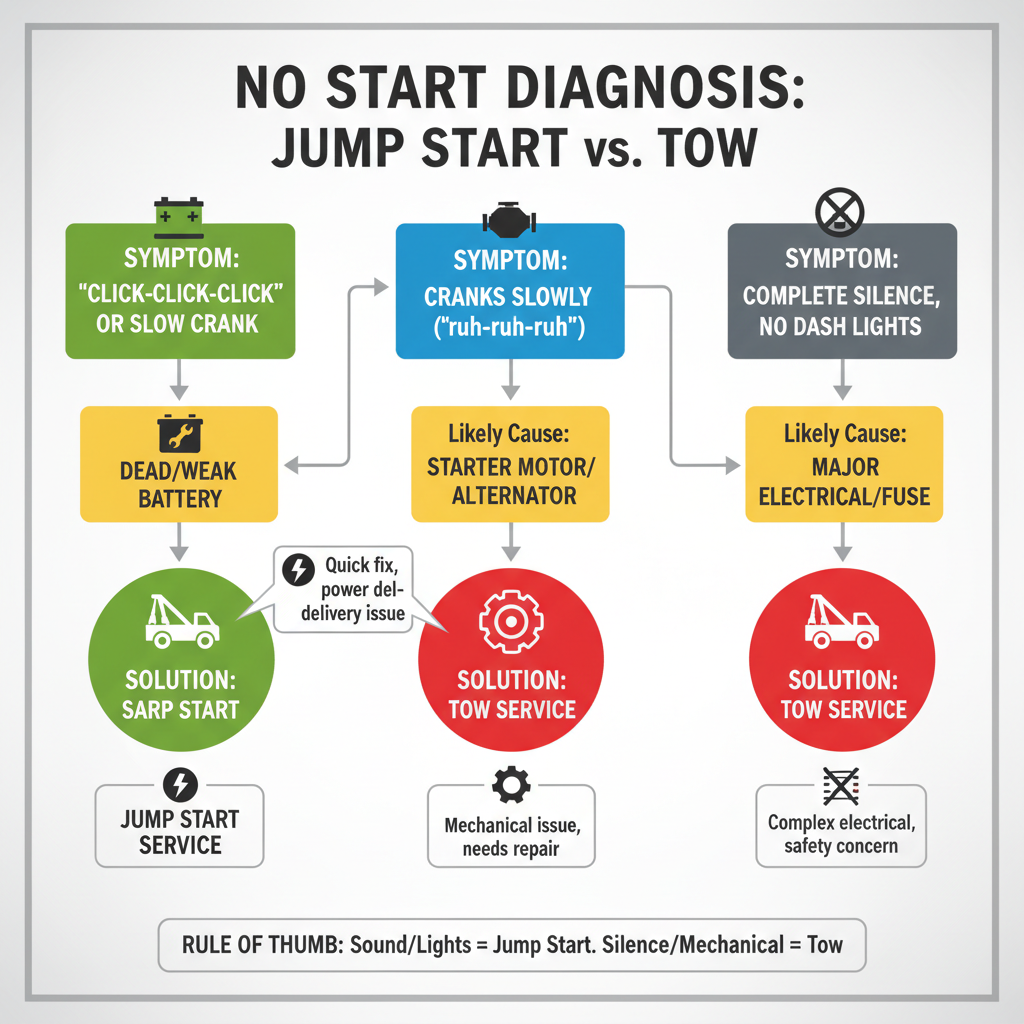
Common Symptoms
Possible Causes
Step-by-Step Diagnosis
Step 1
Stop and listen. Turn the key once and identify the sound: rapid clicking, slow cranking, a single clunk, a grind, or silence.
Step 2
Check the electronics. Turn the key to the 'On' position (not 'Start'). Observe the dashboard lights and try the headlights. Bright lights suggest the battery is okay; dim or no lights point to a dead battery.
Step 3
Pop the hood for a visual inspection. Look for heavy corrosion (white or blue-green crust) on the battery terminals.
Step 4
Check the battery case for physical damage. If you see any swelling, bulging, or cracks leaking fluid, do not attempt a jump-start.
Step 5
If symptoms point to a weak battery and there's no physical damage, attempt a jump-start. If it fails after one or two tries, the problem is more complex.
DIY vs Professional Costs
| Repair Type | DIY Cost | Professional Cost | Time Required |
|---|---|---|---|
Jump-start with Jumper Cables | $20-50 (one-time for good cables) | $50-100 (for a service call) | 15-20 minutes |
Jump-start with a Portable Jump Starter | $60-150 (one-time for the device) | N/A | 5-10 minutes |
Clean Battery Terminals Most Common | $5-15 (for a brush & cleaner) | Usually included with a battery service | 10 minutes |
Call for a Tow Truck (Local) | N/A | $75-150 hook-up fee + $3-7/mile (Typical total $100-250+) | 1-2 hours+ (wait time) |
When to Call a Professional Towing
- A jump-start fails after one or two attempts, indicating a problem beyond a simple drained battery.
- You observe signs of major mechanical issues such as smoke, steam, significant fluid leaks, or strong burning smells.
- There is visible damage to the battery (leaking acid, swelling/bulging sides, cracks) making a jump-start unsafe.
- The vehicle is in a dangerous location, like the shoulder of a busy highway, and your safety is the top priority.
- You are unsure of the problem's cause or uncomfortable attempting a DIY fix due to safety concerns or lack of experience.
- The car starts after a jump, but dies immediately or struggles to run, which strongly suggests a bad alternator.
Prevention Tips
- Get your battery tested for free at most auto parts stores, especially if it's over 3 years old or before winter.
- Invest in a quality AGM (Absorbent Glass Mat) battery, which is more reliable for modern cars with heavy electronic loads.
- Keep a portable jump starter (like a NOCO Boost) in your vehicle for emergencies so you don't have to rely on another car.
- Once a year, clean any corrosion off your battery terminals using a wire brush and a baking soda/water paste to ensure a solid connection.
- Get in the habit of double-checking that all lights (headlights, dome lights) and accessories are off before you lock and leave your car.
Frequently Asked Questions
Related Guides
Avoiding disreputable or predatory towing companies by recognizing red flags and knowing how to vet a service provider during a stressful vehicle breakdown or accident. Troubleshooting & Fixes
Verifying Tow Truck Operator Credentials (License & Insurance) Troubleshooting & Fixes (2024 Guide)
Feeling uneasy about that tow truck driver? Here's my 25+ years of experience on how to spot the fakes, check their license and insurance, and make sure you don't get scammed.
Car Won't Start: Diagnosing the Issue and Deciding Between a Jump Start and Towing Troubleshooting & Fixes (2024 Guide)
Car won't start and you're stuck? A veteran tech explains if it's the battery, starter, or something else. Learn when to jump-start and when to call for a tow.
Jump Start vs. Tow Truck: What's the Right Call When You're Stranded? (Troubleshooting & Fixes)
Stranded with a car that won't start? A veteran tech explains how to tell if you need a cheap jump start or a tow truck for a bigger problem.
Car Wrecked? Here's the Real Deal on Towing & Recovery (Troubleshooting & Fixes)
A veteran tow operator's no-nonsense guide to handling towing after a car accident. Learn the immediate steps, how to avoid scams, and what it'll cost.
So Your Car's Dead? How to Not Wreck It Worse with a Bad Tow (2024 Guide)
Your car's broken down, don't let a bad tow make it worse. A veteran tow operator's guide on how to protect your ride and your wallet.
Need Professional Help?
Find top-rated towing experts in your area