Quick Answer
Okay, here's the quick and dirty. Your car's on the side of the road and you need a tow. The biggest mistake you can make is not telling the tow company the truth about your car. Is it all-wheel-drive? Is it lowered? Got a fancy plastic bumper? Tell 'em. That way they send the right truck—usually a flatbed. All you gotta do is get your valuables out, put the car in neutral, and make sure the steering ain't locked. Don't let some rookie with a hook show up and shred your transmission. A basic local tow starts around $75-$200.
Common Symptoms
Possible Causes
Step-by-Step Diagnosis
Step 1
Perform a 360-degree walk-around of the vehicle to assess its condition, location, and any pre-existing damage.
Step 2
Determine the vehicle's drivetrain (AWD, 4WD, RWD, FWD) by checking for badges or asking the owner.
Step 3
Identify safe and secure towing points on the vehicle's frame, avoiding suspension components or plastic bumpers.
Step 4
Check for and secure any loose parts, such as damaged body panels or mirrors, that could come off during the tow.
Step 5
Confirm with the driver that the vehicle is in Neutral, the parking brake is disengaged, and the steering column is unlocked.
Step 6
Determine if a flatbed is necessary due to the drivetrain, low clearance, or vehicle damage.
DIY vs Professional Costs
| Repair Type | DIY Cost | Professional Cost | Time Required |
|---|---|---|---|
Standard Local Tow (Hook-up + first 5-10 miles) | $0 (Not a DIY job) | $75 - $200 | 1-2 hours |
Winch-Out / Ditch Pull (Basic) | $0 (Extremely dangerous to DIY) | $100 - $350 | 1-3 hours |
Complex Recovery (Rollover, difficult terrain) | $0 (Requires specialized equipment) | $350 - $1,000+ | 2-5+ hours |
When to Call a Professional Towing
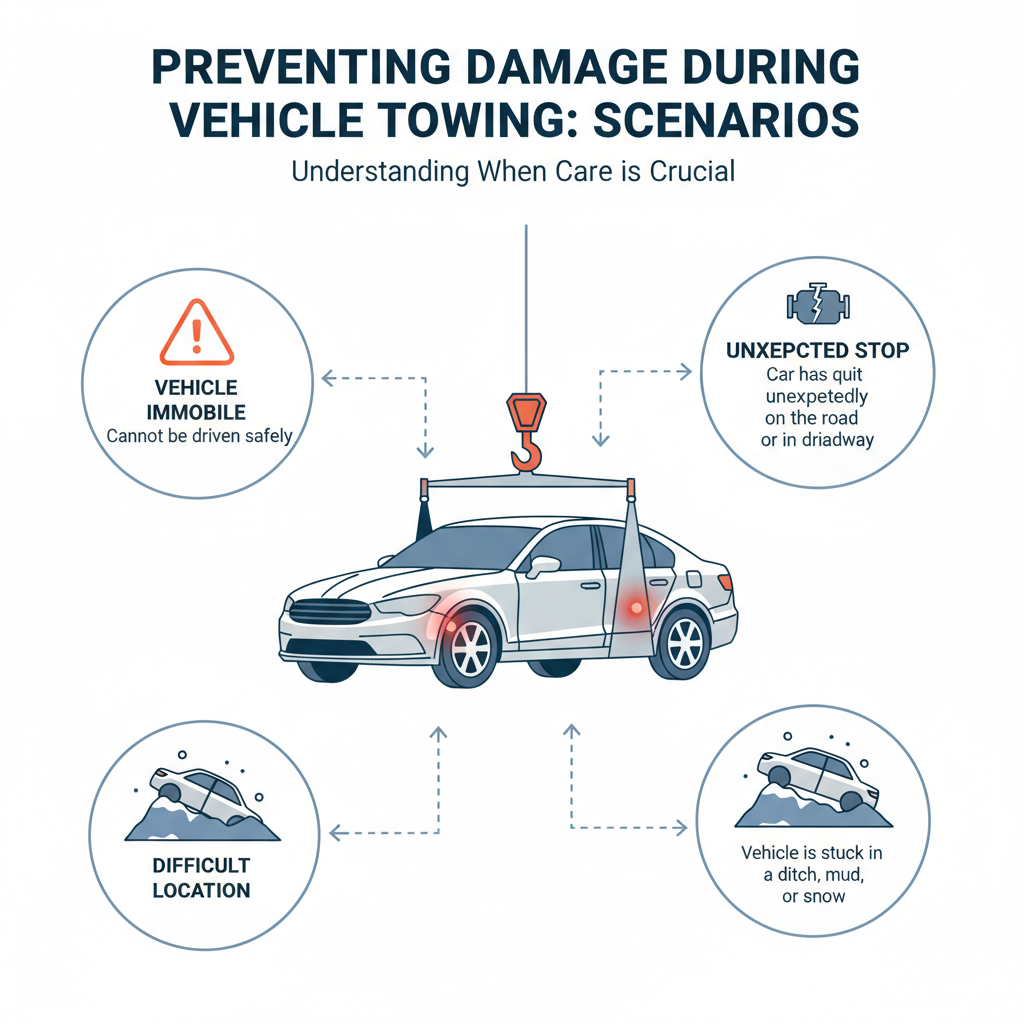
- The moment your car is undrivable or stuck in a location you can't easily get out of (ditch, mud, snow).
- Any time you've been in an accident, as there may be unseen damage that makes the vehicle unsafe to drive.
- If you lack the specialized equipment and knowledge to recover a vehicle safely, which is true for 99.9% of drivers.
- When you hear any severe mechanical noises like grinding or clunking; driving further could destroy your engine or transmission.
- Basically, if your car won't go and you're not a trained tow operator, you need to call a professional.
Prevention Tips
- Know your vehicle's drivetrain (AWD, 4WD, FWD, RWD) and communicate it clearly to the tow dispatcher.
- Always request a flatbed tow for AWD/4WD vehicles, low-profile cars, or if you have any doubts.
- Take photos of your vehicle from all angles before it is hooked up to document its condition.
- Prepare your vehicle by putting the transmission in Neutral, disengaging the parking brake, and unlocking the steering wheel.
- Remove all valuables and personal items from your car before the tow truck arrives.
- If it's safe, stay with your vehicle during the loading process to observe and ask questions.
Frequently Asked Questions
Related Guides
Avoiding disreputable or predatory towing companies by recognizing red flags and knowing how to vet a service provider during a stressful vehicle breakdown or accident. Troubleshooting & Fixes
Verifying Tow Truck Operator Credentials (License & Insurance) Troubleshooting & Fixes (2024 Guide)
Feeling uneasy about that tow truck driver? Here's my 25+ years of experience on how to spot the fakes, check their license and insurance, and make sure you don't get scammed.
Car Won't Start: Diagnosing the Issue and Deciding Between a Jump Start and Towing Troubleshooting & Fixes (2024 Guide)
Car won't start and you're stuck? A veteran tech explains if it's the battery, starter, or something else. Learn when to jump-start and when to call for a tow.
Jump Start vs. Tow Truck: What's the Right Call When You're Stranded? (Troubleshooting & Fixes)
Stranded with a car that won't start? A veteran tech explains how to tell if you need a cheap jump start or a tow truck for a bigger problem.
Car Wrecked? Here's the Real Deal on Towing & Recovery (Troubleshooting & Fixes)
A veteran tow operator's no-nonsense guide to handling towing after a car accident. Learn the immediate steps, how to avoid scams, and what it'll cost.
So Your Car's Dead? How to Not Wreck It Worse with a Bad Tow (2024 Guide)
Your car's broken down, don't let a bad tow make it worse. A veteran tow operator's guide on how to protect your ride and your wallet.
Need Professional Help?
Find top-rated towing experts in your area